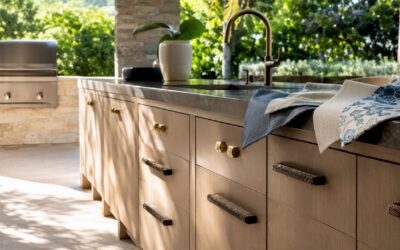

The most influential 2026 kitchen hardware trends center on warm metallic finishes, sculptural silhouettes, and ergonomic scale. Aged brass, oil-rubbed bronze, and unlacquered metals are replacing cooler chrome as the dominant finish choices. Minimalist edge pulls and handleless systems are redefining how luxury cabinetry reads. Mixing metals intentionally, sizing hardware proportionally, and choosing materials built to age gracefully are the three principles shaping every well-resolved kitchen this year.
Here is a quick scan of what is defining the shift:
- Warm living finishes: Unlacquered brass, aged bronze, and champagne gold that develop patina over time
- Sculptural and statement pieces: Half-moon pulls, demilune forms, and oversized appliance pulls as focal points
- Minimalist and handleless systems: Edge pulls, recessed channels, and push-to-open mechanisms for visual quiet
- Etched and textured details: Knurled surfaces, fluted pulls, and hammered finishes that add tactile depth
- Mixed metals: Curated contrast using two or three complementary finishes rather than one uniform metal
- Backplates and vintage revival: Cup pulls, bow pulls, and backplate-mounted hardware making a refined return
- Oversized and elongated pulls: Long bar pulls on wide drawers and pantry doors for both ergonomics and visual rhythm
- Sustainable materials: Recycled-content metals and durable PVD-style plated finishes built for longevity
- Smart and electronic integration: Touch-activated and motion-sensor hardware entering the luxury kitchen conversation
- Colorful accents: Two-tone hardware in black-and-brass or bronze-and-wood combinations for personality
Table of Contents
- What styles and finishes are dominating kitchen hardware design in 2026?
- How to choose kitchen hardware that balances style and function
- What the 2026 kitchen hardware moment means for your renovation
- Key Takeaways
- Hardware as the quiet hero of kitchen design
What styles and finishes are dominating kitchen hardware design in 2026?
Hardware is no longer the last item on the specification list. Designers now treat it as architectural jewelry, chosen with the same deliberateness as stone and plumbing. The result is a kitchen where every pull, knob, and edge profile contributes to a coherent visual language.
Warm metals and living finishes
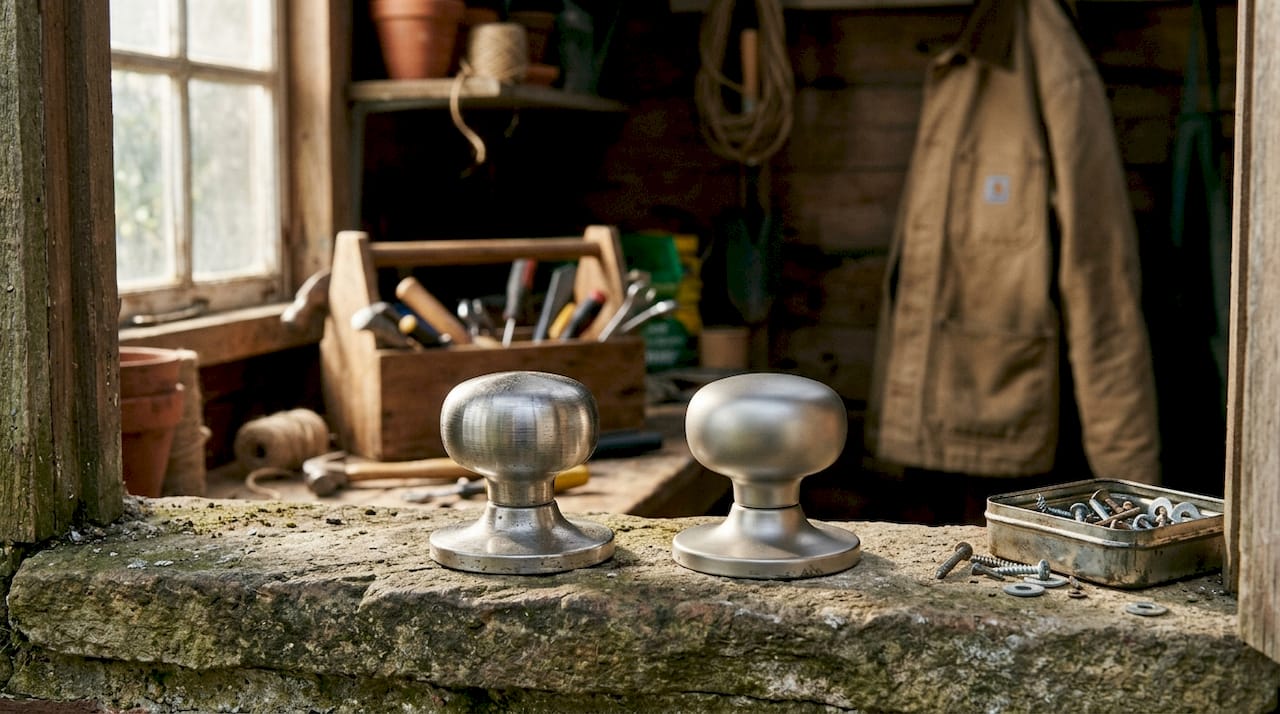
Unlacquered brass and oil-rubbed bronze are the dominant finish story for 2026. These “living finishes” are designed to evolve, developing a deep, personal patina as they react to air and daily touch. That organic aging process creates a sense of history that polished chrome simply cannot replicate. Brushed brass offers a softer middle ground, warm without too much shine, and it pairs particularly well with dark-stained oak, warm neutrals, and full-height slab cabinetry.
Bronze is making a strong return after years of chrome dominance. Champagne bronze gives you the warmth of brass without the yellow intensity, making it one of the most versatile finish choices for 2026. Matte black remains a reliable anchor for contrast, especially against white or natural wood cabinetry, though it now tends to appear as an accent rather than the sole finish throughout a kitchen.
Etched details, backplates, and vintage-inspired forms
Texture is where hardware earns its keep as a tactile object. Knurled brass knobs, hammered bronze pulls, and fluted bar handles add character without visual clutter. A knurled surface feels industrial yet refined in hand, and hammered finishes give even a simple kitchen a sense of warmth and craft. Fluted hardware works especially well in contemporary spaces because it introduces movement while keeping the overall composition clean.

Backplates are returning as a framing device, particularly in transitional and vintage-inspired kitchens. Paired with cup pulls or bow pulls on Shaker-style cabinetry, they create a layered, collected look that feels considered rather than matched. Classic cup pulls, sometimes called bin pulls, remain the gold standard for Shaker drawers, offering a nostalgic sturdiness that holds up beautifully against aged brass or oil-rubbed bronze finishes.
Sculptural and statement hardware
The clearest silhouette shift in 2026 is toward forms with a stronger point of view. Half-moon pulls, demi-lune shapes, and elongated appliance pulls bring sculptural contrast to cabinetry runs. A slim edge pull can make a flat-panel white oak kitchen feel sharper and more tailored. A demi-lune pull softens a painted cabinet run and creates a quieter focal point. Neither direction is more current than the other; the difference is clarity of intent.
Oversized cabinet hardware creates clean lines and a custom appearance, particularly effective on wide drawers and pantry doors. Long, substantial pulls improve both ergonomics and visual rhythm, and they read as high-end even when the cabinetry itself is modest.
Mixing metals and colorful accents
Matching every metal in the kitchen is no longer the goal. Curated contrast and layered finishes create more sophisticated interiors than a uniform approach. The Rule of Three recommends one dominant metal for roughly 60–70% of the room, then two accent metals for the remaining elements. Stainless appliances, matte black cabinet pulls, and warm brass pendant lights is a classic 2026 combination that bridges cool and warm tones without feeling forced.

Two-tone hardware is also gaining ground, with black-and-brass, chrome-and-white, and bronze-and-wood combinations appearing in both modern and transitional kitchens. The key is coordinating undertones rather than chasing exact matches. A brushed gold faucet will usually clash with a polished brass handle because the undertones differ, even when both read as “gold” from across the room. You can explore how layering textures and materials creates depth in other areas of the home for further inspiration.
Minimalist and handleless systems
At the quieter end of the spectrum, handleless systems, recessed channels, and edge pulls are fully established in luxury kitchens. They preserve long, uninterrupted cabinet planes and suit slab doors and inset cabinetry especially well. Push-to-open mechanisms take this further, removing visible hardware entirely for a seamless, architectural surface. This visual quiet trend aligns with the broader 2026 move toward zoned, storage-first kitchen layouts where the cabinetry itself does the talking.
How to choose kitchen hardware that balances style and function
Selecting hardware is a balancing act between ergonomic performance and visual identity. Modern kitchens increasingly favor zoned layouts with functional priorities, which means hardware choices are driven by comfort and daily performance as much as aesthetics.
Proportion and the One-Third Rule
The most common mistake in hardware selection is undersizing. A pull that looks fine in isolation can make even expensive custom cabinetry look unfinished when it is too small for the drawer front. The One-Third Rule offers a reliable framework: a pull should occupy approximately one-third of the total drawer width. For a standard 12-inch drawer, a 4-inch pull is appropriate. For the wide 30–36-inch drawers now common in luxury kitchens, a single dramatic 10–12-inch pull is the superior choice for both ergonomics and visual clarity. It lets you open a heavy drawer with one hand without putting uneven strain on the glides.
Mixing sizes for a custom look
Mixing hardware sizes within a single kitchen is now a mainstream approach, not just a high-end designer move. A kitchen might use one pull length on upper cabinets, another on base cabinets, and a longer size on drawer stacks or pantry walls. Paneled appliances often call for dedicated appliance pulls that carry more visual scale. The key is keeping the silhouette and finish consistent across sizes so the result feels custom rather than busy.
Pro Tip: When mixing pull lengths, choose pieces from the same collection or at least the same finish family. Consistency of form across different sizes is what separates a curated kitchen from a cluttered one.
Ergonomic scale for high-use areas
Ergonomic hardware choices are becoming essential as kitchens incorporate larger pantry walls, integrated appliances, and oversized drawer stacks. Longer pulls on deep drawers distribute force more evenly and reduce wrist strain over years of daily use. Comfortable projection depth matters on heavier panels, and soft-close mechanisms with high-cycle durability are now considered baseline in well-specified kitchens.
- Use longer pulls on wide drawers and tall pantry doors for balanced force
- Choose comfortable projection depth for heavy integrated appliance panels
- Prioritize soft-close and high-cycle mechanisms for frequently used cabinetry
- Scale knobs and shorter pulls to standard upper cabinet doors where appropriate
Durability and living finishes
Hardware selection should be integrated at the start of kitchen design to ensure scale and style consistency across cabinetry and appliances. Early choices influence drawer stack planning and the overall ergonomic logic of the space. Living finishes like unlacquered brass and oil-rubbed bronze require an acceptance of natural patina as a feature rather than a flaw. PVD-style plated finishes offer an alternative for high-wear zones where consistent appearance matters more than organic aging.
Sustainability in hardware focuses on durable, eco-friendly materials that age well rather than temporary style choices. Recycled-content metals, long-lasting plated finishes, and serviceable mechanisms are the practical expressions of this shift. Choosing hardware built to last a decade or more is both an environmental and an economic decision. You can find further inspiration for 2026 kitchen renovation ideas in Artinlifestyle’s coverage of backsplash and surface trends.
What the 2026 kitchen hardware moment means for your renovation
The defining quality of 2026 kitchen hardware is intentionality. Every trend this year, from warm living finishes to sculptural statement pulls, rewards homeowners who make hardware decisions early and with purpose rather than treating them as a finishing afterthought.
- Choose your finish temperature first. Warm metals like aged brass, champagne bronze, and oil-rubbed bronze anchor the 2026 palette. Match finish temperature to your countertop undertones before selecting specific pieces.
- Apply the One-Third Rule to every drawer. Undersized hardware disrupts the architectural integrity of even the most expensive cabinetry.
- Mix metals with intention. Use the Rule of Three: one dominant finish, two accents, with coordinated undertones throughout.
- Select hardware before finalizing drawer stack heights. Early hardware decisions shape ergonomic comfort and visual rhythm across the whole kitchen.
- Prioritize durability alongside aesthetics. Living finishes, recycled-content metals, and PVD-style plated options offer both character and longevity.
- Let the cabinet style guide the silhouette. Edge pulls suit slab doors; cup pulls and backplates suit Shaker and inset styles; sculptural forms work best on painted or flat-panel cabinetry.
The broader 2026 shift is away from formulaic, matched kitchens and toward spaces that feel personal, layered, and built to last. Hardware is the detail that makes that shift visible.
Key Takeaways
The single most important principle in 2026 kitchen hardware is proportion: hardware sized and finished with intention transforms cabinetry from functional storage into a cohesive design statement.
| Point | Details |
|---|---|
| Warm living finishes lead | Unlacquered brass, aged bronze, and champagne gold are the dominant 2026 finish choices. |
| The One-Third Rule governs scale | A pull should span roughly one-third of the drawer width for professional-grade proportion. |
| Mix metals with the Rule of Three | One dominant finish at 60–70%, plus two accent metals, creates curated contrast without clutter. |
| Select hardware early in the process | Early hardware decisions shape drawer stack planning, ergonomics, and overall design cohesion. |
| Sustainability means durability | Recycled-content metals and PVD-style finishes prioritize longevity over short-lived style trends. |
Hardware as the quiet hero of kitchen design
There is a tendency in kitchen renovations to treat hardware as the final checkbox, the detail you sort out after the countertops are ordered and the cabinetry is installed. The 2026 moment asks you to reverse that sequence entirely.
When hardware is chosen early, it shapes everything downstream: the height of drawer stacks, the visual temperature of the room, the way a finish reads against stone or wood grain. A warm brass pull placed against richly veined marble pulls the gold tones forward in a way that no amount of lighting adjustment can replicate after the fact. A slim edge pull on white oak slab cabinetry creates a line so clean it reads almost as architecture. These are not decorative decisions. They are structural ones.
What Artinlifestyle finds most compelling about this year’s trends is the move toward materials that age with grace. Unlacquered brass that deepens over years of use, hammered bronze that softens with touch, recycled metals that carry a quiet environmental conscience. These are not finishes that freeze a kitchen in a showroom moment. They are finishes that grow more personal with time, accumulating the kind of warmth that no catalog image can fully capture. For readers drawn to that same philosophy of living with beautiful, evolving objects, Artinlifestyle’s coverage of DIY home decor ideas offers a natural companion to this approach.
The best hardware choices in 2026 are not trend-chasing choices. They are proportional, tactile, and specific to the millwork they serve. When the details are right, the whole room holds together.