
Yes, you can commission a custom artwork, and the process is far more accessible than most people assume. Start by deciding the work’s purpose, its site, and your budget, then approach an artist with a clear brief. Protect the arrangement with a written contract and milestone payments, and document approvals at every stage so nothing gets lost between concept and delivery.
TL;DR:
- Clarify environmental conditions, space measurements, and budget ranges early to prevent mismatch between the artwork and its intended location.
- Vet artists by reviewing multiple project examples, confirming availability, and understanding their process to avoid risks and miscommunications.
- Provide a detailed written brief with site specifics, dimensions, preferred materials, and clear references, separating inspiration from must-haves, to ensure clarity.
- Include all costs such as fabrication, framing, shipping, and installation in the budget, and use escrow or milestone payments to limit financial risks.
- Understand that commissioning involves collaboration and potential delays, so maintain open communication, document approvals, and respect the artist’s creative process.
Table of Contents
- Commissioning Art Starts With Purpose, Site, and Budget
- How Do You Find and Vet an Artist for a Commission?
- What Should Go Into Your Commission Brief?
- How Much Does Commissioning Art Cost?
- What Belongs in a Commissioning Contract?
- How to Manage Communication and Revisions During a Commission
- Delivery, Installation, and Caring for the Finished Piece
- Commissioning Art: A Quick Do’s and Don’ts Checklist
- Setting Realistic Expectations as a Commissioning Client
- Ethical Considerations When Commissioning Art
- Art in Lifestyle’s Perspective: Commissioned Art as Interior Strategy
- Let Art Concierge Handle the Commission for You
- Sources
Commissioning Art Starts With Purpose, Site, and Budget
Before you contact a single artist, settle three things: what the piece is for, where it will hang or stand, and what you can realistically spend. A commissioned painting destined for a sunlit dining room needs different materials than one bound for a basement studio or an outdoor courtyard. Humidity, direct light, and structural weight limits all shape what an artist can safely propose, and skipping this step is the fastest way to end up with a piece that doesn’t fit its intended space.
Scale and material choice drive both cost and timeline. A large sculpture in bronze or steel takes longer to fabricate than a canvas painting of the same dimensions, and pricing reflects that gap.
- Measure the exact wall, alcove, or floor footprint, including clearance for framing or a pedestal.
- Note environmental factors: sun exposure, moisture, foot traffic, or weight-bearing limits.
- Set a budget range, not a single number, so the artist can propose materials that fit.
- Expect a deposit of a substantial portion of the total fee before work begins, which is standard across most independent studios.
Matching your budget to an artist’s typical price tier avoids awkward renegotiations later. A muralist charging by the square foot works very differently than a sculptor quoting by material and labor hours.
How Do You Find and Vet an Artist for a Commission?
Start where the work already exists: artist websites, gallery rosters, curated platforms, and referrals from designers or collectors who have commissioned before, such as on Chase Fine Art. Look past the polished hero images and dig into an artist’s process documentation. Studio shots, work-in-progress photos, and client testimonials tell you more about reliability than a single finished piece ever will.
- Review at least three to five portfolio pieces similar in scale or medium to what you want.
- Ask directly about current availability, typical turnaround, and how they structure milestone check-ins.
- Request references or examples from a past commission close to your project’s size and complexity.
- Confirm whether they handle framing, fabrication, and shipping in-house or subcontract those steps.
Watch for warning signs. An artist who can’t describe their own commission process, dodges questions about timeline or fees, or has no documented past work is a risk regardless of how appealing their public portfolio looks. Online commissioning is common practice today), but not every artist who posts finished work actually accepts custom projects, so confirm that upfront rather than assuming.
What Should Go Into Your Commission Brief?
A written brief is the single document that keeps a project on track, and a strong brief should spell out site context, timeline milestones, and a budget with separate lines for the artist’s fee and fabrication costs. Vague requests produce vague results, so specificity here pays off later.
- Site and context: room, lighting conditions, adjacent furnishings or architecture.
- Exact dimensions, with tolerance ranges if the space allows some flexibility.
- Preferred materials, finish, and color notes, including anything you want avoided.
- Deadline and budget range, stated plainly rather than implied.
- Reference images, labeled clearly as inspiration versus must-match elements.
There’s an important distinction between prescribing physical constraints and prescribing the actual composition. Telling an artist the piece must be 48 inches wide and warm-toned is a constraint. Telling them exactly where every brushstroke should go isn’t a brief, it’s a demand for a copy of someone else’s work, and it undermines what you’re paying for.
Pro Tip: Separate your references into two folders: one labeled “mood and palette” and one labeled “non-negotiable.” Artists work faster and more confidently when they know which references are inspiration and which are requirements.
How Much Does Commissioning Art Cost?
A fair budget covers more than the artist’s creative fee. Materials, fabrication, framing, shipping, and installation all add up, and a quote that skips these line items usually means they’ll surface later as surprises.
- Artist fee: covers design time, concept development, and execution.
- Materials and fabrication: canvas, pigment, bronze casting, welding, or digital rendering hardware.
- Framing or mounting: often quoted separately from the artwork itself.
- Shipping and installation: especially relevant for large sculptures or out-of-state delivery.
Each payment confirms a specific stage rather than just marking time passed.
Most custom art projects wrap up within a two to six week window, depending on medium, scale, and drying or curing time, so a rushed quote for a complex sculpture is worth questioning.
To reduce payment risk, use an escrow service or a documented milestone approval process rather than sending full payment upfront. Art-specific escrow services hold funds and release them only when agreed milestones are met, which protects both sides if a project stalls or a dispute arises.
What Belongs in a Commissioning Contract?
Physical ownership of a finished artwork and copyright are not automatically the same thing. Creators hold copyright and reproduction rights by default under US law, meaning the artist can typically still reproduce or exhibit images of the piece unless the contract states otherwise. If you want exclusive reproduction rights, that needs explicit written language, not an assumption.
- Scope of work and specific deliverables, tied to the approved brief.
- Full payment schedule with dates or milestone triggers.
- Number of included revisions before extra fees apply.
- Delivery, installation, and long-term maintenance terms.
- Cancellation terms and remedies if either party doesn’t perform.
For high-value commissions, a short consultation with an art-law attorney is worth the cost. Copyright.gov and industry associations both publish model clauses that make a solid starting draft.
How to Manage Communication and Revisions During a Commission
Agree on communication channels and frequency before work starts. Some artists prefer scheduled photo updates every two weeks; others send progress notes after each major stage. Either works, as long as you both agree upfront.
- Define what a milestone approval actually means before signing off on one.
- Confirm what progress updates will include, whether that’s photos, material samples, or a studio visit.
- Set a clear policy for revisions beyond what the contract includes, and price them upfront.
- Document every approval in writing, even a quick “approved, proceed” email.
Checking in only near project completion is one of the more common commissioning mistakes, since problems caught early are cheap to fix and problems caught late often aren’t fixable at all.
Pro Tip: Ask your artist to send one photo update per milestone, even a quick phone snapshot. It costs them almost nothing and gives you a paper trail if a dispute ever comes up.
Delivery, Installation, and Caring for the Finished Piece
For large or fragile works, hire professional art handlers and insure the shipment. Standard couriers rarely carry the right coverage for fine art damage.
- Confirm mounting points, total weight, and any finish protection before installation day.
- Document the piece’s condition on arrival with photos, before unwrapping if possible.
- Request written care and maintenance instructions directly from the artist.
- Keep the original invoice and contract with your home insurance records.
Commissioning Art: A Quick Do’s and Don’ts Checklist
Before you sign anything, run through this short list.
Do: put every agreement in writing, respect the artist’s creative process and timeline, and set clear milestones with payments attached to each one.
Don’t: expect an exact replica of a reference image, skip the contract because the artist seems trustworthy, or assume a complex commission will move at the speed of a print-on-demand order.
- Budget confirmed, including materials, framing, and shipping.
- Brief written and shared, with must-haves separated from inspiration.
- Contract reviewed, covering ownership, revisions, and cancellation terms.
- Deposit arrangement agreed, ideally through escrow or milestone-based release.
Setting Realistic Expectations as a Commissioning Client
The biggest mistake first-time commissioners make isn’t picking the wrong artist. It’s misunderstanding what commissioning actually is. You’re not ordering a product off a shelf; you’re entering a working relationship with a creative professional whose process involves drafts, revisions, material testing, and sometimes unexpected turns. A painter might sketch three compositions before landing on the one that works. A sculptor might discover halfway through that the material you both chose won’t hold the shape you wanted, and adjustments follow.
Give yourself permission to expect some friction. Timelines slip when materials arrive late or a technique needs more testing than planned. That’s normal in custom fabrication work, not a sign something has gone wrong. What matters is whether the artist communicates those slips promptly and whether your contract accounts for reasonable delays.

It also helps to understand that artists aren’t illustrators for hire in the strictest sense, even when working from your brief. Most commissioned artists bring their own visual instincts to a project, and the strongest commissioned pieces tend to happen when clients state their needs clearly, then step back and let the artist interpret those needs through their own style. Clients who try to control every visual decision often end up with a stiffer, less resonant piece than those who set clear parameters and trust the process.
Read reviews, ask for references, and talk to past clients if you can. But once the contract is signed, treat the relationship the way you’d treat any skilled professional you’ve hired for their expertise, not just their hands.
Ethical Considerations When Commissioning Art
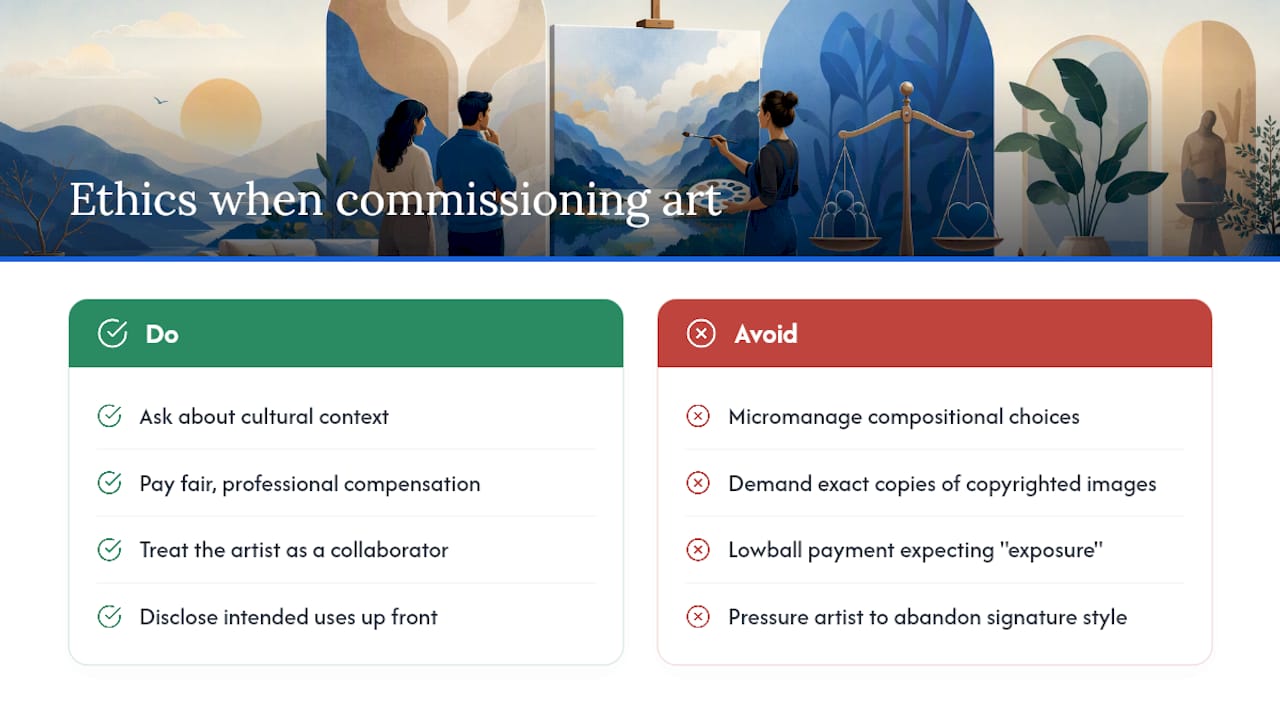
Respecting an artist’s creative freedom isn’t just good etiquette, it’s core to what you’re actually paying for. Micromanaging every compositional choice, insisting on exact reproductions of copyrighted reference images, or pressuring an artist to abandon their signature style defeats the purpose of a commission. If you want a piece that looks identical to something you found online, you’re better served buying a print or licensed reproduction, not commissioning original work.
Cultural sensitivity deserves specific attention, particularly when a commission draws on imagery, symbols, or traditions outside your own background. If you’re requesting work inspired by a cultural motif, a religious symbol, or a historical style tied to a specific community, ask the artist directly about appropriate context and representation. Many artists welcome cross-cultural commissions and handle them thoughtfully, but the responsibility to raise the question belongs to the client, not just the artist.
Fair compensation matters here too. Lowballing an artist because you assume “exposure” or a portfolio credit counts as payment undermines the entire commissioning relationship and reflects poorly on the client, not the artist. Treating the artist as a professional consultant, not a vendor filling an order, tends to produce better outcomes for everyone involved. That mindset shift, from purchasing a product to co-creating a piece, is often what separates a satisfying commission from a frustrating one.
Finally, be transparent about how you intend to use the work. If you plan to reproduce it, feature it commercially, or display it publicly, say so before signing. Reproduction rights are a legal matter, but surprising an artist with unexpected uses after the fact is also a trust issue.
Art in Lifestyle’s Perspective: Commissioned Art as Interior Strategy
Commissioned pieces work as anchored focal points, not just decoration, because they’re the one element in a room built specifically for that wall, that light, that story. A generic print fills space. A commissioned piece holds it. For readers weighing DIY commissioning against managed help, complexity and timeline are the real deciding factors, not confidence.
— Nealda
Let Art Concierge Handle the Commission for You
Everything covered above, vetting artists, writing briefs, negotiating contracts, tracking milestones, takes real time, and mistakes at any step can cost you money or a piece that misses the mark. Art Concierge is Artinlifestyle’s answer for readers who want a commissioned piece without managing every phase themselves. It sources qualified artists matched to your space and budget, drafts the brief, coordinates contract terms, and manages installation logistics from start to finish.
Concierge support makes the most sense for larger-scale commissions, tight deadlines, or simply when you’d rather spend your time choosing the piece than chasing paperwork. If you’re still shaping your vision for the room itself, Living Room Art Ideas is a good starting point for styling direction. When you’re ready to move forward, reach out to Art Concierge and describe your space, budget, and timeline to get matched with the right artist.
Sources
- Copyright Circular 38A — Works made for hire and related guidance
- Do’s and Don’ts of Commissioning an Artwork — Artwork Archive
- Artworld