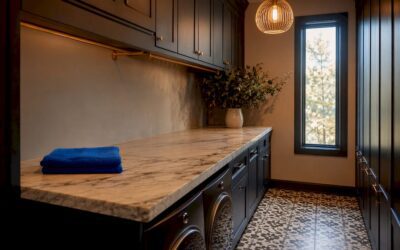
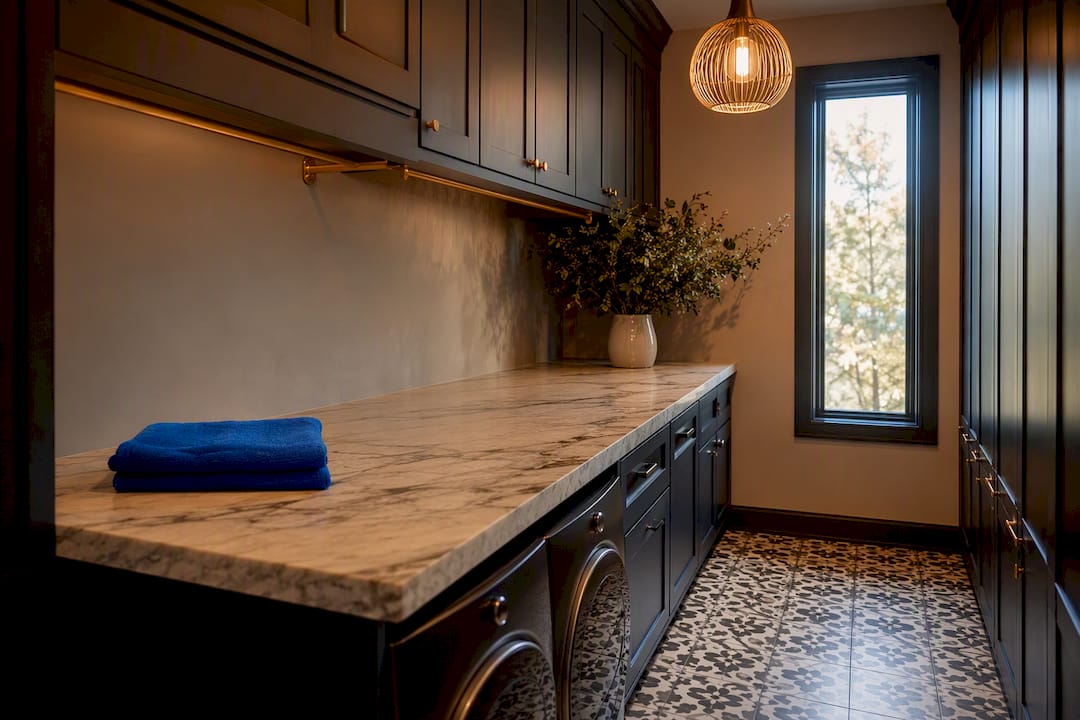
The highest-impact moves are custom-style cabinetry, a statement surface underfoot or overhead, layered lighting, and a dedicated workflow zone for folding and garment care. Get those four right, and the rest of the room reads as luxury almost automatically. What follows walks through the specific ideas worth copying, the material trade-offs behind them, and where your money actually shows.
TL;DR:
- Choosing moisture-rated wallpaper and bold, saturated cabinetry dramatically elevates the room’s visual impact and feels more luxurious than standard finishes.
- Investing in high-quality, durable counter materials like quartz or porcelain and textured patterned floors enhances both style and functionality with minimal maintenance.
- Incorporating concealed storage, custom cabinetry, and a dedicated garment-care zone makes the laundry space highly functional without sacrificing aesthetics.
- Prioritizing layered lighting and matching hardware finishes creates a cohesive, welcoming look that emphasizes quality details and atmosphere.
- Opting for energy-efficient appliances and eco-friendly materials allows for a high-end laundry room experience without compromising sustainability or operating costs.
Table of Contents
- Luxury Laundry Room Ideas That Actually Change How the Room Feels
- Materials That Look Expensive and Actually Hold Up
- Cabinetry and Storage That Looks Custom and Works Hard
- Appliances and Layout for a High-End Workflow
- Layered Lighting and Hardware That Set the Tone
- Finishing Touches That Make It Feel Curated, Not Just Clean
- Budget Ranges and Where to Splurge vs. Save
- Eco-Friendly and Energy-Efficient Choices for a Luxury Laundry Room
- Noise Reduction Solutions for a Quieter Laundry Space
- What Art in Lifestyle’s Editors Think Separates a Good Laundry Room From a Luxury One
- Browse Curated Galleries for More Room-by-Room Inspiration
- Sources
Luxury Laundry Room Ideas That Actually Change How the Room Feels
Most laundry rooms fail at luxury for one reason: they’re treated as an afterthought, tucked behind a door and finished with whatever was left over from the kitchen budget. The rooms that photograph beautifully and function even better share a different logic. They borrow the same design confidence you’d apply to a powder room, then layer in genuinely useful storage and workflow upgrades. Designers often treat laundry rooms like small boutique spaces precisely because they’re private and contained, which gives homeowners license to try bold patterns and colors that might feel like too much in a living room.
Here are the ten moves worth prioritizing, roughly in order of visual and functional payoff.
1. Bold or moisture-rated wallpaper
A patterned wallcovering, especially a botanical or geometric print, turns a utility closet into a room people actually want to walk into. Choose a vinyl or moisture-rated paper so humidity from the dryer vent or a utility sink doesn’t cause peeling at the seams.
2. Color-drenched cabinetry
Painting cabinets, trim, and sometimes the ceiling in a single saturated hue, a technique often called color-drenching, is one of the defining trends designers are leaning into for 2026, alongside jewel-toned cabinetry and encaustic patterned floors. Deep green, ink blue, and terracotta all read as expensive because they commit rather than compromise.
3. Premium counters
Marble or quartzite delivers the veining that makes a folding counter look like furniture, but quartz and porcelain slab alternatives get you nearly the same visual weight with far less maintenance anxiety. More on that trade-off below.
4. Patterned floors with real texture
Encaustic cement tile or penny-round tile adds pattern underfoot in a room too small to need much of it. Both styles show up repeatedly in current designer-approved laundry room projects because they add texture without competing with cabinetry color.
5. Statement lighting
A single sculptural pendant over the folding counter or utility sink does more for perceived luxury than almost any other single fixture change. Pair it with under-cabinet task lighting so the drama up top doesn’t leave you folding shirts in shadow.
6. Custom cabinetry with concealed sorting
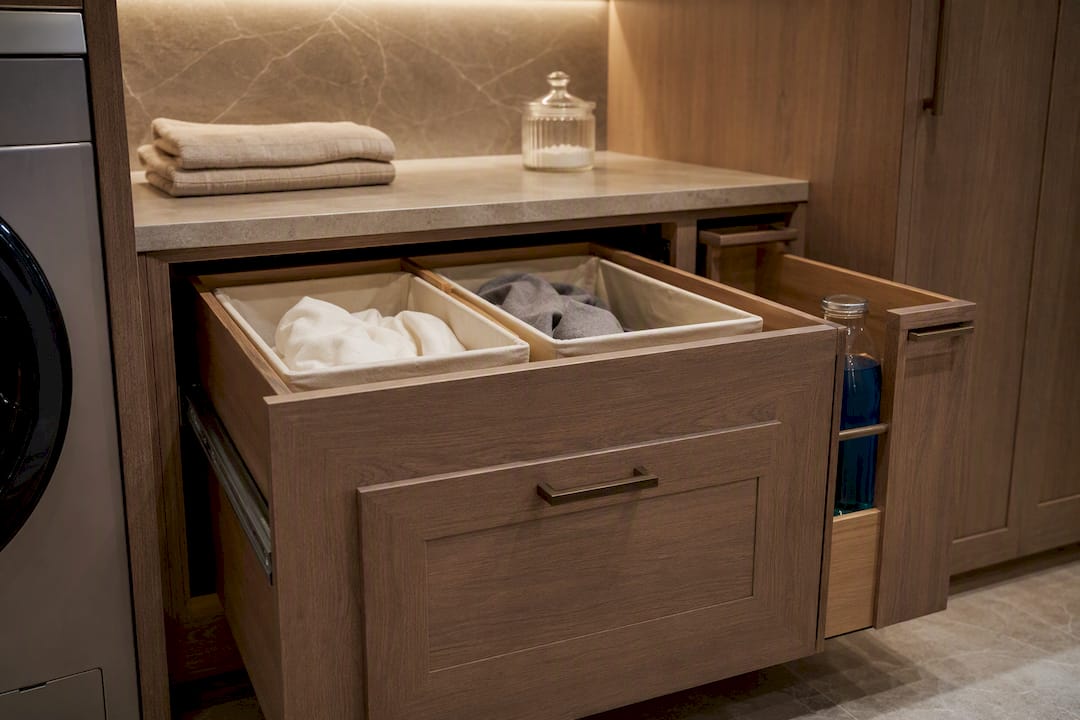
Built-in laundry hampers that pull out from behind a cabinet face, tilt-out sorting bins, and pantry-style pull-outs for detergent all keep the room looking tidy even mid-load. This is the feature that separates a genuinely custom laundry room from a dressed-up basic one.
7. A long folding counter and a garment-care zone
A counter that runs the full length of one wall, ideally at a comfortable working height, gives you space to fold a full load without stacking clothes on top of the dryer. Add a small hanging rod or a fold-down ironing station nearby for garment care.
8. A utility sink upgrade, sometimes doubling as a pet-wash station
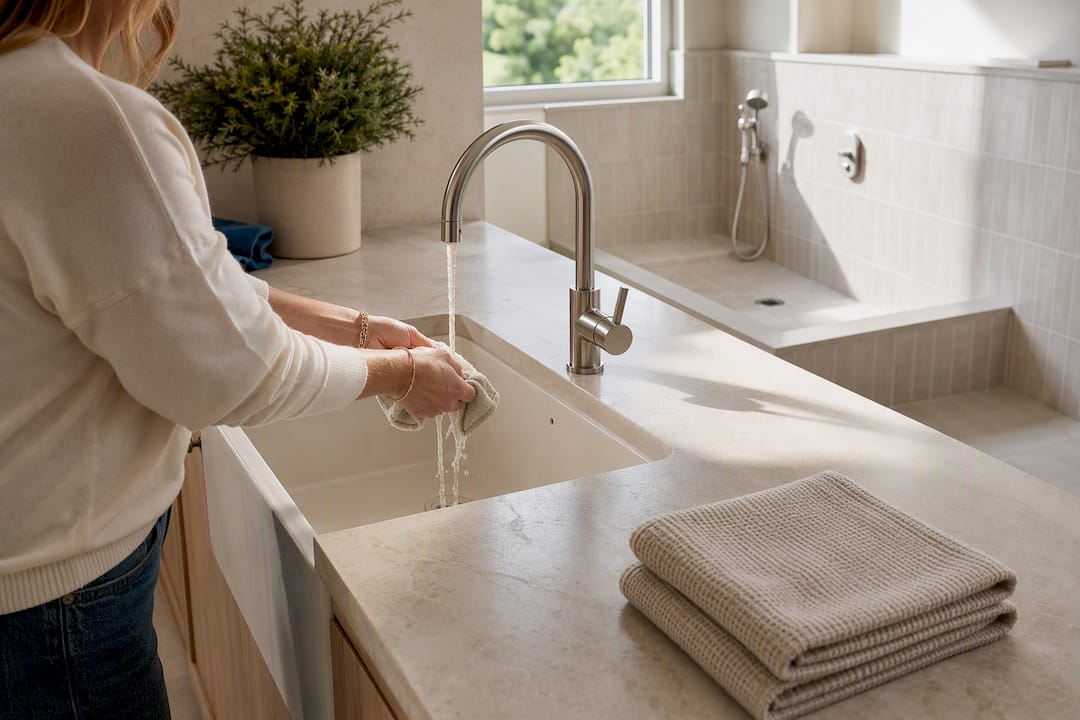
A deep apron-front sink in the same stone or quartz as your counters elevates a purely functional fixture into a design feature. In households with dogs, a low walk-in pet-wash bay off the laundry room is quickly becoming one of the most requested multifunctional upgrades.
9. Integrated drying solutions
Pull-out drying racks built into a lower cabinet, or a retractable line hidden behind a panel, solve the delicate-item problem without a bulky freestanding rack cluttering the floor.
10. Luxe hardware and finishes
Unlacquered brass pulls, a matte black faucet, or fluted cabinet fronts are the detail work that makes everything above feel finished rather than assembled. Cabinet hardware and a statement pendant are consistently cited as two of the highest-return, lowest-effort upgrades a homeowner can make without a full remodel.
Pro Tip: If you only change two things, make it a two-tone cabinet scheme (a rich lower cabinet color with a lighter or paneled upper) paired with a patterned floor as the room’s visual anchor. That combination does more heavy lifting than any single splurge item on this list.
Materials That Look Expensive and Actually Hold Up
Every luxury material choice in a laundry room has to survive water, heat, detergent, and daily traffic, so the real decision is which trade-off you’re comfortable making.
For counters, marble or quartzite gives you the most dramatic veining but stains if spilled bleach or oil-based stain remover sits too long. Quartz is engineered stone with resin binders, so it resists staining and never needs sealing, though the pattern reads a bit more uniform. Porcelain slab splits the difference: it handles heat and scratches better than either natural stone option and increasingly mimics marble convincingly enough that most guests can’t tell the difference at a glance.
Flooring follows a similar logic:
- Encaustic cement tile delivers rich, hand-painted pattern but needs periodic sealing to resist staining and should be finished with a slip-resistant coating near the sink.
- Penny tile in a rounded or hexagon shape adds texture underfoot and works well with a contrasting grout color, though grout lines need routine cleaning in a high-moisture room.
- Porcelain wood-look planks give you the warmth of wood with none of the water sensitivity, and they’re the easiest of the three to keep slip-resistant.
Moisture-rated wallpaper handles splashes near a sink far better than standard paper, and tile backsplashes remain the most durable option directly behind a utility sink. For faucets and sink finishes, unlacquered brass develops a living patina over time, while matte black and brushed nickel stay visually consistent with little upkeep.
Most homeowners spend $500 to $12,000 refreshing a laundry room, and material choice is usually where that range swings hardest. A satin paint finish, meanwhile, is one of the cheapest upgrades that still performs: it wipes clean easily and resists the moisture buildup that dulls flatter finishes over time, according to Southern Living’s decorating guide.
Cabinetry and Storage That Looks Custom and Works Hard
Custom-style plywood cabinetry, even when it’s semi-custom rather than fully bespoke, outperforms painted stock cabinets in both longevity and visual weight. Stock cabinets can look nearly as good with the right door style and hardware, but plywood boxes resist warping in a humid room far longer than particleboard alternatives.
The storage details that make a laundry room feel genuinely custom:
- Hidden hampers built into a lower cabinet, so sorting happens out of sight until wash day.
- Integrated ironing stations that fold flat into a drawer front when not in use.
- Appliance pedestals that raise the washer and dryer to a comfortable loading height while adding drawer storage underneath.
- Pull-out drying racks for sweaters and delicates that need to lie flat or hang without a hook.
- An 80/20 storage split, keeping roughly 80% of contents concealed behind cabinet fronts and 20% displayed on open shelving, which designers use to keep the room feeling curated instead of cluttered.
Two-tone cabinetry, a darker lower run paired with a lighter or glass-front upper, is one of the simplest ways to coordinate a laundry room with an adjacent kitchen or mudroom without matching every finish exactly. Pick one accent color from the neighboring room and let it repeat here.
Appliances and Layout for a High-End Workflow
Choose larger-capacity machines, or a side-by-side double washer and dryer setup, when the household regularly runs multiple loads a week or handles bulky items like comforters and sports gear. Stacked units make sense for narrow footprints but sacrifice counter space above the dryer, which matters if folding happens in the same room.
Layout should follow footprint. A galley layout (appliances on two facing walls) works well in long, narrow rooms and keeps wet and dry zones close together. An L-shaped layout frees up a full wall for a folding counter and cabinetry. A U-shaped layout is the most luxurious option when space allows, giving you distinct zones for washing, drying, folding, and garment care without crossing paths.
Designers generally separate wet and dry zones deliberately, giving each its own task lighting, ventilation, and outlets so steam near the sink never becomes an electrical hazard near the dryer.
Small ergonomic upgrades that punch above their cost:
- Appliance pedestals reduce bending for loading and unloading.
- Counters built over front-loading machines create instant folding space without adding square footage.
- A dedicated steam or refresh cabinet near the garment-care zone handles wrinkle removal without an ironing board taking over the floor.
Layered Lighting and Hardware That Set the Tone
A luxury laundry room needs three lighting layers working together: ambient overhead light for general visibility, task lighting focused on the folding counter and sink, and accent lighting that adds mood. Layered lighting with dimmers and under-cabinet LEDs eliminates the flat shadows that make even a beautifully designed room feel like a utility closet.
A few fixture ideas that scale down well for small rooms:
- A single statement pendant over the sink or folding counter, sized modestly since laundry rooms rarely have the ceiling height for anything oversized.
- Under-cabinet LED strips along the upper cabinetry, aimed directly at the counter’s work surface.
- A flush-mount ambient fixture on a dimmer switch, so the room can shift from bright working light to a softer evening mood.
Hardware finish matters more than people expect. Pick one metal family, unlacquered brass, matte black, or brushed nickel, and carry it across cabinet pulls, the faucet, and any exposed fixture hardware. Mixing metals in a room this small tends to look accidental rather than intentional.
Finishing Touches That Make It Feel Curated, Not Just Clean
A small framed print or a single piece of art above the folding counter finishes the room the same way it would a powder room, and scale matters more than subject matter in a space this tight. A washable, low-pile rug in a durable fiber like polypropylene handles detergent drips far better than wool or jute. For greenery in low-light conditions, pothos and ZZ plants tolerate the inconsistent light most laundry rooms get, and plant picks like these translate easily into a small utility space.
For display, stick to the 80/20 rule again: a few neatly labeled glass jars for detergent pods or dryer sheets on open shelving, everything else concealed. On scent, a subtle reed diffuser holds up better than a plug-in air freshener, which can struggle against humidity and dryer exhaust over time.
Budget Ranges and Where to Splurge vs. Save
Most laundry room refreshes fall between $500 and $12,000, with a smaller group of full custom builds reaching into six figures once appliances, custom cabinetry, and stone counters are all specified at once.
| Investment level | Typical scope | What’s included |
|---|---|---|
| Refresh | $500 to $12,000 | Paint, hardware swap, peel-and-stick wallpaper, new light fixture |
| Mid-range remodel | $500 to $12,000 | Semi-custom cabinetry, tile or porcelain slab counter, layered lighting, new flooring |
| Premium custom build | $12,000 and up | Full custom cabinetry, natural stone counters, integrated appliances, dedicated garment-care zone |
Splurge on cabinetry, counters, and lighting, the three elements that touch every square foot of the room and are the hardest to upgrade later without a full teardown. Save on hardware, which is inexpensive to swap again in a few years, and on wallpaper, where a peel-and-stick option delivers most of the visual impact of a fully installed paper at a fraction of the cost and labor. Phasing the work, cabinetry and counters first, styling and hardware later, spreads the cost without leaving the room looking unfinished at any stage.
Eco-Friendly and Energy-Efficient Choices for a Luxury Laundry Room
Energy efficiency and luxury aren’t in competition in a well-designed laundry room. High-efficiency front-loading washers use significantly less water per cycle than older top-loaders, and pairing one with a heat-pump dryer avoids the ductwork of a traditional vented dryer while cutting energy use over time.
Countertops made from recycled quartz or reclaimed wood for open shelving bring the same visual richness as virgin materials with a smaller environmental footprint. Low-VOC paint, especially in a satin finish that already resists moisture well, keeps indoor air quality in check in a room that runs warm and humid for hours at a time.
Water-saving utility sink faucets with aerators cut flow without sacrificing pressure for pre-treating stains. If a pet-wash station is part of the plan, a low-flow sprayer attachment serves double duty there. LED fixtures throughout the layered lighting plan use a fraction of the energy older incandescent or halogen fixtures did, and they generate far less ambient heat, which matters in a room that already runs warm from the dryer.
None of these swaps require sacrificing the marble-look counter or the statement pendant. They just mean choosing the efficient version of each luxury feature rather than the standard one.
Noise Reduction Solutions for a Quieter Laundry Space
A washing machine on spin cycle or a dryer tumbling a comforter can be surprisingly loud, and noise is one of the most overlooked luxury details in laundry room design. Front-loading machines with insulated drums run quieter than older top-loaders, and installing them on a solid, level base rather than a hollow subfloor cuts vibration noise considerably.
Anti-vibration pads under both washer and dryer absorb the rattle that travels through floor joists into adjacent rooms. If the laundry room sits near a bedroom or home office, adding a solid-core door instead of a hollow one blocks sound transfer far more effectively, and a door sweep at the base seals the gap where noise typically leaks through. For a full remodel, insulated interior doors and panel styles are worth considering specifically for their sound-dampening benefit, not just their look.
Soft materials help too. A washable rug on the floor and a fabric window treatment, if the room has a window, both absorb sound that would otherwise bounce off hard tile and stone surfaces. Acoustic insulation inside the wall cavity during a remodel is invisible once the drywall goes back up, but it’s often the single most effective noise fix available, since it stops sound at the source rather than muffling it after the fact.
What Art in Lifestyle’s Editors Think Separates a Good Laundry Room From a Luxury One
Most laundry rooms fail not from a lack of budget but from treating every surface the same. The rooms that read as genuinely luxurious commit to one bold material decision, then let workflow and lighting do the rest. Our checklist: one statement surface, one lighting moment, one concealed storage system, and hardware that matches throughout…
— Nealda
Browse Curated Galleries for More Room-by-Room Inspiration
This site is the place to keep exploring once the laundry room ideas start giving you momentum for the rest of the house. Unlike a single-topic renovation blog, our galleries let you carry a color palette or a lighting idea straight from the laundry room into adjacent spaces without starting your research over from scratch.

If a statement ceiling caught your eye in the ideas above, our ceiling design gallery shows how the same color-drenching approach plays out in dining rooms and entryways. For anyone working with a tighter footprint, our space-saving decor picks double as functional art in rooms too small for extra furniture. And if you’re ready to see how these ideas connect to a full-home plan, our 2026 home trends guide walks through what’s shaping every room this year, not just the laundry closet. Browse the galleries, save what fits your space, and start building your own room-by-room plan today.
Sources
- What Goes Into a High-End Custom Laundry Room: Materials, Layouts, and Investment Considerations
- 11 bold laundry room ideas interior designers are actually using right now
- 15 Genius Laundry Room Decor Ideas