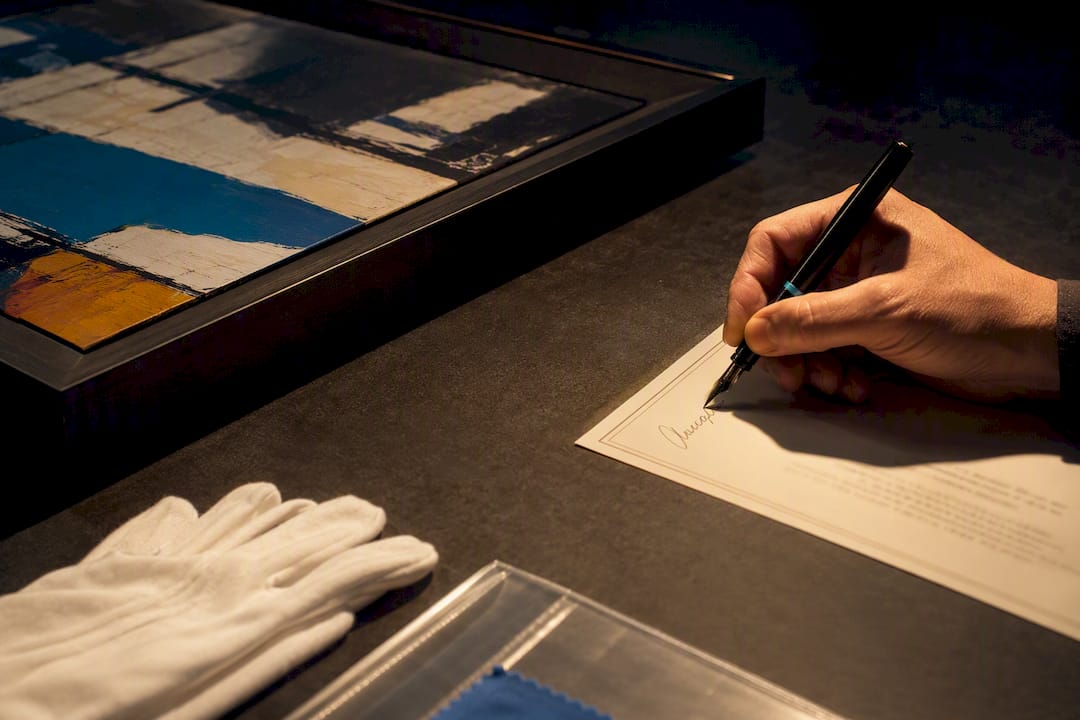
A Certificate of Authenticity (COA) is the document that verifies an artwork’s authorship, materials, and provenance, and it belongs with nearly every original or limited-edition piece an artist sells or a collector buys. Most artists should issue one at the point of sale or consignment. Its actual worth, though, hinges entirely on who signed it. A COA from the artist, their estate, or a recognized authority carries weight in building retail trust. One from an anonymous seller does not.
TL;DR:
- A credible COA must be signed by the artist, estate, or recognized authority, as a certificate from an unknown seller holds little value.
- Including specific details such as the artist’s full name, artwork title, creation year, medium, dimensions, and an unique ID enhances verification and resale potential.
- A COA should feature a signature, date, and a link like a hologram or QR code to tie the certificate to the physical artwork securely.
- Verifying a COA involves checking issuer credibility, signature matches, and matching records in catalogue raisonnés or estate archives to prevent forgeries.
- Building a comprehensive provenance record, including scanned backups and linked digital records, ensures long-term proof of authenticity.
Table of Contents
- What Is a Certificate of Authenticity in Art?
- Why a COA Matters for Sellers and Collectors
- What Should Go on a Certificate of Authenticity?
- How to Create, Sign, and Store a COA
- How to Verify a COA and Spot a Fake
- Do Insurance, Donations, and Resale Need More Than a COA?
- Templates and Platforms Worth Using
- Keep Your Provenance Records Intact for Decades
- Why Consistent Documentation Belongs in Every Art Collection
- Need Help Verifying Provenance Before You Buy or Sell?
- Sources
- FAQ
What Is a Certificate of Authenticity in Art?
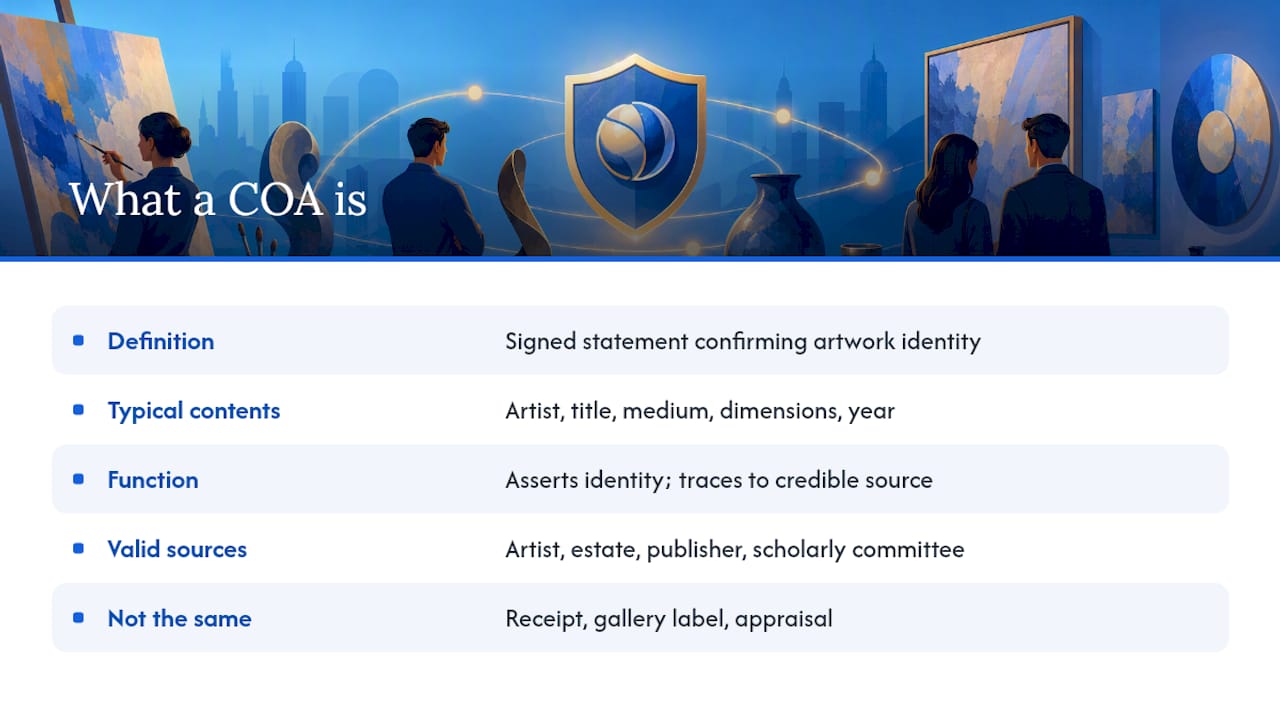
A certificate of authenticity is a signed statement confirming that a specific artwork is what it claims to be. It typically names the artist, the title, the medium, the dimensions, and the year of creation, giving the piece a documented identity separate from the object itself, according to Wikipedia’s overview of the document type.
It’s not the same thing as a sales receipt, which just records a transaction, or a gallery label, which identifies a piece on a wall without vouching for its origin. An appraisal is different again: it assigns monetary value, often assuming authenticity has already been established elsewhere. A COA does something none of those documents do on their own. It asserts the work’s identity and traces it back to a credible source.
That source matters more than the paperwork’s format. A COA can legitimately come from the artist, the artist’s estate, an authorized publisher, or a recognized scholarly committee tied to a catalogue raisonné. A COA printed by a random reseller with no connection to the artist is close to worthless, no matter how official it looks.
Why a COA Matters for Sellers and Collectors
Buyers hesitate when a piece has no documented history, and that hesitation shows up directly in resale speed and price. A COA from a credible issuer shortens that hesitation because it gives the next buyer, and the one after that, a paper trail they can check.
Insurers and appraisers lean on COAs too. A policy covering a five-figure painting is much easier to underwrite when the insurer can see who made the work and when it was verified. Appraisers use the same document as a starting point before they assign a current market value.
The flip side is real risk. A missing or sloppy COA doesn’t just slow a sale. It invites doubt about the whole piece, and doubt is expensive: beginning collectors are routinely advised to confirm edition numbers, signatures, and COA issuers before buying, precisely because a COA on its own is supporting evidence, not proof.
What Should Go on a Certificate of Authenticity?
A COA earns its credibility from specificity, not length. Vague language (“an original work by the artist”) tells a future buyer nothing they can verify. Precise fields do.
Every COA should include:
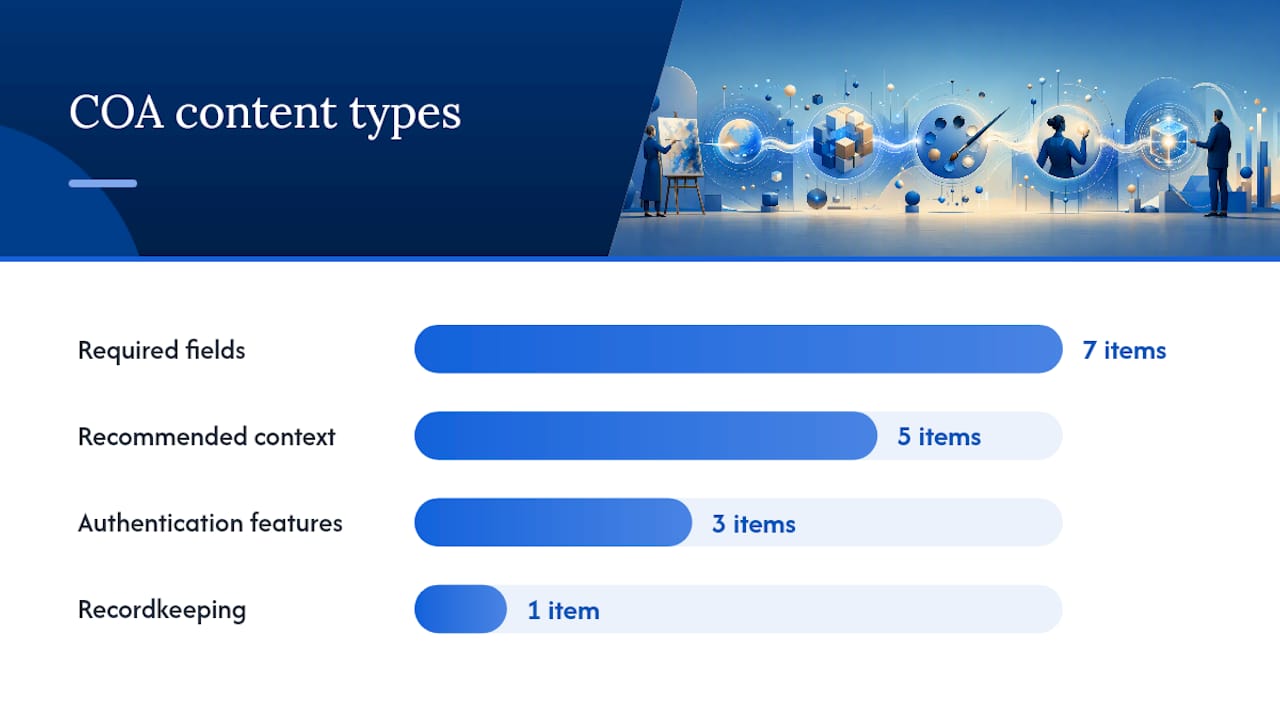
- The artist’s full legal name
- The artwork’s title
- Year of creation
- Medium (oil on canvas, bronze, archival pigment print, and so on)
- Exact dimensions
- Edition number and total run size, for prints or sculpture editions
- A unique identifying number tied to the artwork and its records
Beyond those mandatory fields, a stronger certificate adds context that makes fraud harder and resale easier:
- A photograph of the finished piece
- Provenance notes: prior owners, exhibition history, sale history
- Storage, framing, or display instructions
- The buyer’s name and the sale date
- The issuer’s contact information for future verification
For authentication itself, Jackson’s Art Blog recommends a hand signature, a clearly dated signing, and either a matching hologram or a QR code that links the physical certificate to the artwork’s label. That link is what makes a COA hard to swap or forge later.
Pro Tip: Number your COAs sequentially and log them in a spreadsheet the moment you issue one. If a buyer ever calls asking you to confirm a certificate years later, that log turns a five-minute lookup into an instant answer instead of a scramble through old files.
How to Create, Sign, and Store a COA
Building a COA doesn’t require legal training, just consistency. The process holds up whether you’re documenting a single painting or a print run of fifty.
- Draft the certificate using a template with all mandatory fields already built in, so nothing gets skipped under deadline pressure.
- Fill in the artwork-specific details, then assign it a unique ID number that also appears somewhere discreet on the piece or its backing.
- Sign the certificate by hand and date it. That signing date documents when you verified the work, which may differ from the artwork’s creation date, and buyers should understand the distinction.
- Deliver the original, signed copy with the artwork at the point of sale or shipment.
- Keep a duplicate, along with a scanned digital copy, in your own records.
Platforms built for artists can shortcut most of this. Artwork Archive generates COAs directly from a piece’s record, pulling in signature fields automatically and saving a history of every certificate issued, so you’re not rebuilding the wheel for each sale.
For storage, treat the COA the way you’d treat a deed:
- Scan every certificate and back it up in at least two locations.
- Note the artwork’s ID number in the file name for fast searching.
- Keep the physical original in an archival sleeve, away from humidity and direct light.
How to Verify a COA and Spot a Fake
Fraudulent certificates are common enough to warrant real scrutiny, especially online. Wikipedia notes that COAs issued by unknown or unverified entities on internet auction sites are frequently fabricated specifically to lend false credibility to counterfeit work.
Watch for these warning signs before you trust a certificate:
- No named, contactable issuer, just a generic template with blanks filled in
- A signature that doesn’t match known examples of the artist’s or estate’s signature
- No unique ID, serial number, or reference that ties the certificate to a specific piece
- Language so vague it could apply to almost any artwork
If a certificate looks legitimate but you want confirmation, contact the named issuer directly and ask them to confirm the serial number against their own records. For established artists, check whether the piece appears in a catalogue raisonné or estate archive. Compare the signature against verified samples, and ask for current condition photos or an in-person inspection if the sale is remote.
Pro Tip: When a five- or six-figure piece is on the line, involve an independent appraiser or conservator before you finalize the sale, not after. Expert authentication reviews typically take days to weeks and cost a few hundred dollars into the low thousands, depending on the artist and complexity, but that’s cheap insurance against buying a well-documented fake.
Do Insurance, Donations, and Resale Need More Than a COA?
A COA is a starting point for these processes, not the finish line. Insurers combine it with a full condition report and a separate appraisal before writing a policy. A COA proves what the piece is; the appraisal establishes what it’s worth today.
Charitable donations face their own rules. The IRS requires a qualified appraisal for non-cash donations above certain thresholds, and a COA helps establish authenticity but doesn’t replace that appraisal for tax purposes.
There’s legal weight here too. A COA can function as an express warranty in a sale, meaning the issuer can be held accountable if the claims turn out false. That’s exactly why issuer credibility carries so much legal and commercial consequence, particularly in a dispute.
Templates and Platforms Worth Using
A simple PDF template works fine for artists selling occasionally and comfortable tracking records manually. Once you’re issuing certificates regularly, a platform pays for itself in saved time.
- Artwork Archive generates COAs from existing piece records and keeps a running history of every certificate issued.
- Saatchi Art requires a signed COA as part of its shipment documentation and provides a template for sellers on its platform.
- A template alone, from any source, doesn’t create credibility. You still need a unique ID, a real signature, and retained provenance records behind it.
Keep Your Provenance Records Intact for Decades
Build a running catalog of every piece: images, dates, sale history, and exhibition credits, alongside your original COAs and scanned backups. A matching label or QR code that links back to an unlisted digital record makes the certificate’s connection to the artwork provable years later. Skip adhesives that can damage a canvas or frame; use archival sleeves and acid-free enclosures instead.
Why Consistent Documentation Belongs in Every Art Collection
It is recommended to treat a COA as standard practice, not an optional extra, for any artist or seller who wants repeat buyers and confident collectors. If you’re just starting an art collection, read our guide on edition numbers and print authenticity next.
Need Help Verifying Provenance Before You Buy or Sell?
Chasing down an artist’s estate, cross-checking a signature, or untangling a piece’s sale history takes time most collectors don’t have, and a wrong guess is expensive to unwind. That’s the gap Artinlifestyle’s Art Concierge service exists to close.
An art concierge service can work alongside you on the documentation side of a purchase or sale: pulling together provenance research, reviewing certificates for the credibility markers covered above, and connecting you with appraisers or specialists when a piece needs deeper verification. It’s built for collectors and sellers who want a second set of eyes before money changes hands, not a generic checklist. If you’re weighing whether to trust a certificate on a piece you’re considering, or want your own COAs put together properly before a sale, start a conversation with Art Concierge and get a clear read on what you’re actually holding.
Sources
- Generating a Certificate of Authenticity | Artwork Archive
- Certificate of Authenticity: How It Works and Legal Weight – LegalClarity
- What Is a Certificate of Authenticity for Artwork? – Jackson’s Art Blog
FAQ
How do I make a Certificate of Authenticity for my art?
Use a template that includes your name, the artwork’s title, medium, dimensions, year, and a unique ID, then sign and date it by hand before delivering the original with the piece.
Do I need a Certificate of Authenticity for my artwork?
Yes, if you’re selling or consigning an original or limited-edition piece. A COA builds buyer trust, supports resale value, and gives insurers and appraisers a documented starting point.
How do I get my artwork authenticated?
Contact the artist or their estate directly if possible, or consult a qualified appraiser or conservator who can compare signatures, materials, and provenance records against known examples.
How much does it cost to get a painting authenticated?
Costs vary widely by artist and complexity. Authentication fees depend on the artist, the complexity of the work, and the level of scholarly research required.
Recommended
- What is a Giclée Art Print? Read This Before Buying One
- Get a Custom Piece in 2–6 Weeks: Commissioning Art for Homeowners
- Art Framing Styles: A Visual Guide and Selection Checklist