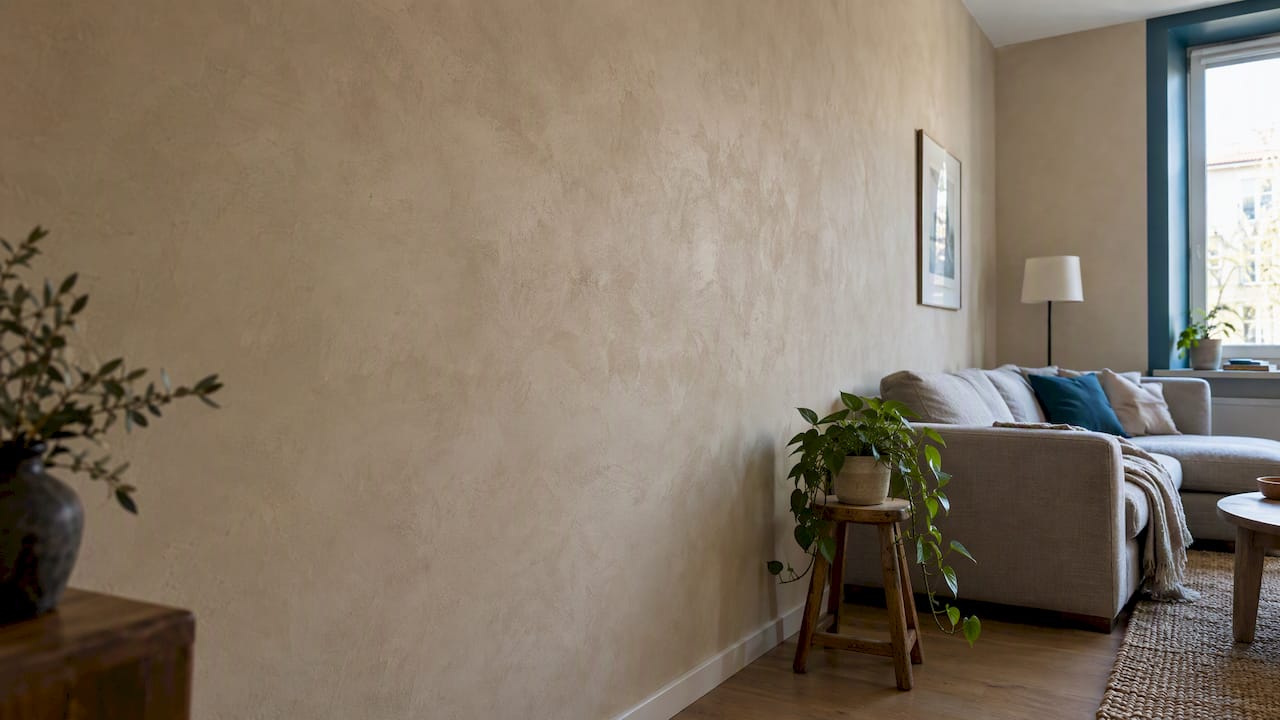
Roman clay walls are a hand-troweled, plaster-like finish that turns a flat painted wall into a soft, suede-like surface with gentle movement and depth. It is smooth to the touch, matte to the eye, and unmistakably the work of a human hand. This guide covers what the finish is, how it differs from limewash and Venetian plaster, what it costs, which colors and rooms suit it, and the mistakes worth avoiding before you commit.
TL;DR
- Roman clay is a paint and plaster hybrid, applied in thin layers with a trowel or putty knife, that dries to a smooth, matte, softly cloudy finish.
- It sits between limewash (chalky, brushed on, rustic) and Venetian plaster (lime and marble dust, burnished to a sheen).
- Expect roughly $6 to $12 per square foot installed in one regional contractor estimate. Labor and wall prep drive the number more than the material.
- Spot repairs are hard to hide and returning to a flat wall usually means a skim coat, so choose color and room with care.
- Judge the applicator by their portfolio, not the catalog photo. The hand is the product.
Table of Contents
- What Roman clay actually is
- Roman clay vs. limewash vs. Venetian plaster
- How the finish goes on
- What Roman clay costs
- Roman clay colors that work
- Where Roman clay belongs
- Our perspective
- Choosing an applicator
- Common mistakes to avoid
- Styling a Roman clay room
- Finding pieces to complement the finish
- FAQ
- Sources
What Roman clay actually is
Think of Roman clay as the middle child of decorative wall finishes. It is a clay-and-plaster compound, troweled on in thin, overlapping layers, that produces a smooth surface with subtle, suede-like variation. Professional painters at TINOS describe it as a hybrid of paint and plaster, distinct from both Venetian plaster and limewash.
The name nods to the long history of lime-based mortars and plasters in Roman building, a subject well documented in research on how Roman mortars and plasters were produced and applied on site. Today’s product is a modern, low-odor interpretation rather than an ancient recipe. Manufacturers describe their versions as an eco-friendly, plaster-like finish for smooth interior walls, applied with a putty knife or trowel to achieve stone, stucco or marble-like effects.
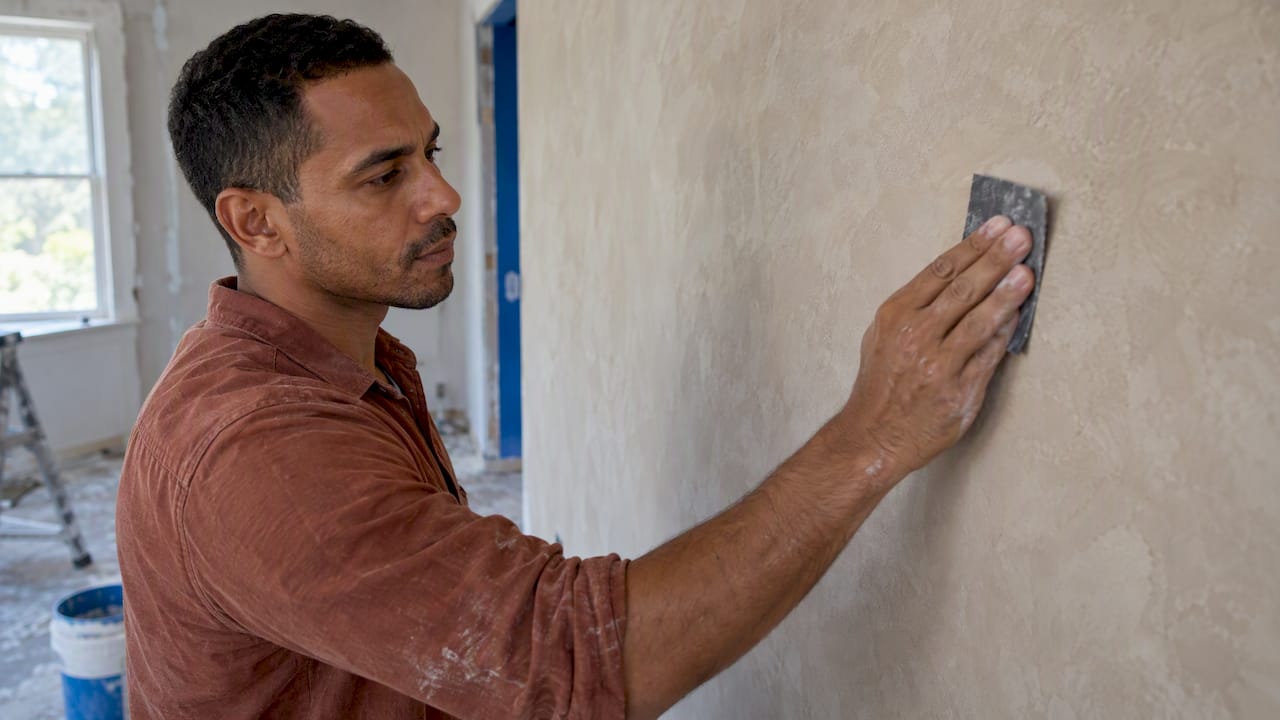
One misconception is worth clearing up early. The word “textured” suggests something you could snag a sweater on. In practice the finish stays smooth to the touch. The texture is visual: light and shadow moving across the surface the way they do across a linen curtain or a worn leather chair. Installers sand lightly with 220 to 400 grit paper between coats and after the final layer to remove high spots and trowel bumps, according to manufacturer guidance.
Roman clay vs. limewash vs. Venetian plaster
These three finishes get lumped together in search results and Pinterest boards, yet they behave differently on the wall and in your budget.
| Limewash | Roman clay | Venetian plaster | |
|---|---|---|---|
| Base | Slaked lime, water, pigment | Clay and natural binders | Lime and marble dust |
| Applied with | Wide brush | Trowel or putty knife | Trowel, then burnished |
| Look | Chalky, cloudy, weathered | Matte to low sheen, suede-like | Polished, stone-like |
| Layers | 2 to 4 thin coats | 1 to 3 thin coats | 3 to 5 thin coats |
| Relative cost | Lowest | Mid-range | Highest |
| Best rooms | Living rooms, bedrooms, accents | Bedrooms, offices, living rooms | Entryways, dining rooms, bathrooms |
The base materials, layer counts, relative costs and room suggestions above follow a side-by-side comparison from a Florida painting contractor. Layer counts vary by product and installer, so treat them as typical rather than fixed.
Limewash: the weathered cousin
Limewash is a mineral finish made from slaked lime. It soaks into porous surfaces and dries to a chalky, cloudy, weathered look. It is brushed on, which gives it that mottled, cloud-like movement. If you love a Tuscan farmhouse or a sun-bleached coastal cottage, limewash delivers. If you want something quieter and more tailored, Roman clay is the better fit.
Venetian plaster: the polished one
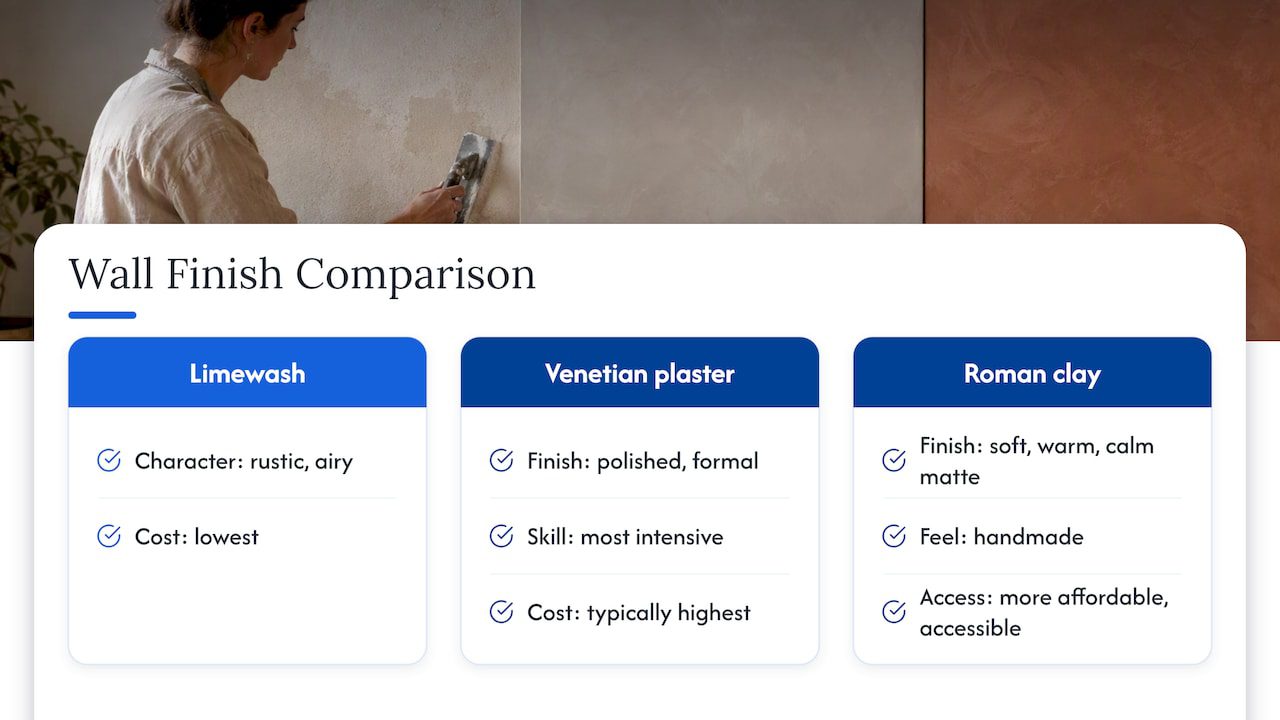
Venetian plaster is lime-based with marble dust, and it is burnished to a higher sheen. It is the finish of grand hallways and formal dining rooms, with a depth that looks almost like honed stone. It is also the most skill-intensive and typically the most expensive. Roman clay is generally more affordable and accessible, though the final bill depends on the artisan more than the volume of material.
So which one should you choose?
Choose limewash for rustic, airy character and the lowest cost. Choose Venetian plaster for a polished, formal surface. Choose Roman clay when you want softness, warmth and a calm matte wall that still feels handmade. For a modern home with clean lines, it is often the most livable of the three.
How the finish goes on
Roman clay is designed for smooth interior drywall, ideally a level 5 finish, according to retailer product guidance. The process takes longer than painting, and each stage matters.
- Prepare the wall. Fill, sand and prime. A stain-blocking primer is essential if the existing wall is a different color or has a glossier paint history. Manufacturers of sample jars recommend a standard PVA primer for adhesion and color accuracy.
- Apply the first thin coat. Using a trowel or putty knife, work in short, overlapping strokes. The movement you make now becomes the pattern you live with.
- Sand lightly. A 220 to 400 grit paper knocks down ridges and trowel marks.
- Apply one or two more coats. Most installations call for two to three thin layers in total, per the same product guidance.
- Final sanding and optional topcoat. In wet or high-touch areas, a compatible protective topcoat is worth considering.
Coverage varies with technique, but one retailer estimates that a 10 kilo bucket covers about 200 to 250 square feet. A 12 by 14 foot bedroom with 8 foot ceilings has roughly 400 square feet of wall before subtracting doors and windows, so plan for two buckets and a little extra for sampling and touch-ups.
What Roman clay costs
There is no single national price, and the honest answer is that labor dominates. One Florida contractor puts Roman clay at $6 to $12 per square foot. Regional labor rates, ceiling height, and the condition of your walls will move that range.
Two things push the figure up:
- Wall prep. Walls with existing texture or an incompatible coating may need skim coating or priming first.
- Applicator skill. Pricing is labor-intensive and varies by artisan, not just by material volume.
The do-it-yourself route lowers the bill but raises the stakes. The material is user-friendly, yet your first wall will teach you more than your last. Many homeowners practice on a spare sheet of drywall, or on a closet wall, before touching the room everyone sees.
Roman clay colors that work
The finish rewards restraint. Because it relies on tonal variation, the most convincing colors are ones with a little built-in complexity, such as a greige with a hint of green, or a white that leans warm rather than stark.
- Warm neutrals: oatmeal, sand, putty and soft stone. These are the safest choices and look expensive in almost any light.
- Earth tones: terracotta, clay pink, ochre and cocoa. They amplify the handmade quality and pair beautifully with walnut, rattan and linen.
- Soft greens and blue-grays: sage, lichen and misty slate. Calming, and especially good in bedrooms.
- Deep, moody shades: charcoal, espresso, near-black. Dramatic, but the finish can be more delicate in some applications and acts much like an ultra-flat paint, so expect it to show scuffs more readily.
Always test a sample on the actual wall. Color shifts with north or south light, and a matte, light-absorbing surface behaves differently from the painted chip in your hand. Sample jars with the real finish let you judge the movement as well as the shade.
If you are weighing a bold color against a quieter one, our guide to accent wall colors that go with gray walls can help you pressure-test the palette, and are accent walls out of style in 2026 offers context on whether a single plastered wall still feels current.
Where Roman clay belongs
Living rooms and bedrooms
This is where the finish shines. A matte clay wall behind a bed or sofa gives the eye what designers call visual rest: a surface that is interesting up close and serene from across the room. In a bedroom, a softly mottled sage or sand wall does more for the mood than any amount of throw pillows.
It also makes a quiet partner for art. A textured, tonal wall lets a canvas read as the focal point rather than competing with it. If you are planning one, our ideas for gallery walls that decorate blank spaces show how to hang with confidence, and the abstract work of Cameron Limbrick is a good example of the soft, layered surfaces that sit well against plaster.
Bathrooms
Bathrooms are the most common question, and the answer is “carefully.” The same Florida comparison rates Venetian plaster as naturally water-resistant when sealed and suggests Roman clay needs a sealer, since its mold resistance is moderate. Keep it out of the direct spray of a shower. On a powder room wall, or a vanity wall away from the shower, a sealed finish can look wonderful. For a steamy family bathroom, ask your installer which topcoat they trust and what ventilation you need.
Dining rooms, entries and offices
Dining rooms benefit from candlelight on clay: the surface glows rather than reflects. Entries and hallways see more bumps from bags and shoulders, so choose a mid-tone rather than a pale or very dark shade, which show marks sooner.
Open-plan spaces
In large open rooms, a single plastered wall can anchor a zone without walls or doors. Our open-concept living room layouts with measurements show where those anchor walls tend to fall.
Our perspective
We have watched a lot of trends arrive in interiors, and few have felt as quietly right as this one. Roman clay is the opposite of a gimmick. It asks you to slow down, to accept a wall that is not perfectly uniform, and to value the evidence of a hand at work. That is the same instinct behind collecting a ceramic by an artist rather than a mass-produced vase.
We also think the finish is easy to oversell. It is a commitment. A scuff on a Roman clay wall is notoriously hard to repair invisibly, because the texture is a hand-built pattern that has to be matched, not simply tinted. And going back to a flat wall typically takes a full professional skim coat. So we suggest it where the wall will be admired and seldom touched: behind a bed, around a fireplace, in a dining room, in a reading nook.
Our practical advice is simple. Choose a color that is a notch warmer and a notch lighter than your instinct. Look at the installer’s finished rooms, not the brand’s catalog. Let one wall be the quiet hero and keep the rest of the room calm. When the surface does the emotional work, the furnishings can be few and well chosen.
— Nealda
Choosing an applicator
Because two people will never produce the same result, professional painters advise reviewing the specific applicator’s portfolio of previous work instead of relying on manufacturer catalog photos. A few questions help:
- Can I see three finished rooms in person or in unfiltered, daylight photos?
- How will you handle my wall’s current surface and primer?
- How many coats, and what will you sand between them?
- Which topcoat do you recommend for this room, and why?
- What happens if the wall is damaged in two years?
A confident installer will answer all five without hesitation, and will usually suggest a sample board on site before touching the wall.
Common mistakes to avoid
- Skipping the sample. A swatch card tells you nothing about movement. Apply the real product on a board and view it morning and evening.
- Ignoring the base wall. Roman clay is made for smooth drywall. Rough or heavily textured walls need correcting first.
- Over-working the trowel. Thin, confident passes read as soft movement. Heavy ones read as plaster blobs.
- Choosing a glossy topcoat. The charm is the matte, suede-like surface.
- Using it everywhere. Contrast between plastered and plain surfaces is what makes the finish feel special.
Styling a Roman clay room
Once the walls are done, the styling should lean organic. Think linen upholstery, oak or walnut, hand-thrown ceramics and a little aged brass. Our guide to modern organic decor walks through that palette, and a few potted house plants add the green that clay tones love. In a small room, space-saving decor that doubles as art keeps the wall uncluttered so the finish can breathe.
Finding pieces to complement the finish
If you are building a room around a new wall, our curated Store Finds collects decor and art picks we like, from sculptural vessels to textured throws that echo a clay wall’s softness. For a broader view of where interiors are heading this year, see our 2026 home trends guide.
FAQ
Are Roman clay and Venetian plaster the same thing?
No. Venetian plaster is lime-based with marble dust and is burnished to a higher sheen, while Roman clay is a clay-and-plaster hybrid with a softer, matte, suede-like finish. Painters distinguish them by material, application and look. Roman clay is usually the more approachable option in both price and skill.
Can you apply Roman clay over textured walls?
It is designed for smooth interior drywall, ideally level 5, so textured walls generally need to be skimmed or smoothed first. Applying it over heavy texture tends to telegraph the old pattern through the new finish. Ask your installer to assess the wall before quoting.
How expensive is Roman clay?
One regional contractor quotes $6 to $12 per square foot. Your price will depend on wall prep, room size and the installer’s skill, so get at least two quotes that include prep and topcoat.
Is Roman clay a good choice for bathrooms?
It can be, with a sealer and good ventilation, and away from direct shower spray. Moisture resistance is described as moderate without a sealer, so ask your installer which protective topcoat suits a wet room.
Can I fix a scuff on Roman clay?
Small marks are difficult to repair invisibly because the pattern is hand-built. Keep leftover material from your job, and have the original installer handle touch-ups where possible.
Sources
- Limewash, Roman Clay & Textured Wall Finishes for 2026 | TINOS Inc
- Roman Clay vs Venetian Plaster vs Limewash (Cost + Durability)
- Roman Clay Series, product information
- Roman Clay, application and sanding guidance
- Roman Clay Sample Jars, primer recommendation
- Roman Clay specifications and coverage
- Production, transport and on-site organisation of Roman mortars and plasters