Hang artwork so its center sits at about 57 inches from the floor. That single rule fixes most “too-high” hangs before they happen, and it holds true whether you’re placing one framed print or an entire gallery wall.
A few situations call for a different number:
- Above a sofa or console: measure up from the furniture, not the floor.
- Above a bed: leave extra clearance for the headboard.
- On a staircase: measure from each step, not a fixed point.
- In a dining room or home office: drop the center slightly for seated eye level.
One more thing before you pick up the hammer: the nail or hook sits higher than the 57-inch center, not at it, because of the frame and wire. The math for that is below.
Key Takeaways
Correct art hanging height depends on centering the artwork at eye level, roughly 57 inches, while adjusting for furniture, staircases, and seated rooms, and always accounting for wire slack in the nail placement math.
| Point | Details |
|---|---|
| Default center height | Hang single pieces so their center sits at 57 to 60 inches from the floor. |
| Nail sits above center | Calculate nail height as center plus half the frame height, minus taut wire distance. |
| Furniture changes the rule | Leave 6 to 8 inches above sofas and consoles, 4 to 8 inches above headboards. |
| Groupings act as one unit | Center the entire gallery wall’s bounding box at 57 inches, not each frame individually. |
| Stairs and seated rooms differ | Measure stairwells from each step; drop dining room centers to 54 to 58 inches. |
Table of Contents
- What Is the 57-Inch Art Hanging Height Rule, and Why Does It Work?
- How High Should Art Hang Above a Sofa, Console, or Bed?
- How Do You Hang a Gallery Wall or Grouped Frames at the Right Height?
- Do Staircases and Tall Ceilings Need a Different Height?
- What Tools and Steps Get the Height Right the First Time?
- Why Does My Art Still Look Wrong After Hanging It?
- Want the Hanging Handled for You?
- Where the Conventional Hanging Advice Falls Short
- Frequently Asked Questions
- Sources
What Is the 57-Inch Art Hanging Height Rule, and Why Does It Work?
Museums and galleries calibrate their walls to 57 inches because that’s roughly the average adult eye level while standing, and it creates a consistent visual horizon across rooms filled with wildly different frame sizes. A 12-inch print and a 40-inch canvas can hang in the same hallway and still feel unified, because their centers, not their edges, line up. Most designers treat 57 to 60 inches as an acceptable working range rather than a single fixed inch mark, and Architectural Digest frames it the same way: 57 inches is the golden rule, but you should still trust your eye for oddly shaped rooms or unusual ceiling heights.
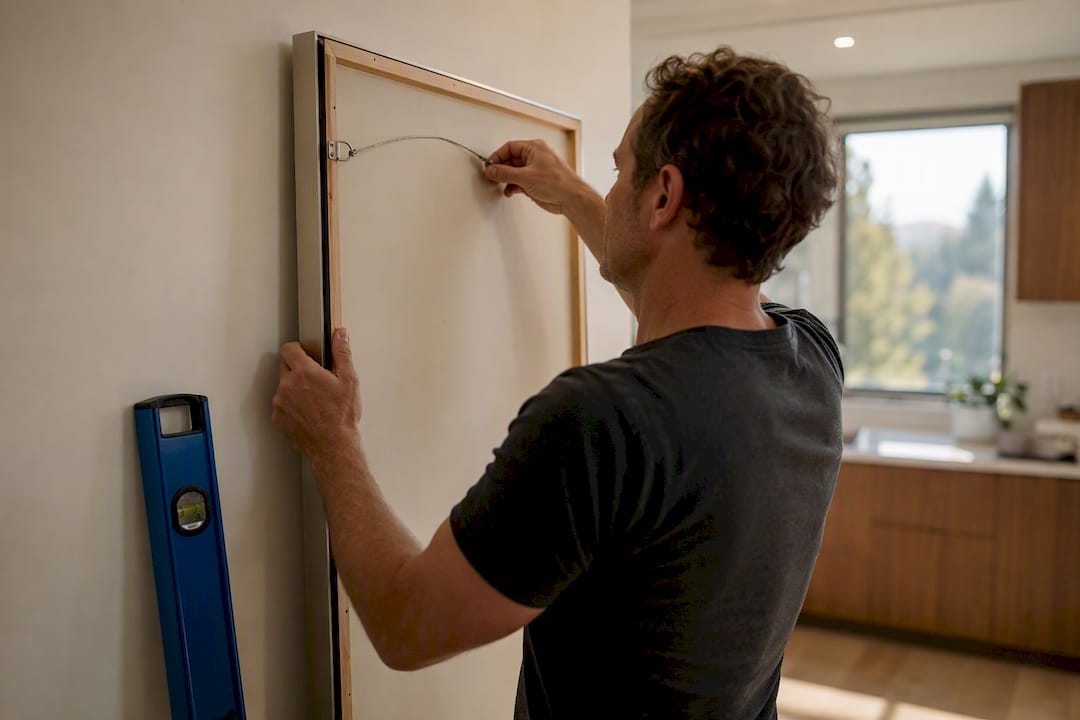
Here’s where most people get tripped up. The 57-inch figure describes where the center of the artwork should land, not where the nail goes. Frames hang from wire or D-rings set back from the top edge, so the hardware always sits above the true center point. The formula:
- Start with your target center height (57 inches, or your chosen exception).
- Add half the frame’s height.
- Subtract the distance from the top of the frame to the wire’s highest point when pulled taut.
Worked example: A frame is 24 inches tall, and the taut wire peaks 3 inches below the top edge. Nail height = 57 + (24 ÷ 2) − 3 = 57 + 12 − 3 = 66 inches from the floor.
That last variable, the wire distance, is where hangs go wrong most often. Measure the wire slack, not taut, and you’ll systematically hang everything too high. Always pull the wire up firmly with your finger before measuring, simulating exactly how it will sit once weighted on the hook. For anything wider than a single frame, a laser level beats a bubble level for keeping multiple nail points honest across a wall.
How High Should Art Hang Above a Sofa, Console, or Bed?
Furniture changes the math entirely. Once a couch, sideboard, or headboard enters the picture, you’re no longer hanging to a fixed eye-level number. You’re hanging relative to that piece, with enough breathing room that the art reads as connected rather than orphaned near the ceiling.
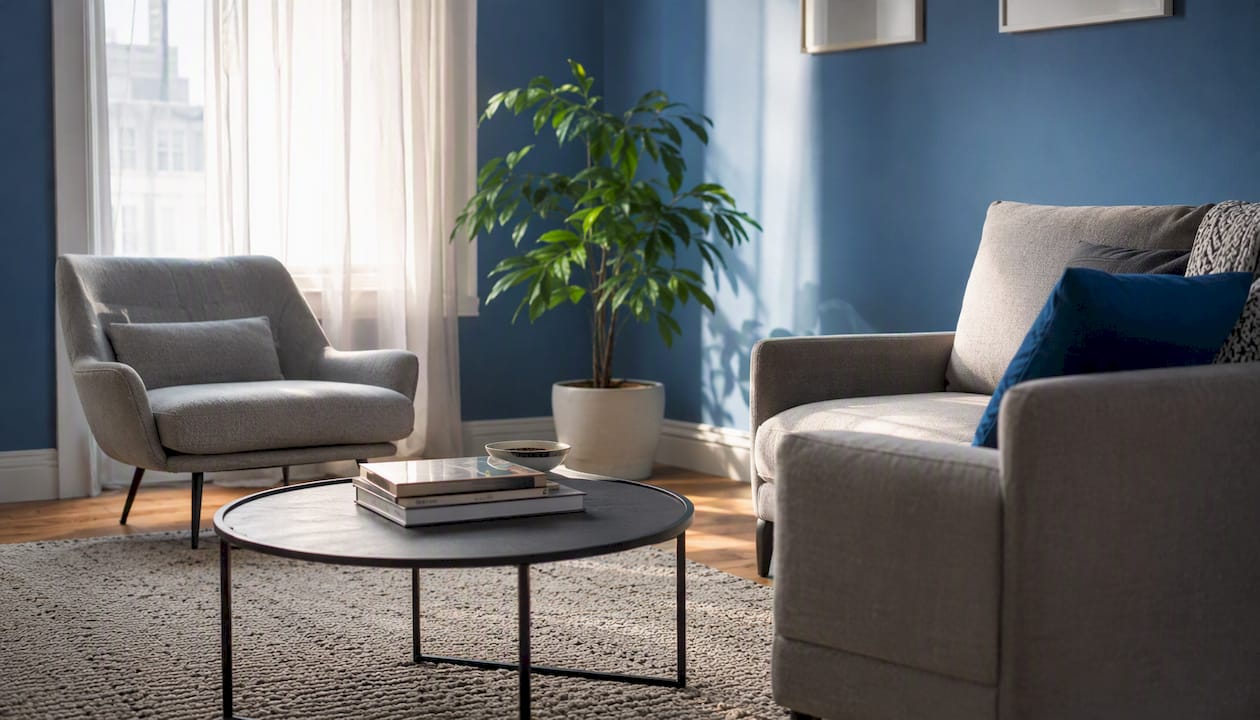
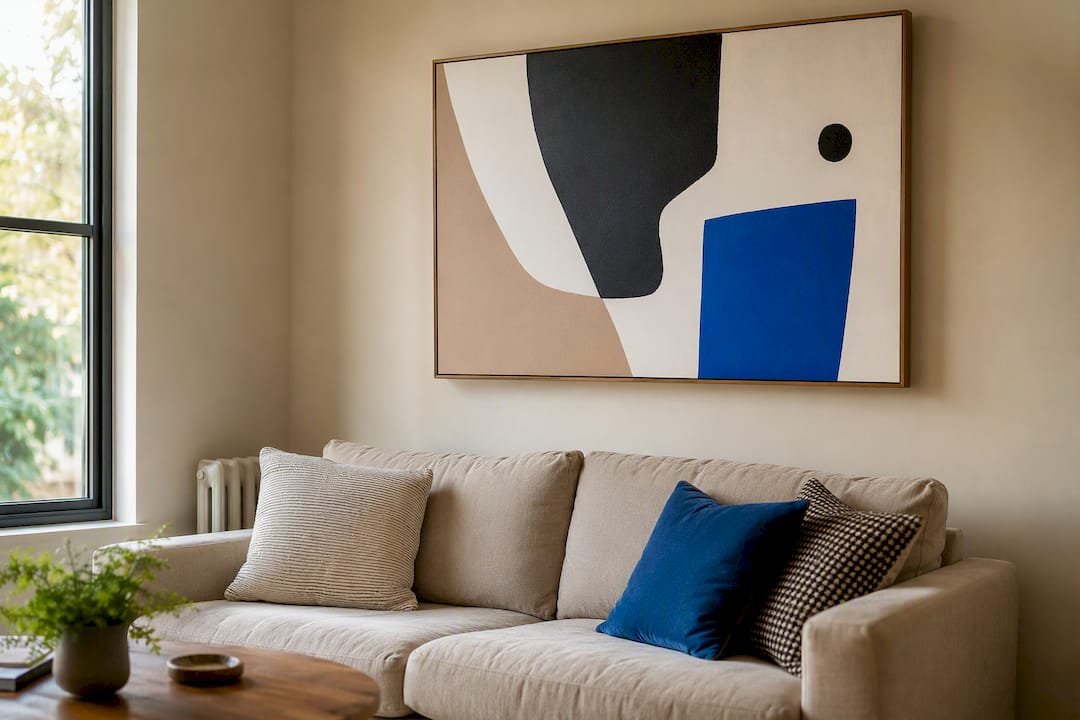
- Above a sofa: leave 6 to 8 inches between the sofa back and the bottom of the frame; size the art to roughly two-thirds to three-quarters of the sofa’s width for a balanced look.
- Above a console or sideboard: 4 to 8 inches of clearance above the surface works well, and it’s worth keeping the art’s scale proportional to whatever sits on the tabletop below it.
- Above a bed: 4 to 8 inches from the headboard is standard, though tall or upholstered headboards can support 8 to 12 inches without the art looking disconnected.
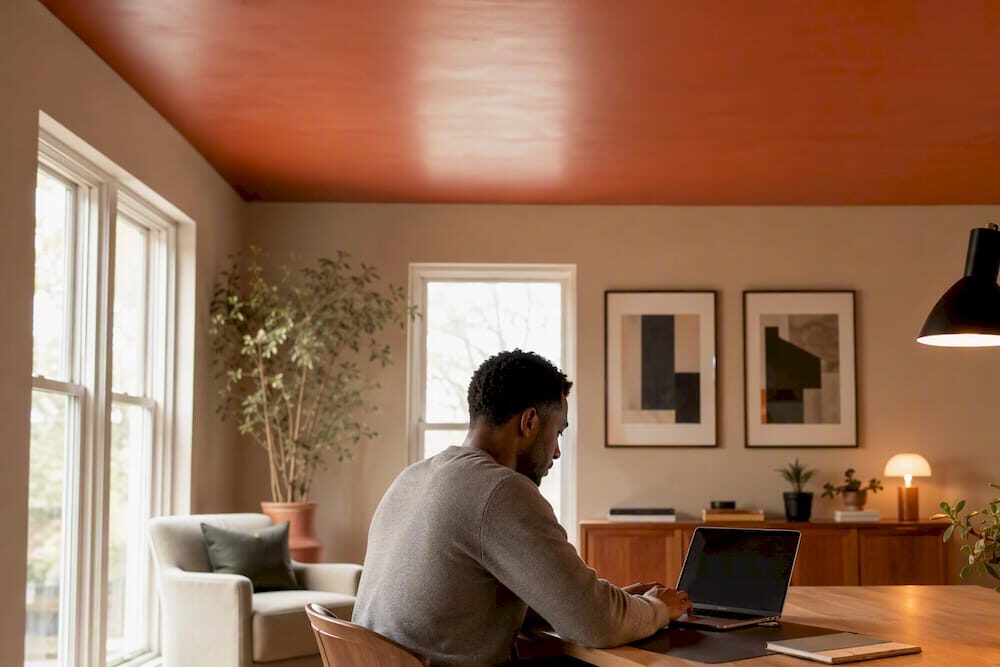
- In a dining room: since guests are usually seated, lower the center so the art reads correctly from a chair, not just from someone standing in the doorway.
Pro Tip: Cut a piece of kraft paper to your frame’s exact size, tape it to the wall, and live with it for a day before committing to a nail hole. It’s the fastest way to catch a proportion mistake before it’s permanent.
Anything mounted above a bed deserves rated anchors, not just a nail into drywall. Heavier framed pieces directly over where someone sleeps are one place you don’t want to guess on hardware. For more sofa-specific pairings and sizing examples, Artinlifestyle’s living room art guide walks through real room layouts.
How Do You Hang a Gallery Wall or Grouped Frames at the Right Height?
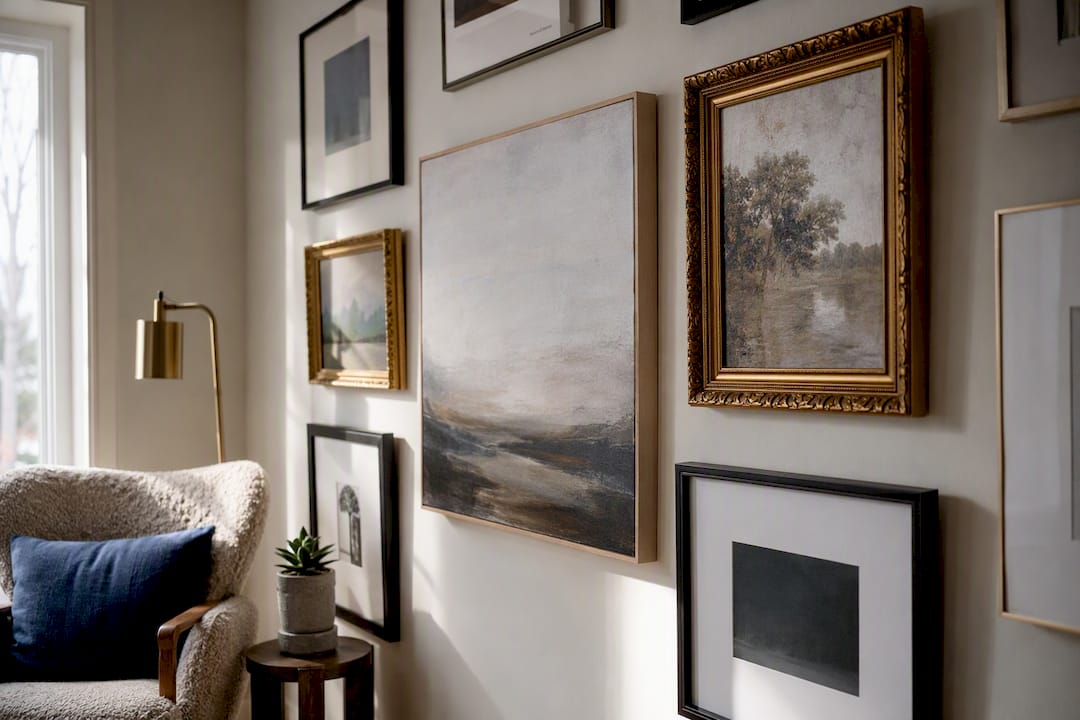
A cluster of frames should be treated as one large piece of art, not several small ones competing for their own eye-level spot. That means the entire group’s visual center, not each individual frame’s center, lands at 57 inches.
- Lay the full arrangement out on the floor first, and photograph it from above before you commit to spacing.
- Keep gaps between frames consistent, generally 2 to 3 inches, so the composition reads as unified rather than scattered.
- Calculate the bounding box of the whole cluster (its total height and width), find that box’s center point, and that’s the spot that goes at 57 inches on the wall.
- Transfer measurements from your floor layout directly to the wall using painter’s tape outlines, then convert to nail heights using the same formula from the previous section for each individual piece.
If the grouping hangs above a sofa or console, swap the 57-inch target for the furniture-based clearance rules instead, measuring up from the furniture rather than the floor. Artinlifestyle’s gallery wall layout guide has templates worth tracing if you want a tested starting arrangement rather than building one from scratch.
Do Staircases and Tall Ceilings Need a Different Height?
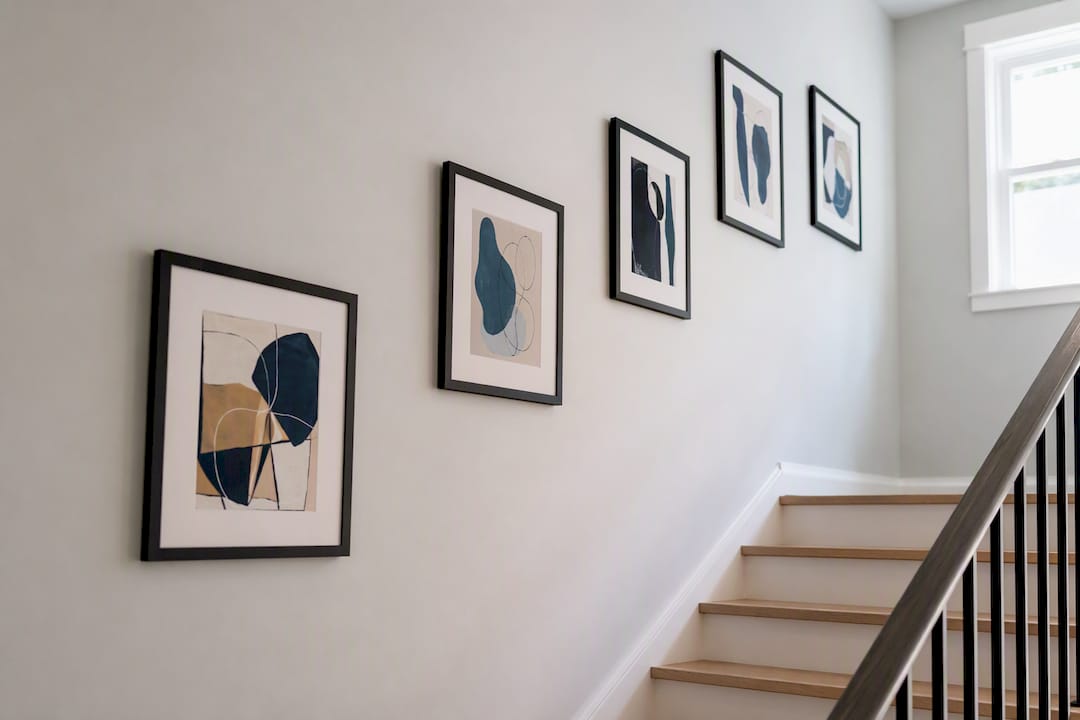
Stairwells break the single fixed-point rule because the floor itself is moving beneath each frame. Instead, measure 57 inches up from the step directly below each piece, not from the bottom of the staircase. Done consistently, the artwork climbs the wall in a clean diagonal that mirrors the stair’s pitch.
- Tall ceilings: resist the urge to simply raise the center height to fill the space; oversized pieces or stacked, layered arrangements read better than a single small frame floating too high.
- Seated rooms: dining rooms and reading nooks benefit from centers around 54 to 58 inches, since most viewing happens from a chair.
- Home offices: if a webcam is the primary way people will see your wall, center the art to the camera’s frame rather than to a standing eye-level mark.
Artinlifestyle’s oversized art guide covers scale choices for rooms with dramatic ceiling height.
What Tools and Steps Get the Height Right the First Time?
You need surprisingly little hardware to do this correctly: a tape measure, pencil, level (laser if you’re hanging more than two pieces), stud finder, appropriate anchors or hooks, and a hammer or screwdriver.
- Measure your frame’s total height and the distance from its top edge to the wire’s highest point, taut, not slack.
- Choose your target center height (57 inches, or a furniture/room-based exception), and run the formula: nail height = center + (frame height ÷ 2) − wire distance.
- Mark the wall lightly in pencil at that exact height.
- If you’re hanging more than one piece, use a level to keep every mark on the same horizontal line before you drive a single nail.
- Match your hardware to the frame’s weight. Small picture hooks handle light frames on drywall, while heavier pieces need rated anchors or a mount into a wall stud.
- Hang the piece, step back at least six feet, and photograph the wall. It’s often easier to spot a slightly off height in a photo than standing directly in front of it.
Pro Tip: Keep the pencil mark faint until you’ve stepped back and confirmed the height looks right in the room. A light mark erases; a nail hole doesn’t.
Why Does My Art Still Look Wrong After Hanging It?
Most complaints trace back to one of a handful of repeatable mistakes.
- Hung by the top edge instead of the center: always measure and mark to the frame’s center point, not its top.
- Wire measured slack instead of taut: if a piece sits noticeably higher than expected, remeasure the wire pulled tight and recalculate.
- Art too small for the furniture below it: rather than re-hanging at the wrong scale, either size up to a larger single piece or add flanking frames to build width.
- Heavy or valuable pieces on the wrong hardware: swap in rated anchors, or bring in a professional installer for anything irreplaceable.
A Note From Artinlifestyle’s Editorial Team
This guide draws on museum-standard placement practice and the same measuring procedures professional installers use daily. For more curated direction, browse Artinlifestyle’s gallery wall ideas, oversized art guide, and space-saving decor picks.
Want the Hanging Handled for You?
Not every homeowner wants to measure wire slack on a Saturday afternoon, and that’s a completely reasonable position to hold. If you’d rather hand off the curation and installation entirely, Artinlifestyle’s Art Concierge service pairs you with someone who handles selection, scale, and placement from start to finish, including the exceptions this guide covers for furniture, staircases, and grouped arrangements. It’s built for readers who want the museum-standard result without doing the math themselves.
Where the Conventional Hanging Advice Falls Short
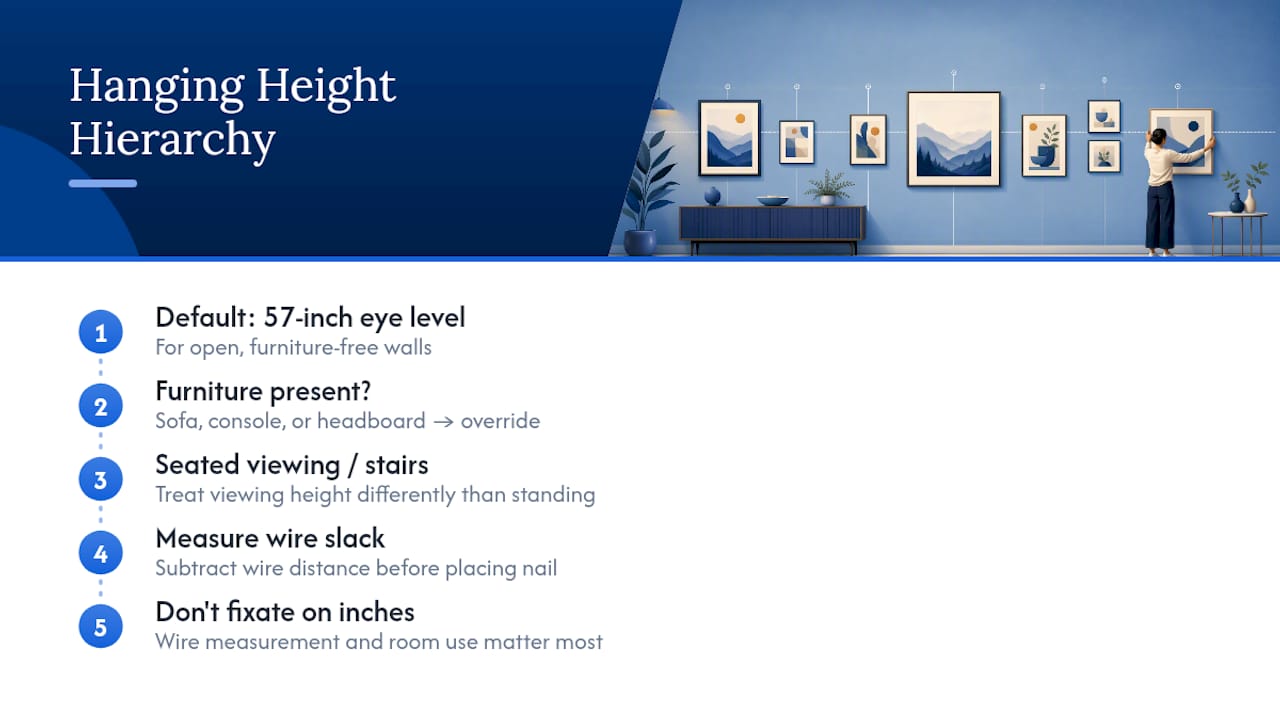
The 57-inch rule gets repeated everywhere, but most guides stop right there, as if a single number solves every wall in every house. It doesn’t. The rule was built for museum corridors where every visitor stands and every wall is empty of furniture. Most homes aren’t that. The moment a sofa, console, or headboard enters the room, 57 inches becomes the wrong target, and clinging to it is why so many living rooms have art floating awkwardly near the crown molding.
What the research actually supports is a hierarchy: use 57 inches as your default for open wall space, then override it the instant furniture, stairs, or seated viewing enters the equation. The arithmetic behind the nail placement matters more than people assume. Skipping the wire-distance subtraction is the single most common reason a “correctly measured” piece still hangs too high. Prioritize that calculation over agonizing between 57 and 60 inches. The exact inch matters far less than getting the wire measurement right and matching the height to how the room is actually used.
Frequently Asked Questions
What is the standard art hanging height?
The gallery standard is 57 to 60 inches from the floor to the center of the artwork, which approximates average standing eye level.
How do I calculate the correct nail height for a picture?
Add half the frame’s height to your target center height, then subtract the distance from the top of the frame to the wire’s peak when pulled taut.
How high should art hang above a couch?
Leave 6 to 8 inches between the top of the sofa back and the bottom of the frame, and size the art to about two-thirds to three-quarters of the sofa’s width.
Does the 57-inch rule apply to dining rooms?
Not exactly. Since dining room art is usually viewed while seated, drop the center height slightly to about 54 to 58 inches.
How do you hang art on a staircase?
Measure 57 inches up from the step directly below each frame, rather than from the bottom of the stairs, so the pieces follow the stair’s diagonal line.
Sources
For deeper reference, Austin Gallery’s placement guide walks through the full nail-height arithmetic, while Print Studio’s room-by-room chart covers stairwells and seated spaces in more detail. A free online calculator can compute your exact hook placement once you input frame height and wire distance. For inspiration and product pairings, revisit Artinlifestyle’s gallery wall templates and living room styling guide.
- How High to Hang Art: The 57-Inch Rule and Every Exception
- How High to Hang Wall Art: The 57-Inch Rule + Room Chart
- How High To Hang Pictures (Guide For The Perfect Height)