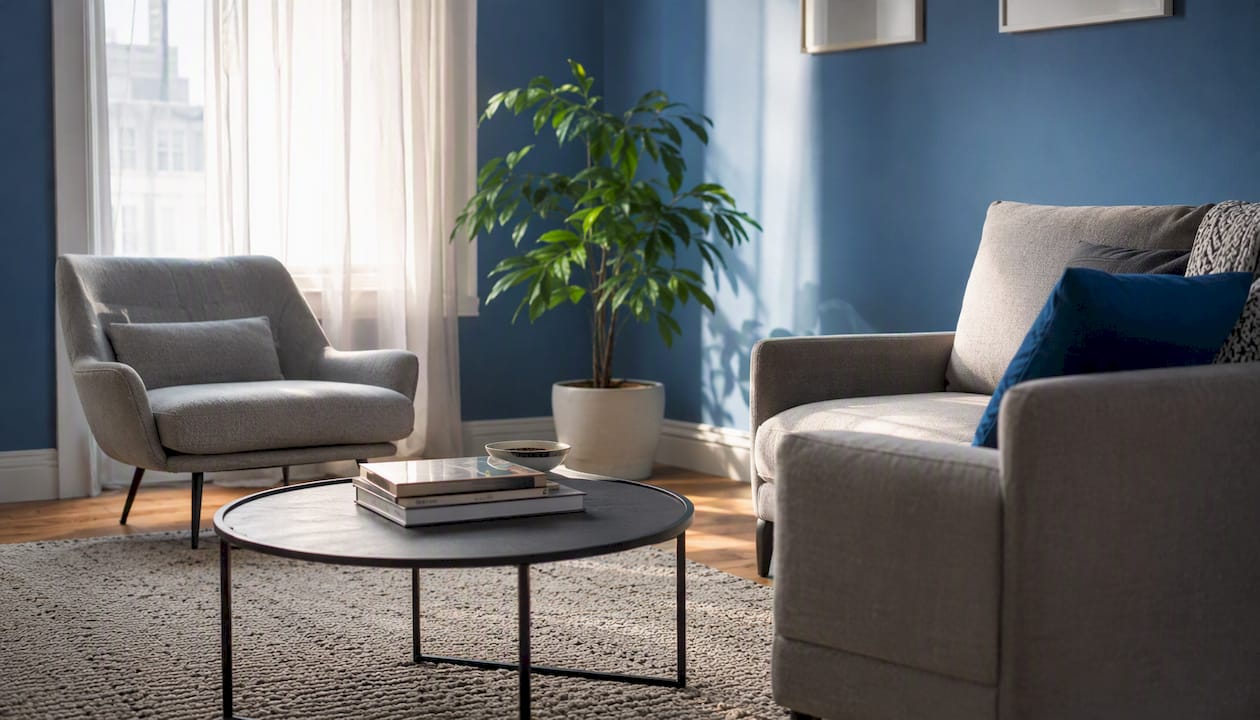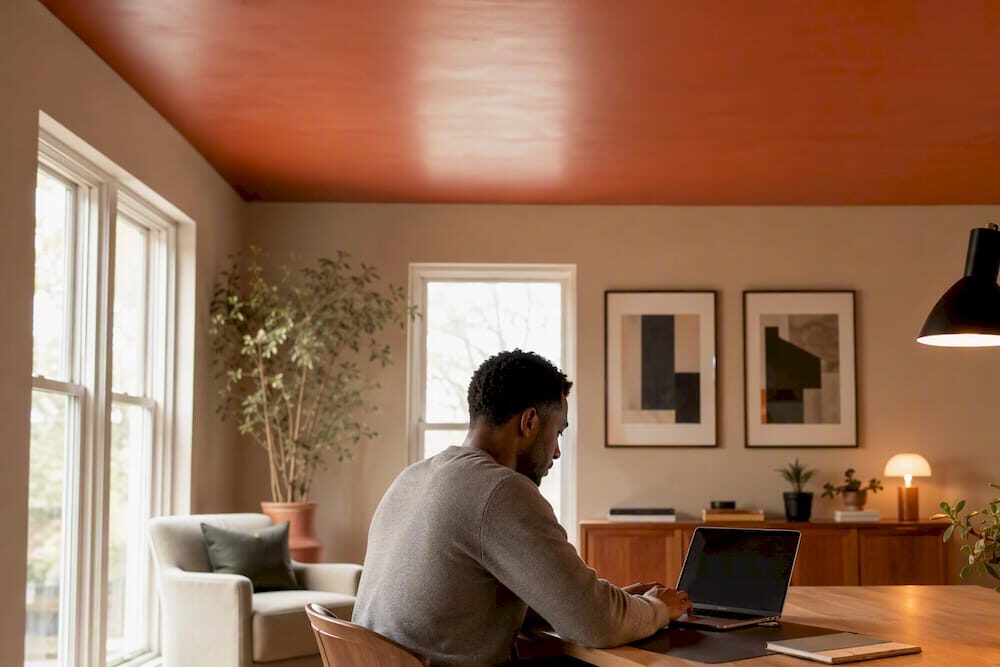
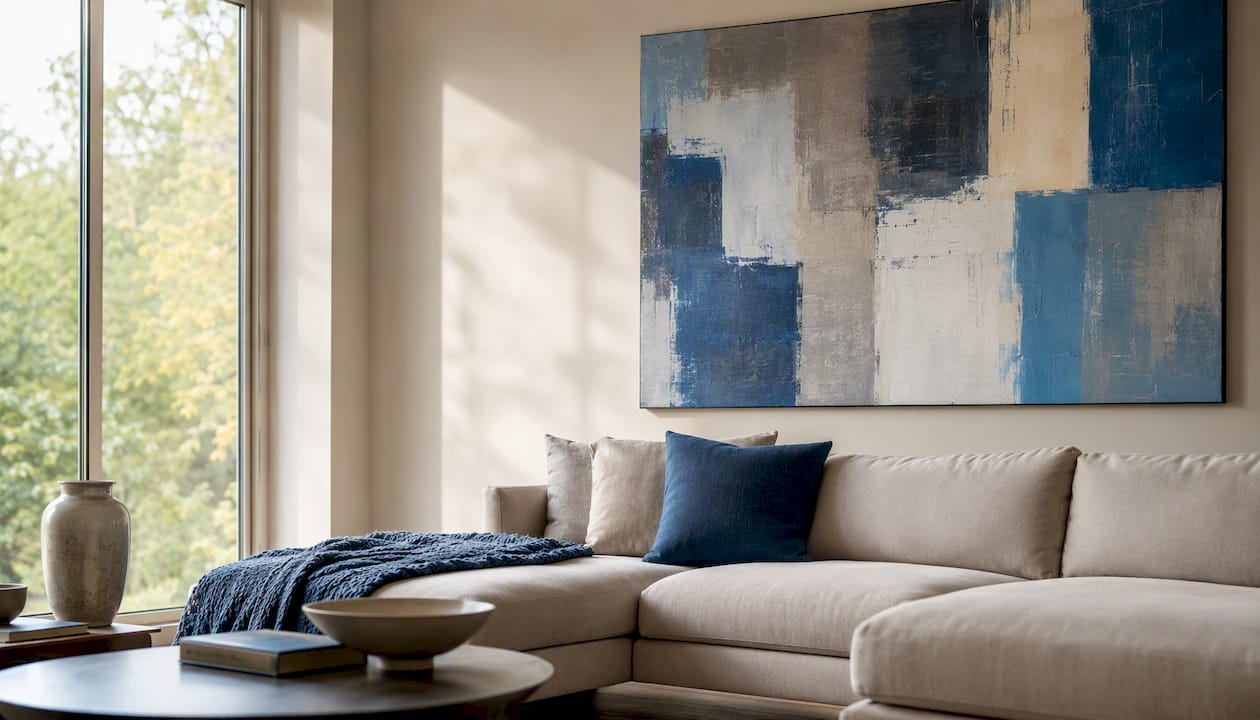
A single well-sized focal piece or a planned gallery wall will finish most living rooms. Before you buy anything, run three quick checks: measure the wall and the furniture beneath it, select a color from your existing palette to match it, and decide on a medium (print, canvas, textile, or original). This helps avoid buyer’s remorse
Start here — your 10-minute pre-purchase checklist:
- Measure the sofa or console width; your art should span a large portion of it
- Note the dominant and accent colors already in the room
- Decide whether you want one statement piece or a curated group
- Set a budget range before you browse (prints start around $30; originals can run into the thousands)
- Choose a hanging method suited to your walls (renters: picture ledges or leaning art)
Key Takeaways
A single well-sized piece or a planned gallery wall, sized to 60–75% of the furniture beneath it and centered at 57–60 inches from the floor, will resolve most living rooms confidently.
| Point | Details |
|---|---|
| Size to furniture, not the wall | Art width should span 60–75% of the sofa or console beneath it. |
| Center at eye level | Hang art so its center sits 57–60 inches from the floor, with a 6–8 inch gap above furniture. |
| Echo one color | Pick one color from the art and repeat it in a pillow, rug, or accessory to make the piece feel chosen. |
| Commit to one bold piece | A single confident statement reads as curated; a wall of small, cautious prints reads as indecision. |
| Artinlifestyle Art Concierge | For managed sizing, sourcing, framing, and installation, the Art Concierge handles every step. |
Table of Contents
- Living room art ideas that work in real homes
- How to pick the right art for your living room
- How to plan and hang a gallery wall without the guesswork
- Mixing mediums, frames, and textures for a cohesive display
- Where to buy or source living-room art
- Budget and timeline expectations for living-room art
- Designer insight: making living-room art reflect who you are
- Lighting your living-room art for maximum impact
- An editorial note on choosing art with intention
- The Artinlifestyle Art Concierge takes the guesswork out of sourcing
- Sources
Living room art ideas that work in real homes
Ten ideas follow below, each with a clear use case so you can match the concept to your actual room rather than just your mood board.
1. Oversized statement canvas
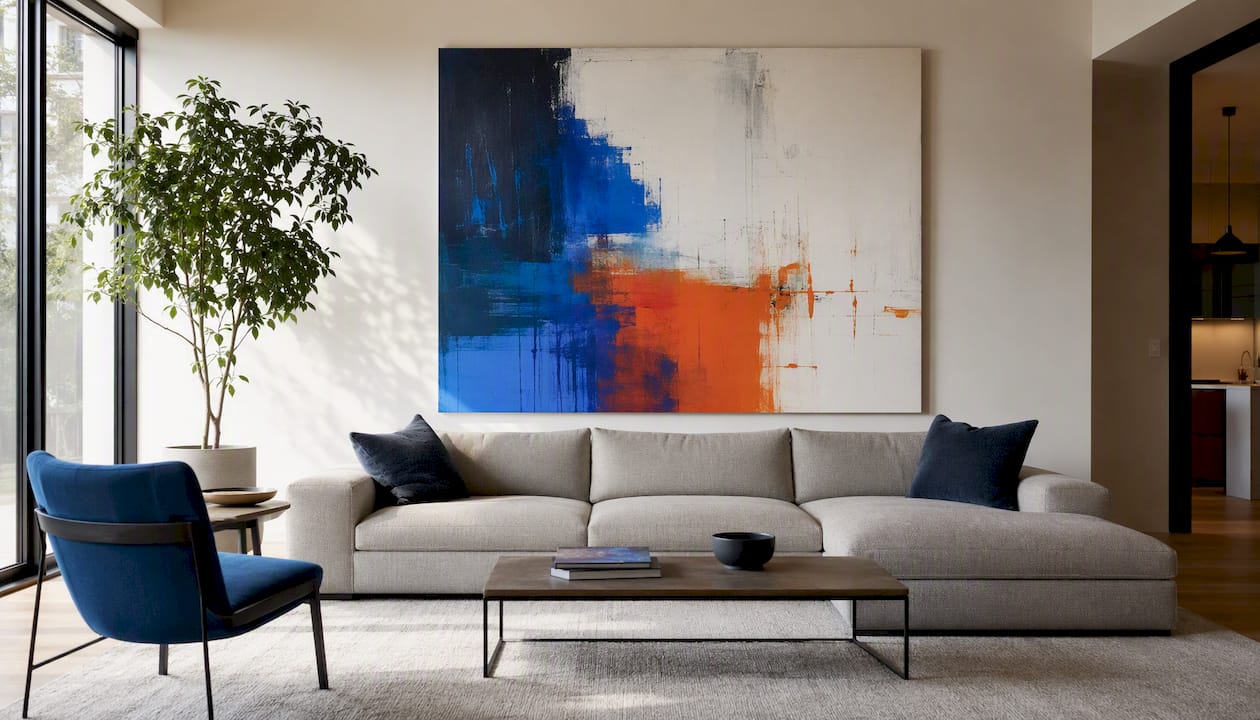
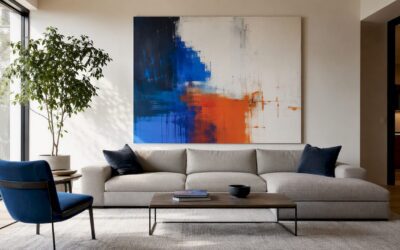
One large canvas, hung centered above the sofa, anchors the entire room. Designers consistently recommend sizing up rather than down and favoring horizontal or square formats above wide furniture. A 48×32-inch piece suits most standard sofas; a 60×40 fits a large sectional. Abstract expressionism and landscape photography both work well here because they read clearly from across the room.
2. Curated gallery wall
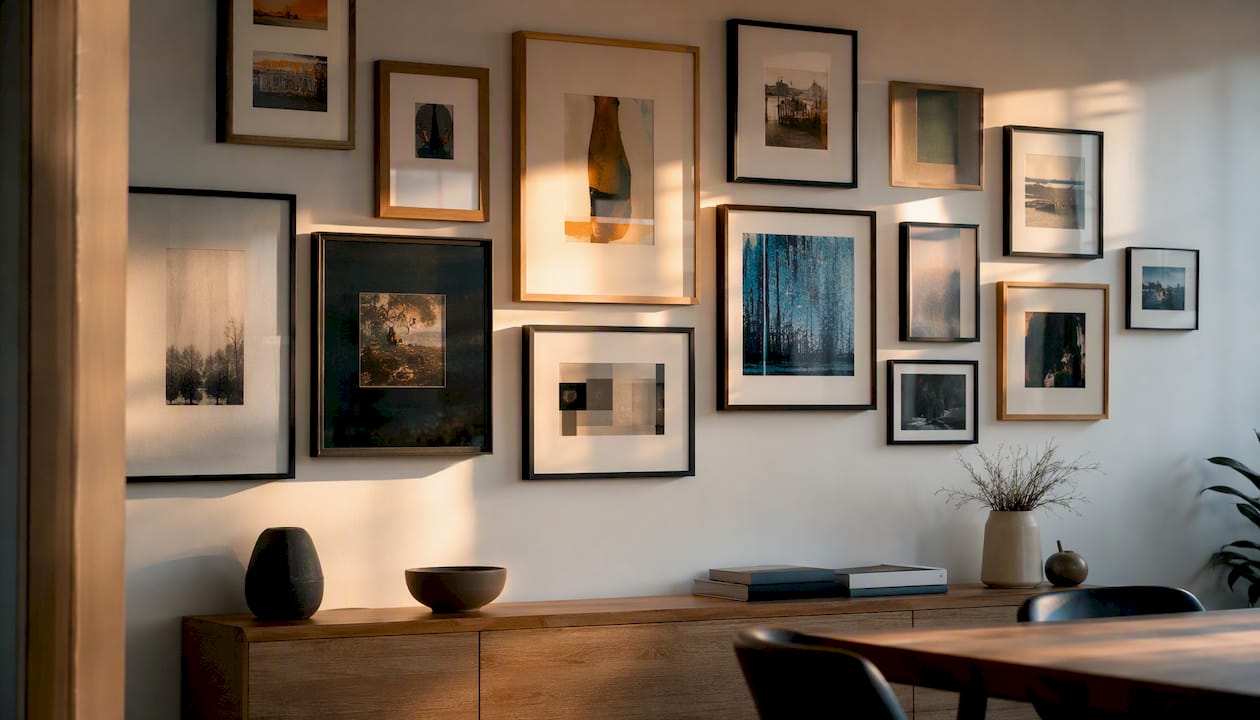
A gallery wall lets you tell a layered story with multiple pieces. It suits rooms with a long, unbroken wall and works especially well in eclectic or transitional interiors. Keep frames in one or two finishes to prevent visual noise, and leave 2–3 inches between each piece. For a deeper look at layout templates, the gallery wall guide on Artinlifestyle covers organic, grid, and ledge arrangements with measurements.
3. Triptych or matched set
Three panels of the same image or a coordinated series create movement across a wall without the complexity of a full gallery wall. Best for narrow rooms or above a long, low console. Space panels 2–4 inches apart so they read as a set rather than three separate pieces.
4. Textile wall hanging
Woven tapestries, macramé, and fiber art add warmth and acoustic softness that flat prints simply cannot. Textural art in warm neutrals is particularly strong in bohemian, Scandinavian, and organic-modern rooms. Hang from a wooden dowel or a slim brass rod to keep the look intentional. Society6 and Minted both carry curated textile options at accessible price points.
5. Sculptural wall piece
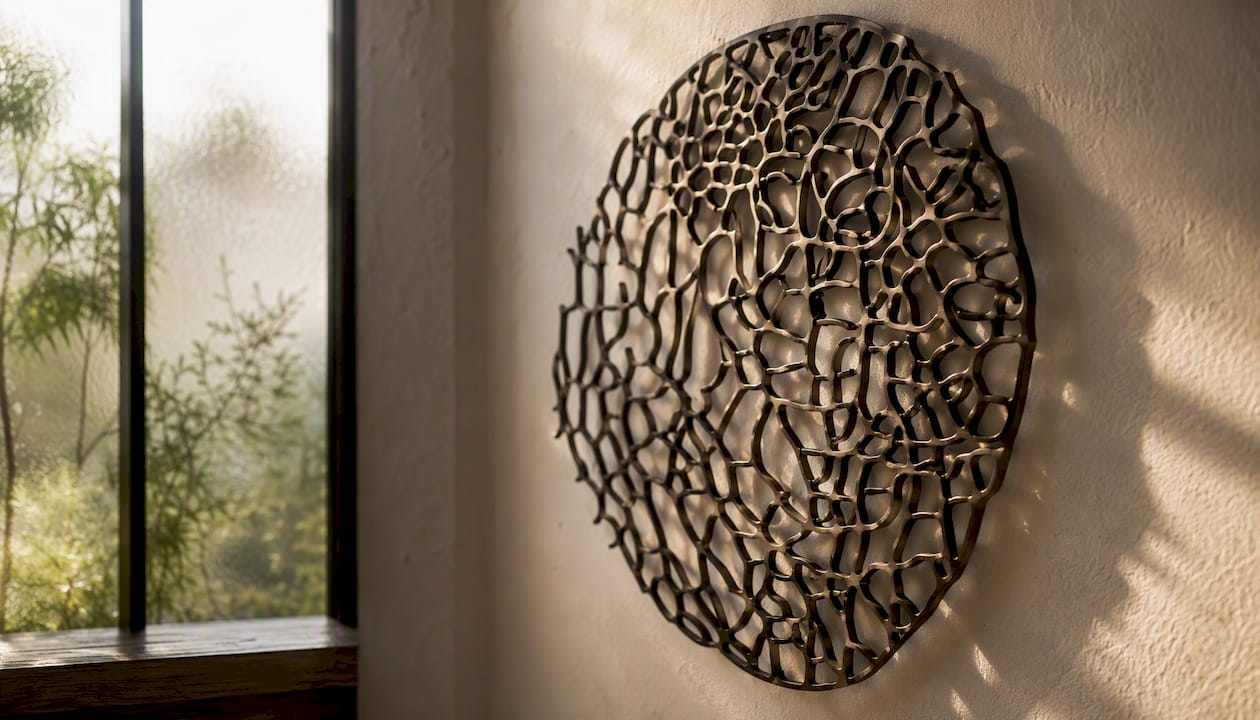
Metal wall sculptures, ceramic relief panels, and carved wood pieces cast shadow and catch light in ways that change throughout the day. They suit minimalist and contemporary rooms where a flat print would feel too expected. Mount at the same center-height rule (57–60 inches from floor to center) as any other piece.
6. Black-and-white photo grid
A tight grid of four to nine black-and-white photographs reads as a single cohesive unit and works in almost any color scheme because it introduces no competing hues. Best for modern, industrial, or transitional rooms. Print at a consistent size (8×10 or 11×14) and use identical frames for a clean result. Big Wall Décor offers oversized photographic prints if you want to scale the concept up dramatically.
7. Floating-shelf vignette
Picture ledges let you layer small framed prints, ceramics, and objects without committing to wall holes. This is the most renter-friendly approach and suits small living rooms where a single large piece might overwhelm. Leaning art and picture ledges are consistently recommended for renters who want a polished result without permanent installation.
8. Framed botanical or nature sets
A pair or trio of framed botanicals, birds, or landscape studies brings organic calm to a room. They suit traditional, cottagecore, and transitional interiors. Artfully Walls curates artist-designed botanical prints with framing options, making it straightforward to order a matched set.
9. Leaning artwork
Leaning a large canvas or framed print against the wall reads as deliberately casual and works in loft-style, bohemian, or contemporary rooms. It also solves the renter problem entirely. Size matters more here than in hung arrangements: go large (at least 36 inches tall) so the piece doesn’t look like it’s waiting to be hung.
10. Statement mirror as art
An oversized mirror with a sculptural frame functions as both art and light amplifier. It suits small or dark living rooms where a painting would absorb light rather than reflect it. Pair with a picture light above for maximum effect.
Pro Tip: When choosing between a textile and a flat print, default to the textile in rooms that already have hard surfaces (concrete, tile, glass). The fiber absorbs sound and adds visual warmth that no print can replicate — texture beats color in acoustically live spaces.
How to pick the right art for your living room
Scale, color, and style are the three levers. Get all three right and almost any piece will work. Miss one and even expensive art can look wrong.
Sizing rules at a glance
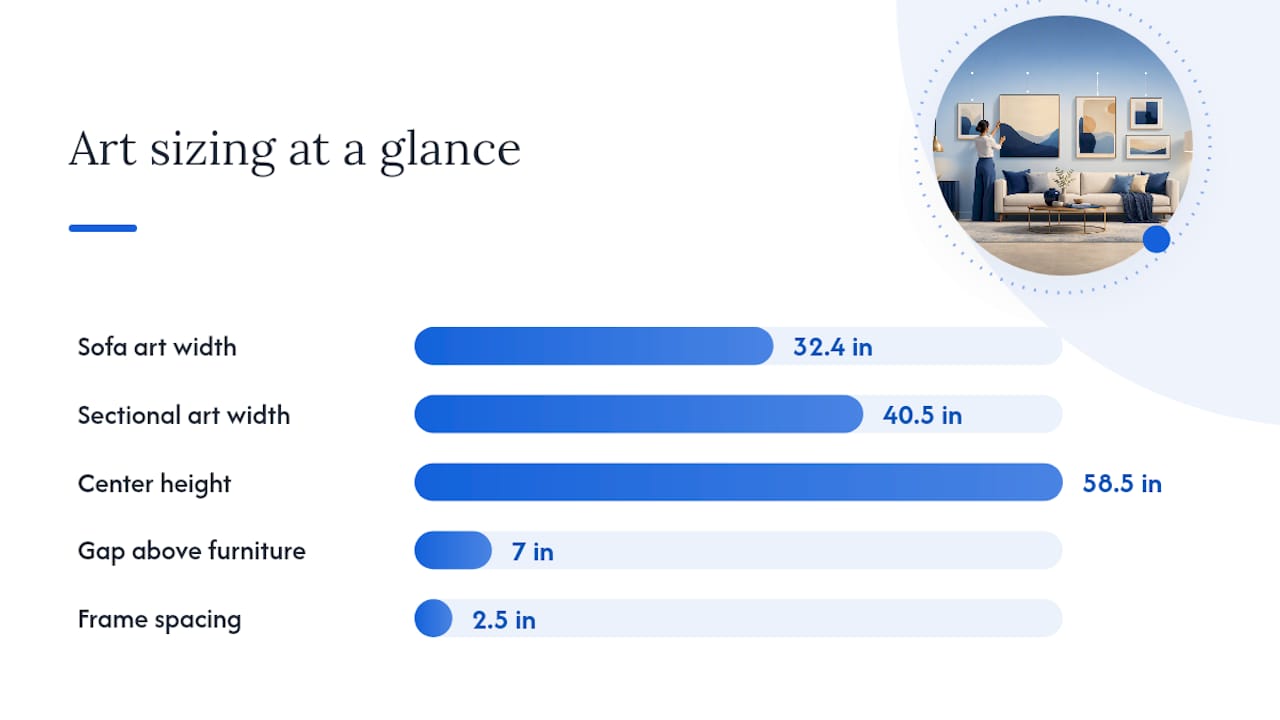
Measurable placement rules give non-designers a reliable starting point. The table below puts the key numbers in one place.
| Rule | Target measurement | Notes |
|---|---|---|
| Art width relative to furniture | 60–75% of furniture width | Two-thirds is the most-cited benchmark |
| Center height from floor | 57–60 inches | Eye-level standard used by most galleries |
| Gap above furniture | 6–8 inches | Bottom of frame to top of sofa or console |
| Spacing between frames | 2–3 inches | For gallery walls and grouped arrangements |
| Common sizes: standard sofa | 48×32 inches | Reference size from Fine Art Canvas |
| Common sizes: large sectional | 60×40 inches | Scale up for sectionals and wide walls |
Color matching
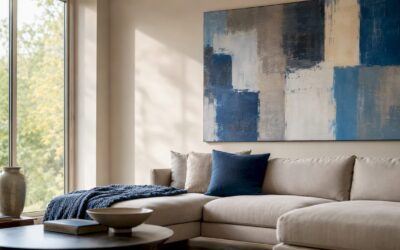
Pick one color from the art and echo it somewhere in the room — a throw pillow, a vase, a rug accent. That single repetition is what makes art feel chosen rather than placed. Neutral rooms (white, greige, warm gray) can handle high-contrast pieces without tension. Rooms with strong existing color need art that either shares that palette or sits in a complementary position on the color wheel.
Style-fit questions
Three questions narrow the field quickly:
- What is the room’s brief? Relaxed and conversational, or composed and formal? Casual rooms absorb eclectic mixes; formal rooms reward restraint.
- How does natural light move through the space? North-facing rooms benefit from warm-toned art; south-facing rooms can handle cooler, more graphic work.
- How much maintenance are you willing to do? Unframed canvas and metal pieces need almost none; paper prints behind glass need occasional cleaning; textiles can attract dust.
Pro Tip: Before committing to a style, photograph the room in its current state and upload the image to Artfully Walls or Minted’s room visualizer. Seeing a piece to scale on your actual wall eliminates most hesitation.
How to plan and hang a gallery wall without the guesswork
A gallery wall looks spontaneous but works best when it’s mapped before a single nail goes in.
Step-by-step hanging plan
- Collect and photograph every piece you plan to include; note each frame’s exact dimensions.
- Lay the arrangement on the floor to test the composition before touching the wall.
- Trace each frame onto kraft paper, cut out the shapes, and tape them to the wall with painter’s tape.
- Mark the nail or hook position on each paper template before removing it.
- Hang the center piece first at 57–60 inches from floor to center, then work outward.
- Check spacing with a ruler as you go: 2–3 inches between frames keeps the arrangement tight without crowding.
Layout templates by sofa width
| Sofa width | Recommended template | Total arrangement width | Notes |
|---|---|---|---|
| — | Grid (2×3 or 3×2) | 48 inches | Clean, symmetrical; suits modern rooms |
| — | Organic cloud | 57–60 inches | Mix of sizes; suits eclectic rooms |
| — | Two-row ledge | 64–— | Picture ledges; renter-friendly, easy to restyle |
Pro Tip: For the organic cloud layout, anchor the arrangement with the largest piece slightly left or right of center rather than dead center. Off-center anchoring reads as curated rather than formulaic — a detail that separates designer-level gallery walls from DIY ones.
Renters can replicate any of these layouts using picture ledges or removable adhesive strips rated for the frame weight, keeping the arrangement fully portable.
Mixing mediums, frames, and textures for a cohesive display
The fastest way to make a mixed display look intentional is to repeat one material across the room. Choose either a metal tone (brass, matte black, brushed nickel) or a wood tone (walnut, oak, white-painted) and use it in at least two of the frames. Everything else can vary.
- Frames: Mix profiles (thin, chunky, ornate) within one finish family. A thin brass frame next to a wider brass frame reads as collected; a brass frame next to a chrome frame reads as accidental.
- Textiles and 3D pieces: Use these to break up a wall of flat prints. One woven piece or sculptural element among five framed prints adds depth without chaos. Current trends favor woven pieces and textured canvases in warm neutrals as counterpoints to flat graphic work.
- Canvas vs. paper prints: Canvas tolerates humidity better and needs no glass, making it easier to maintain. Paper prints behind glass offer sharper detail and suit photography and fine-line illustration. Metal prints are the most durable and suit contemporary and industrial rooms.
- Lighting by medium: Direct picture lights work for canvas and metal; avoid them on paper prints behind glass, where the glare obscures the image. Indirect ambient lighting (uplights, recessed spots angled at the wall) works for all mediums.
For rooms where the wall treatment itself is part of the composition, the accent wall guide on Artinlifestyle covers painted backdrop strategies that complement rather than compete with art.
Where to buy or source living-room art
Different sourcing paths suit different budgets, timelines, and tastes. Here is a practical map.
- Curated online shops (Artfully Walls, Minted, Big Wall Décor): Best for framed, ready-to-hang prints with artist credentials and sizing guides. Artfully Walls features a room visualizer; Minted offers artist-designed work with custom framing; Big Wall Décor specializes in oversized formats. Check return policies before ordering large pieces.
- Print-on-demand marketplaces (Society6): Best for affordable, trend-driven prints in a wide range of styles. Quality varies by seller; request a sample or check buyer reviews for paper weight and color accuracy before committing to a large size. High-quality printable art looks premium when printed at the correct resolution on good paper and properly matted.
- Visual inspiration and moodboarding (Pinterest): Not a shop, but the fastest way to identify a style direction before spending money. Pinterest boards dedicated to living room wall art offer thousands of real-room examples organized by style and layout.
- Local galleries and art fairs: Best for originals and limited editions with direct artist relationships. Prices are higher, but provenance is clear and the work is unique. Ask the gallery for a loan or approval period if they offer one.
- Direct from artists (Instagram, Etsy, artist websites): Best for commissioned originals and one-of-a-kind pieces. Confirm the artist’s turnaround time, shipping method, and whether they offer a certificate of authenticity. Features like the Cameron Limbrick abstract art profile on Artinlifestyle show what to look for in an artist’s portfolio.
Budget and timeline expectations for living-room art
Knowing what things cost before you fall in love with a piece saves considerable frustration.
To reduce cost or lead time:
- Choose standard sizes (8×10, 11×14, 16×20, 24×36) — custom sizes add cost at every step
- Order unframed and frame locally; a local framer often beats online framing on both price and speed
- Download a digital file and print at a local print shop for same-week turnaround
- Buy from a retailer with free returns on large pieces so you can test scale in the room
Designer insight: making living-room art reflect who you are
The living room is where personality meets guests, which is precisely why art choices there carry more weight than in any other room.
The practical implication: anchor your art choices on one recurring element — a color, a subject matter, or a texture — and let that thread run through every piece in the room. A collector who loves botanical illustration and warm terracotta tones will produce a more coherent room than one who buys whatever looks good in isolation. The thread doesn’t need to be obvious; it just needs to exist.
Pro Tip: For guest-facing rooms, designers recommend committing to at least one bold piece rather than playing it safe with small, inoffensive prints. A single confident choice reads as curated; a wall of cautious small prints reads as indecision. The Jonathan Adler collection coverage on Artinlifestyle is a good reference for what bold-but-cohesive looks like in practice.
Lighting your living-room art for maximum impact
Art that is poorly lit can look flat, dull, or simply invisible after dark. Lighting is the detail most homeowners skip and most designers consider non-negotiable.
Picture lights (small fixtures mounted directly to the frame or wall above a piece) are the most targeted option. They suit single statement pieces and originals. Choose a warm white bulb (2700–3000K) to avoid the clinical look of cool light on warm-toned art.
Recessed adjustable spotlights angled at 30 degrees from the wall illuminate art without glare and suit gallery walls where a single picture light would be impractical. If your ceiling has recessed cans, repositioning them toward the art wall is often the highest-impact, lowest-cost lighting upgrade available.
Track lighting offers flexibility for renters and for rooms where the art arrangement changes. A single track with adjustable heads can cover a full gallery wall and be redirected when pieces move.
Avoid placing art directly opposite a window where afternoon sun will hit the surface. UV exposure fades pigments in paper prints and textiles over time. If the room gets strong direct light, use UV-filtering glass on framed pieces or position art on the perpendicular wall instead.
An editorial note on choosing art with intention
The ideas in this guide were chosen because they work across a wide range of rooms, budgets, and design sensibilities — not because they are trendy. The sizing rules, the one-color echo principle, and the advice to commit to at least one bold piece are the same principles that appear in trade publications and designer interviews year after year because they reflect how the eye actually reads a room.
Artinlifestyle covers art and interior design from the perspective of people who live with these choices, not just photograph them. The home tours and design features on the site show these principles applied in real rooms, which is often more useful than a mood board.
The Artinlifestyle Art Concierge takes the guesswork out of sourcing
Finding the right piece at the right size, getting it framed, and hanging it correctly are three separate problems — and most homeowners hit a wall (so to speak) at the framing or installation stage.
The Art Concierge service at Artinlifestyle handles all three. You describe the room, the wall, and your budget; the concierge team identifies pieces to scale, confirms framing options, and coordinates installation. There is no hunting through marketplaces, no guessing whether a 48×32 will look right above your specific sofa, and no managing three separate vendors. The service is designed for homeowners who want a finished result rather than a project. Book a consultation on the Art Concierge page to get a gallery mockup for your room.
Sources
A short list of trusted resources for visual inspiration, technical rules, and purchasing guidance:
- Living Room Wall Decor Ideas: Layouts, Rules & Trends (2026 Guide) – Orenjihome
- 16 Living Room Wall Art Ideas That Add Personality and Style – DecorBeam
- Living Room Wall Art Guide: Size, Style & Placement Tips | Fine Art Canvas
- 46 Wall Art Ideas for Your Living Room in 2026 | Living Spaces