
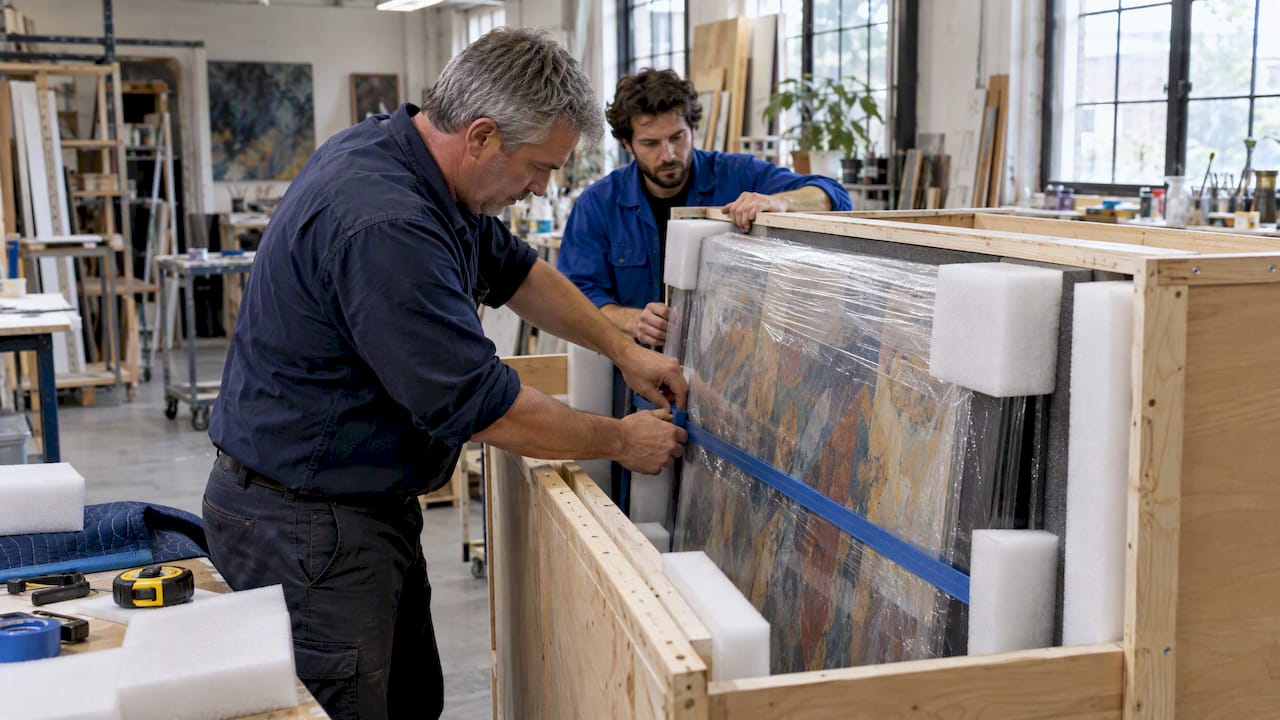
Pack from the art outward: glassine against the surface, cushion, add corner protection, then double-box or crate, and insure for full value. This sequence, standard among galleries and professional shippers, protects against the two real threats in transit: impact and movement. Pieces over 48 inches on any side generally need a wooden crate, and carrier choice shifts once a work is oversized or high-value. If you need to act in the next ten minutes, jump to the quick-start checklist below.
TL;DR:
- Proper packaging layers, including glassine, bubble wrap, and corner protectors, are essential to prevent impacts and movement during transit.
- Oversized or high-value artworks over 48 inches require crate construction with foam-lined interiors and forklift-ready skids, not just reinforced boxes.
- Dimensional weight calculations often increase shipping costs for bulky packages, especially when crating or excessive padding is involved.
- Insure artworks for full value, photograph the piece before packing, and require signature upon delivery to support damage claims.
- Hiring a specialist shipper is advisable for high-value, oversized, or complex pieces to ensure proper handling, climate control, and customs clearance.
Table of Contents
- Quick start checklist for shipping a piece right now
- Materials and tools: what to buy and why each item matters
- Step-by-step packing for framed paintings and framed works
- Packing prints, photographs and rolled works: when to roll and when to ship flat
- Packing sculptures and oversized or irregular pieces; when to crate
- Choosing a carrier, calculating cost (DIM weight) and insurance
- Climate, drying, and timing: avoid heat, humidity and shipping too soon
- Documentation, labeling and proof: photos, condition report and label placement
- When to hire a specialist: white-glove art shippers and what they do
- Publisher perspective and E-E-A-T: how we support readers
- Author perspective: a concise studio-to-shipper checklist
- Art Concierge and curated Store Finds: how we can help
- FAQ
- Sources
Quick start checklist for shipping a piece right now
Before you reach for tape, gather what you need and confirm the basics. A few minutes of preparation now prevents a damaged corner or a denied claim later.
- Gather glassine, bubble wrap, corner protectors, tape, and the right boxes before you start.
- Measure the piece on all sides and photograph it, front and back, in good light.
- Decide whether it ships flat, rolled, or crated based on size and medium.
- Mark the declared value on the shipping label and request signature on delivery.
- Do a shake test: if anything rattles or shifts, it isn’t packed correctly yet.
- Photograph the finished package with a ruler beside it, plus the shipping label.
If you’re short on time or the piece is large and valuable, skip the DIY route and book a local packing service or white-glove pickup instead. We cover that trade-off later in this guide.
Materials and tools: what to buy and why each item matters
Every layer in a shipping package does a specific job. Skip one and you’ve left a gap for damage to find.
- Glassine sits directly against the painted or printed surface because it’s breathable and won’t stick or imprint the way plastic or bubble wrap can when placed right on the art.
- Bubble wrap goes outside the glassine with bubbles facing out, so the cushioning absorbs shock before it reaches the frame.
- Foam sheeting and rigid backing boards add rigidity against bending, especially for unframed or lightly stretched canvases.
- Corner protectors slip over each corner before boxing, since corners take the brunt of drops and shelf collisions.
- Tape and H-taping seal every seam; a proper H-pattern on the box flaps resists popping open under pressure.
- Telescoping picture boxes, double-wall corrugated boxes, and mailing tubes each suit a different format, and art supply stores or packing specialists typically stock the right sizes.
Pro Tip: Buy corner protectors a size larger than you think you need. A snug fit on the corner defeats the purpose of the cushion.
Step-by-step packing for framed paintings and framed works
Framed pieces fail in transit for one of two reasons: the surface gets scuffed, or the frame shifts and the corners take a hit. This sequence addresses both.
- Lay glassine directly over the painted or printed surface to create a breathable barrier.
- Wrap bubble wrap around the whole piece with the bubbles facing outward, adding a cardboard face board over the front if the frame is shallow.
- Slide corner protectors onto all four corners. Corners are the single most common failure point in framed-art shipments, since box edges absorb most impact there.
- Place the wrapped piece into a snug inner box, then set that inner box inside an outer box with 2 to 3 inches of fill on every side. This box-in-box method is the standard professional approach for absorbing drop and stacking energy.
- Seal every seam with H-taping and attach clear labels on at least two sides.
- Shake the sealed box gently. No rattle, no shift means it’s ready; any movement means you reopen and re-cushion.
For glazed works, you have two options: tape an asterisk pattern across the glass to contain shards if it breaks, or remove the glazing entirely and pack it flat and separately, which avoids pressure cracks altogether. If you’re unsure which framing setup suits your next shipment, our framing styles guide walks through glazing choices in more detail.
Packing prints, photographs and rolled works: when to roll and when to ship flat
Format drives the decision here, not personal preference. Get this wrong and you risk permanent creases or cracked emulsion.
- Roll unstretched canvases and many posters face-out around a wide core, at least 3 to 4 inches in diameter, with a glassine interleaf protecting the surface.
- Ship fine art prints and photographs flat whenever possible: a protective sleeve, rigid backing board, and a flat mailer labeled DO NOT BEND on both sides.
- Add a moisture barrier layer inside the packaging for humid shipping routes, since trapped moisture is as damaging as a dent.
- Cap both ends of any shipping tube and tape the caps in place so the roll can’t slide out during handling.
Rolling suits works on paper that tolerate gentle curvature; it’s the wrong call for anything with thick paint or a brittle surface, which should always ship flat or framed.
Packing sculptures and oversized or irregular pieces; when to crate
Sculptures and large canvases introduce a different set of risks: projecting elements, uneven weight distribution, and surfaces that can’t tolerate a snug box.
- Measure the piece’s full projection, not just its footprint, and identify the most fragile points before choosing packaging.
- Once any side exceeds the 48-inch wooden-crate threshold that most carriers and marketplaces require, plan for a crate rather than a reinforced box.
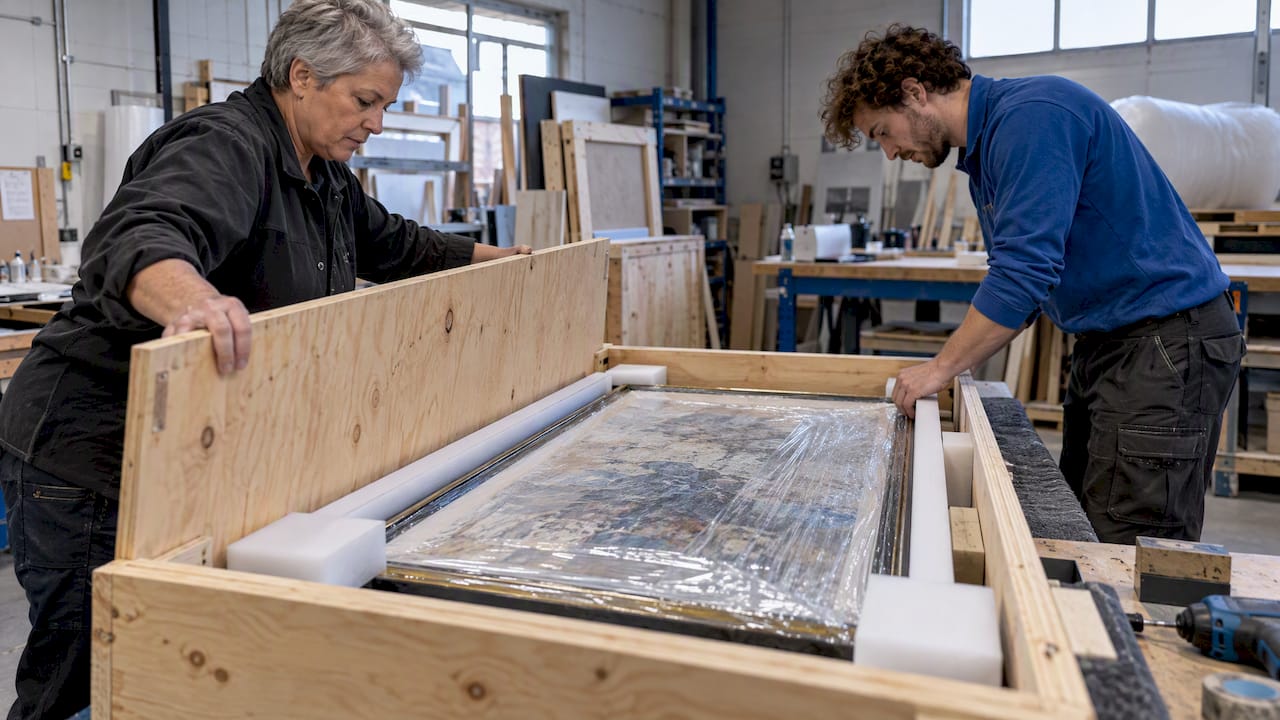
- Build crates with skids for forklift handling, foam-lined interior cavities shaped to the piece, a removable lid for inspection, and moisture sealing on seams.
- Seat heavy pieces so their weight rests on a stable base inside the crate, never hanging from straps or foam alone.
- For freight-class shipments, palletize the crate and book white-glove service rather than a standard parcel pickup.
If you’re shipping an oversized piece for the first time, our oversized art ideas roundup also covers how these pieces get handled once they arrive.
Pro Tip: When in doubt about whether a crate is required, measure the longest side including any frame lip or base. That number, not the canvas size alone, determines the threshold.
Choosing a carrier, calculating cost (DIM weight) and insurance
Carriers don’t charge by actual weight alone. They use dimensional weight: length times width times height in inches, divided by a divisor such as 139, and you pay whichever is higher, actual or dimensional. A bulky, well-cushioned box can cost more to ship than a heavier but more compact one, which is one reason oversized packaging needs planning, not just extra tape.
| Shipment type | Typical carrier fit | Insurance approach |
|---|---|---|
| Small to medium framed work | USPS, UPS, or FedEx, packed to standard | Declared value plus signature on delivery |
| Oversized, fragile, or very high-value work | Specialist fine-art shippers | Separate fine-art transit insurance |
Parcel carriers handle small and medium framed pieces reliably when packed to the standards above. Once a piece is oversized, climate-sensitive, or carries a high appraised value, a specialist shipper’s crating and insurance coverage are worth the added cost. Either way, require a signature on delivery and keep the proof of that requirement with your shipping receipt.
Climate, drying, and timing: avoid heat, humidity and shipping too soon
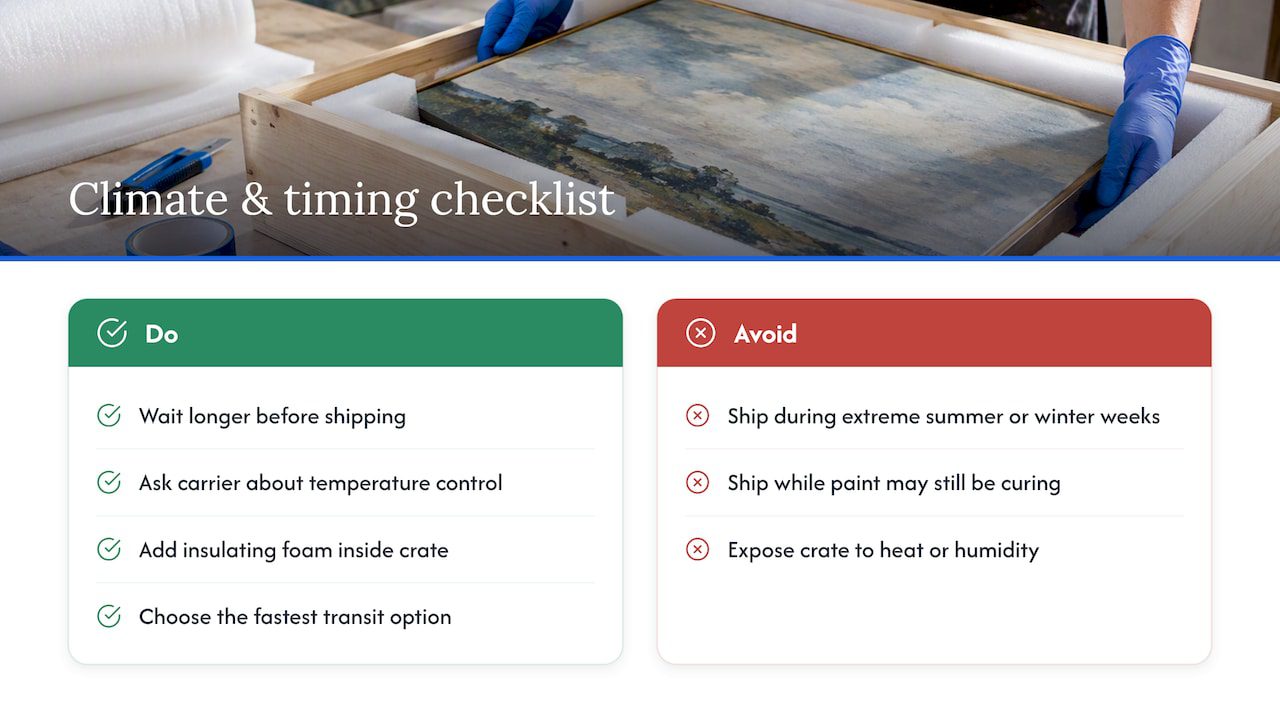
A painting that feels dry to the touch may still be curing underneath, and heat or humidity exposure during transit can soften those partially cured paint films even when the surface seems set. Wait longer than feels necessary before shipping a recently finished oil painting.
For long-haul or seasonal routes, ask your carrier about temperature-controlled transport, or add insulating foam layers inside the crate yourself. Shipping during extreme summer or winter weeks raises risk, and choosing the fastest available transit option simply reduces the window during which temperature and humidity can do damage.
Documentation, labeling and proof: photos, condition report and label placement
Good documentation is what turns a shipping mishap into a resolved claim instead of a dispute.
- Photograph the piece from multiple angles, including detail shots of any existing wear, before it goes into the box.
- Photograph the sealed package with a ruler beside it and the shipping label visible, since carriers and marketplaces may require this proof for damage or DIM-weight disputes.
- Write a brief condition report noting any existing marks, and store it with your receipts and appraisal.
- Label the box Fragile, This Side Up, with a clear return address, and cover or remove any old shipping labels.
Keeping timestamped photos and a signed condition report on file meaningfully improves your odds in a damage dispute, since carriers routinely contest claims for fragile goods absent clear proof of packaging standards.
When to hire a specialist: white-glove art shippers and what they do
Hire a specialist once value, size, fragility, or exhibition logistics push past what careful DIY packing can reasonably cover. A piece headed to a fair, an installation requiring deinstallation and reinstallation, or anything crossing international customs usually qualifies.
White-glove firms handle on-site packing, custom crate construction, climate-controlled trucks, customs brokerage, and insurance tailored to the piece’s appraised value. When vetting one, ask for references, proof of insurance, and a written estimate before anything ships.
Publisher perspective and E-E-A-T: how we support readers
We built our coverage of art and interior design around practical, tested advice, and shipping guidance is no exception. For hands-on help choosing packing materials or vetting a shipper, our Art Concierge offers tailored referrals, and our Store Finds shop page features curated packing supplies worth a look.
Author perspective: a concise studio-to-shipper checklist
If it rattles, it isn’t packed. That’s the test I’d want any artist or gallery to run before sealing a box, because every other mistake traces back to something shifting inside. Photograph the piece, insure it for full value, and require a signature. For anything that gives you pause, our Art Concierge is there to help you sort it out.
— Nealda
Art Concierge and curated Store Finds: how we can help
We offer two practical paths here: our Art Concierge gives tailored packing and shipper referrals for pieces that need more than a standard box, and our Store Finds page features vetted packing supplies and decor picks. Some links may be affiliate links that support the work behind the content at no extra cost to the user.

- Reach out through Art Concierge for shipper referrals suited to your piece.
- Browse Store Finds for glassine, corner protectors, and other packing essentials.
Ready for guidance on your next shipment? Start with Art Concierge.
FAQ
How much does it cost to ship an artwork?
Cost depends on the piece’s size, weight, and the carrier’s dimensional weight calculation, which charges by whichever is higher: actual or dimensional weight. Oversized or crated pieces cost more because bulky packaging raises the billable dimensional weight even when the actual weight is modest.
What is the 70/30 rule in art?
This question refers to an art world convention unrelated to shipping technique, and we don’t have a sourced definition to offer here. For packing and shipping decisions, the thresholds that matter are the size and value limits covered above.
Is FedEx or UPS better for shipping artwork?
Both carriers are suitable for small to medium framed pieces when packed to professional standards, so the better choice usually comes down to your specific route and pricing rather than one carrier being categorically superior. For oversized, climate-sensitive, or high-value work, a specialist fine-art shipper is the better fit than either standard parcel carrier.
How much does UPS charge to ship artwork?
UPS prices shipments using its own rates combined with dimensional weight, so the charge varies by package size, weight, and destination rather than a single flat rate. Check UPS directly for a quote based on your package’s exact dimensions and declared value.
Sources
- Packaging Your Artwork – Help Center
- Dimensional Weight Shipping Calculator
- How to Pack and Ship Art Safely: Glassine, Corners, and Box-in-Box