Japan has a way of looking completely different depending on where you go. One moment, you're admiring a quiet lake. Next, you're walking along a busy Tokyo street. Then there's Kyoto, where centuries-old traditions still shape everyday life.
Five photographs capture these contrasts. Each presents a different side of Japan, revealing its natural beauty, urban character and cultural identity.
Together, they offer a refreshing look at Japan, without trying to tell the whole story.
Mount Yotei and Cherry Blossoms: Spring Arrives in Hokkaido

Cherry blossoms are practically synonymous with Japan. But photographer Eva Sahib gives this familiar subject a slightly different setting.
Her photograph features Mount Yotei, Hokkaido's famous volcanic peak. A cherry blossom tree stands proudly on the left. Mount Yotei occupies the right, its summit still covered with snow.
The composition works because neither subject competes for attention. The pink blossoms provide colour. The mountain gives the photograph scale. A generous blue sky keeps everything wonderfully simple.
There's also an interesting seasonal contrast. Spring has arrived, yet winter hasn't quite disappeared.
The photograph avoids the crowded cherry blossom scenes commonly seen in travel photography. Instead, it captures a quieter Japanese landscape.
Lake Toya: Hokkaido's Beautiful Blue Landscape

Eva Sahib continues her Hokkaido journey with a panoramic photograph of Lake Toya.
The lake dominates the picture. Its deep blue waters stretch across the landscape, surrounded by gently rolling hills. Rust-coloured trees fill the foreground. A few small buildings and cultivated fields reveal signs of rural life.
What makes this photograph interesting is its simplicity.
There isn't one dramatic subject demanding attention. The beauty comes from the landscape itself. The blue water, distant hills and earthy vegetation create a pleasing balance.
The elevated viewpoint also helps. We get a good sense of the lake's enormous size.
It's a straightforward landscape photograph, and that's part of its appeal. Eva lets the scenery speak for itself.
Tokyo Oyamacho: A Different Side of Japan's Capital

Tokyo usually brings neon lights, busy crossings and towering buildings to mind. Eva Sahib chooses something much more ordinary.
Her black-and-white photograph captures a quiet street in Oyamacho. Large trees line the road. Cars pass. Pedestrians walk along the pavement. Apartment buildings sit behind the greenery.
A huge tree trunk dominates the foreground. Its rough bark adds texture, while the surrounding branches create a natural canopy.
The monochrome treatment works particularly well here. Without colour, we notice the shapes, shadows and architectural details.
This is probably the most documentary-style photograph among the five. There's no spectacular landmark. No dramatic scenery. Just everyday Tokyo.
And that's precisely why it's worth looking at.
Kyoto Lanterns: Japanese Tradition Meets Graphic Art

Yavall Studio's digital artist, Nealda Sahib, takes a different photographic approach. Rather than capturing an entire landscape, she moves close to her subject.
Her photograph features tightly arranged Japanese paper lanterns. Their warm glow illuminates delicate paper surfaces. Black triangular patterns, red circular emblems and floral motifs repeat throughout the composition.
The result is surprisingly graphic.
The lanterns become a study of shapes, patterns and repetition. Their overlapping arrangement creates depth, while the dark background strengthens the contrast.
There's very little empty space. Almost every corner contains another lantern.
What makes the photograph appealing is its treatment of a familiar cultural object. The lanterns retain their traditional character, yet the composition feels almost like contemporary pattern art.
It's easily the most decorative photograph in this selection.
Mount Fuji: Japan's Most Recognisable Mountain
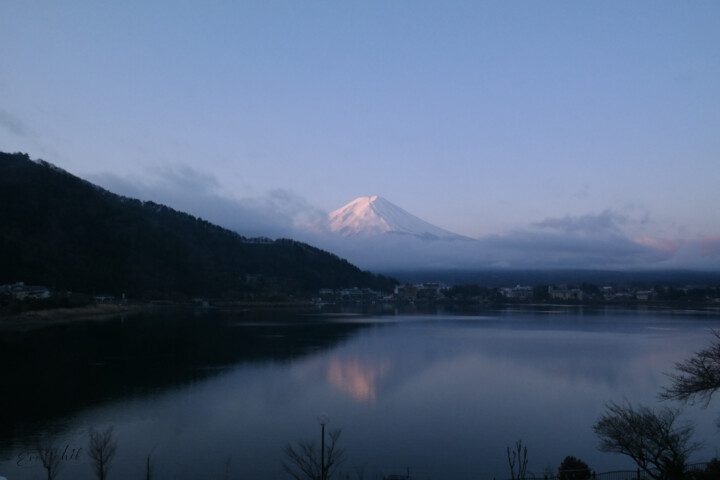
No photographic collection of Japan feels quite complete without Mount Fuji.
Eva Sahib captures the famous mountain during the early morning. Soft pink sunlight touches its snowy summit. Dark wooded hills frame the scene. A still lake reflects the mountain's silhouette.
The colours are particularly attractive. Pale blues and pinks dominate the sky. The dark foreground creates a strong contrast.
Unlike the Mount Yotei photograph, where the mountain commands attention, Fuji appears relatively small and distant.
That decision gives the photograph a different character. The mountain becomes part of a larger landscape rather than its only subject.
There's also a lovely sense of early morning stillness. The light is gentle. The lake appears almost motionless.
It's a familiar Japanese scene, but Eva's restrained composition gives it a quiet charm.
Five Photographs, Five Different Impressions
What makes these photographs interesting isn't simply their Japanese subjects. It's how differently the photographers approach them.
Eva Sahib favours expansive landscapes and everyday surroundings. Her photographs give nature plenty of room. Even her Tokyo street scene feels spacious.
Nealda Sahib takes the opposite approach. Her Kyoto lantern photograph is tightly composed, colourful and full of detail.
Together, the five works offer a varied portrait of Japan. There are familiar landmarks, quiet neighbourhoods, seasonal changes and traditional decorative arts.
Perhaps the most interesting observation is that Japan doesn't always need spectacular scenery to make a compelling photograph. Sometimes, an ordinary street or a collection of paper lanterns can be equally rewarding.