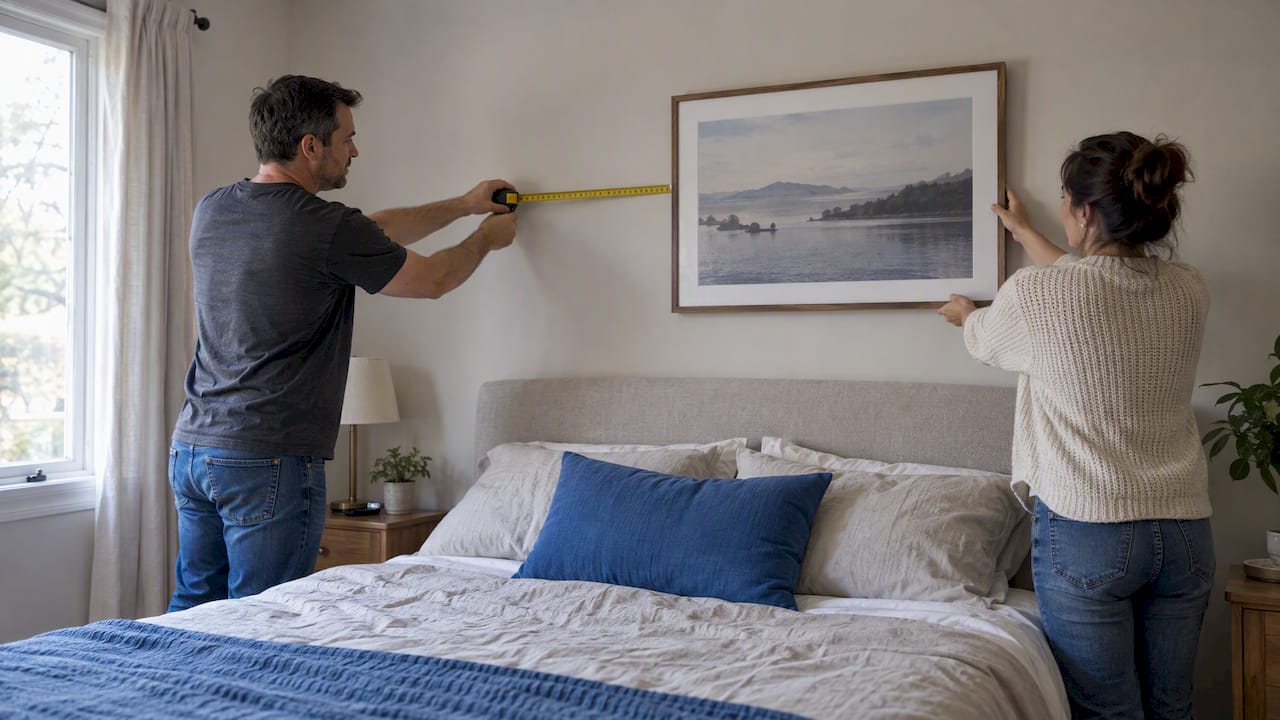
The easiest way to finish a bedroom is to anchor the bed with art: choose one oversized piece, a symmetrical pair, a triptych, or a curated gallery wall. Then size it to roughly two thirds to three quarters of the bed’s width and hang it a few inches above the headboard. Get those proportions right and the rest, lighting, framing, and styling, falls into place. We walk through both below.
TL;DR:
- The ideal art should be about two thirds to three quarters of the bed’s width and hung 6 to 10 inches above the headboard to create a balanced look.
- Symmetrical pairs, triptychs, or gallery walls are common patterns, with layout and spacing mapped beforehand to avoid unnecessary holes.
- Use rated hardware, wall anchors, or stud attachment for heavier pieces, and consider rotating art seasonally on a floating shelf or gallery ledge.
- Lighting choices like LED bulbs and UV-filter glazing help preserve art over time while complementing the room’s style.
- Sentimental and personal pieces should be scaled appropriately and framed consistently to feel curated within the bedroom’s decor.
Table of Contents
- 1. Idea patterns that work above a bed
- 2. How to measure and hang art above a bed
- 3. Lighting and framing that make art above a bed last
- 4. Materials and textures for different bedroom moods
- 5. Budget and DIY ways to style above the bed
- 6. Matching art to your bedroom’s style
- 7. What we have learned about styling above the bed
- 8. Safely hanging art above a bed without damage
- 9. Adding personal or sentimental pieces above the bed
- 10. Seasonal and rotating art displays above the bed
- 11. Where the conventional above-bed advice falls short
- Curated above-bed picks worth browsing
- FAQ
- Sources
1. Idea patterns that work above a bed
Certain layouts repeat across well-styled bedrooms because they solve the same problem: filling a wide, visually heavy wall without competing with the bed itself. Here are the patterns worth trying, along with a quick sizing note for each.
- One large statement piece suits minimalist or modern rooms; keep the artwork around two thirds to three quarters of the bed’s width so it reads as intentional, not accidental.
- Symmetrical pairs bring a calm, formal rhythm; match the frames and keep spacing between them even, usually a few inches on either side of center.
- Triptychs or multi-panel sets fill a wide wall and add visual rhythm without the commitment of one giant canvas.
- Gallery walls, whether gridded, salon-style, or staggered, suit personal collections and eclectic rooms; map the layout before you commit to any holes.
- Textiles and tapestries add texture and help soften sound in a room built for rest, and work particularly well in cozy, layered bedrooms.
- Mirrors or reflective art bounce light around a small bedroom and can stand in for a traditional picture entirely.
- A floating shelf with leaned art gives you a flexible, renter-friendly setup you can rearrange without new nail holes.
- Dimensional pieces, like woven baskets or small sculpture, add shadow play and depth that flat art cannot.
- Hanging lights or trailing plants work as unconventional alternatives, provided you measure for safe clearance above the sleeper’s head.
Large-scale art deserves particular attention because when sized and placed correctly, it can function almost like a headboard. Architectural Digest notes that printing an oversized photo onto canvas is an affordable route to this effect, and that leaned pieces can double as a faux headboard as long as they sit a small, stable distance from the bed frame. For more on scaling a single piece to fill a wall, our guide to oversized art ideas walks through proportion in more detail.
2. How to measure and hang art above a bed
Getting the proportions right is less about taste and more about arithmetic. A few consistent rules keep the result looking designed rather than guessed at.
- Start from the standard 57-inch center rule, the gallery convention for eye-level hanging, then adjust downward slightly for art placed above a headboard, since the headboard itself changes the visual center.
- Leave a few inches between the bottom of the frame and the top of the headboard, per Architectural Digest’s hanging guidance; a tall upholstered headboard or a floor-to-ceiling art piece may call for less gap or none at all.
- Size the art to two thirds to three quarters of the bed’s width, and give taller ceilings extra vertical breathing room above the frame.
- For gallery walls, map the arrangement first using kraft-paper templates, painter’s tape outlines, or a dry run on the floor, a method Better Homes & Gardens recommends for avoiding unnecessary holes.
- Match hardware to weight: use wall anchors rated for the piece, hit a stud for anything heavy, or choose rated adhesive strips for a rental-safe, hole-free option.
Pro Tip: Cut a paper template the exact size of your artwork and tape it to the wall first; it is the fastest way to catch a sizing mistake before you pick up a drill.
3. Lighting and framing that make art above a bed last
Light shapes how art reads at night and how well it survives the years above a bed. Ceiling-mounted accent lights, track fixtures, and wall washers each throw a different kind of glow, while picture lights create a more intimate, gallery-style focus but sometimes need hardwiring or a nearby outlet.
- Choose LED bulbs over halogen; Architectural Digest advises LED lighting reduces the UV and heat exposure that can fade or warm delicate pieces over time.
- Match frame weight and finish to your lighting method: a substantial frame pairs naturally with a picture light, while frameless canvas suits ambient or track lighting.
- Keep art out of direct sun, or use UV-filter glazing if a window throws glare across the piece.
- Low-profile, battery-powered picture lights are a practical, renter-friendly option when hardwiring is not possible.
LED lighting reduces the UV and heat exposure that damages artwork over time, according to Architectural Digest’s lighting guide, which makes it the safer long-term choice for anything hung directly above where you sleep. Our own art lighting guide goes deeper into fixture types for home galleries.
4. Materials and textures for different bedroom moods
The material behind the image matters nearly as much as the image itself, especially in a room meant for winding down.
- Canvas or unframed prints stay lightweight and low-glare, easy to hang with minimal hardware.
- Framed prints and photographs deliver a more polished, finished look but need sturdier anchors or a stud.
- Textiles and tapestries bring warmth and help dampen sound, a natural fit for a room built around rest.
- Sculptural or dimensional pieces add depth and shadow but require checking wall clearance and weight limits first.
For a calm bedroom, pair a single muted canvas with soft linen bedding. For drama, go bold with a large framed abstract. For cozy warmth, layer a woven tapestry with a nightstand lamp underneath.
5. Budget and DIY ways to style above the bed
A polished look above the bed does not require a designer budget. A few low-cost techniques deliver real impact.
- Blow up a favorite photo and have it printed on canvas; it is an affordable way to get the oversized, headboard-like effect Architectural Digest describes.
- Thrift mismatched frames and unify them with matching mats or a single coat of paint for a gallery look on a tight budget.
- Lean a large canvas against the wall as a faux headboard, keeping a small, stable gap from the bed and anchoring it if it is heavy.
- Hang a textile or macramé piece as an affordable, texture-rich statement that needs no frame at all.
- Use rated adhesive strips for lightweight pieces, matching the strip’s weight limit to the item, a simple fix for renters. Our DIY home decor ideas cover more no-drill projects like this one.
6. Matching art to your bedroom’s style
The right above-bed art should echo the bones of the room rather than fight them.
- Minimal bedrooms suit a single slim print in a neutral palette with low-contrast matting.
- Boho bedrooms call for a woven tapestry, layered textures, and an asymmetric gallery arrangement.
- Modern bedrooms take well to a bold, large-scale abstract in a frameless canvas.
- Traditional bedrooms look intentional with matched framed pairings flanked by coordinating sconces.
Whatever the style, tie the art back to the room: echo a color from the bedding, pick up the headboard’s material in the frame finish, and let the nightstand styling repeat a shape or tone from the piece above the bed. Our hotel bedroom ideas show how this coordination plays out in a more elevated, layered bedroom.
7. What we have learned about styling above the bed
We built our approach to above-bed styling around one consistent idea: the art should carry the same proportions a headboard would, whether or not an actual headboard exists. That principle holds across the oversized art features we have run and the current shifts we track in our 2026 bedroom trends coverage.
Pro Tip: Measure the bed before you fall in love with a piece; proportion solves more decorating problems than taste does.
Beyond measurement, we pay close attention to how light interacts with a finished wall, since the wrong fixture can undo good framing. Readers ready to shop finished pieces can browse our curated Store Finds for options sized and framed with this balance in mind.
8. Safely hanging art above a bed without damage
Art above a bed sits directly over someone’s head for hours each night, which makes secure hanging a safety question, not just a style one. Match the hardware to the weight of the piece: lightweight prints can rely on rated adhesive strips, while anything heavier needs a wall anchor rated for the load or a direct hit into a stud.
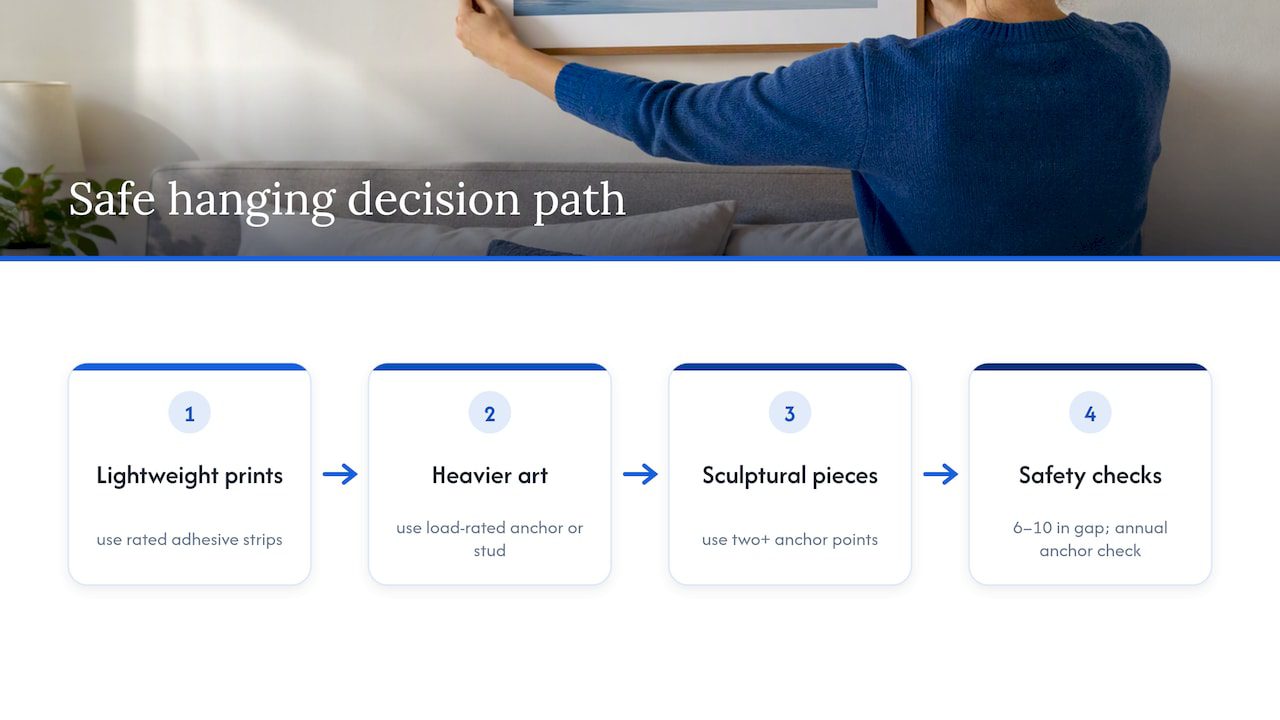
For heavier or sculptural pieces, distribute the weight across two or more anchor points rather than a single nail, and check that the hanging wire or bracket on the back of the frame is rated for the piece’s actual weight, not just its apparent size. A guide to hanging heavy art walks through load distribution for substantial wall pieces, useful if you are mounting anything beyond a standard framed print.
Leave a visible gap between the bottom of the art and the headboard, both for the 6 to 10 inch proportion rule and for simple safety: a piece that rests directly against a headboard can shift or fall if the bed is bumped. If you are leaning a large canvas rather than hanging it, anchor it with a small wall strap or museum putty so a bump in the night cannot send it sliding down. Double check drywall anchors annually, since humidity and temperature shifts in a bedroom can loosen hardware over time, and avoid hanging glass-fronted frames directly above a sleeper’s head when a frameless print or canvas would do the same job more safely.
9. Adding personal or sentimental pieces above the bed
A bedroom is one of the few rooms where sentimental art genuinely belongs, since it is a private space rather than one designed to impress visitors. A child’s drawing enlarged and framed, a travel photograph from a meaningful trip, or a hand-me-down painting from a relative can anchor the wall just as effectively as a store-bought print, provided the sizing rules still apply.
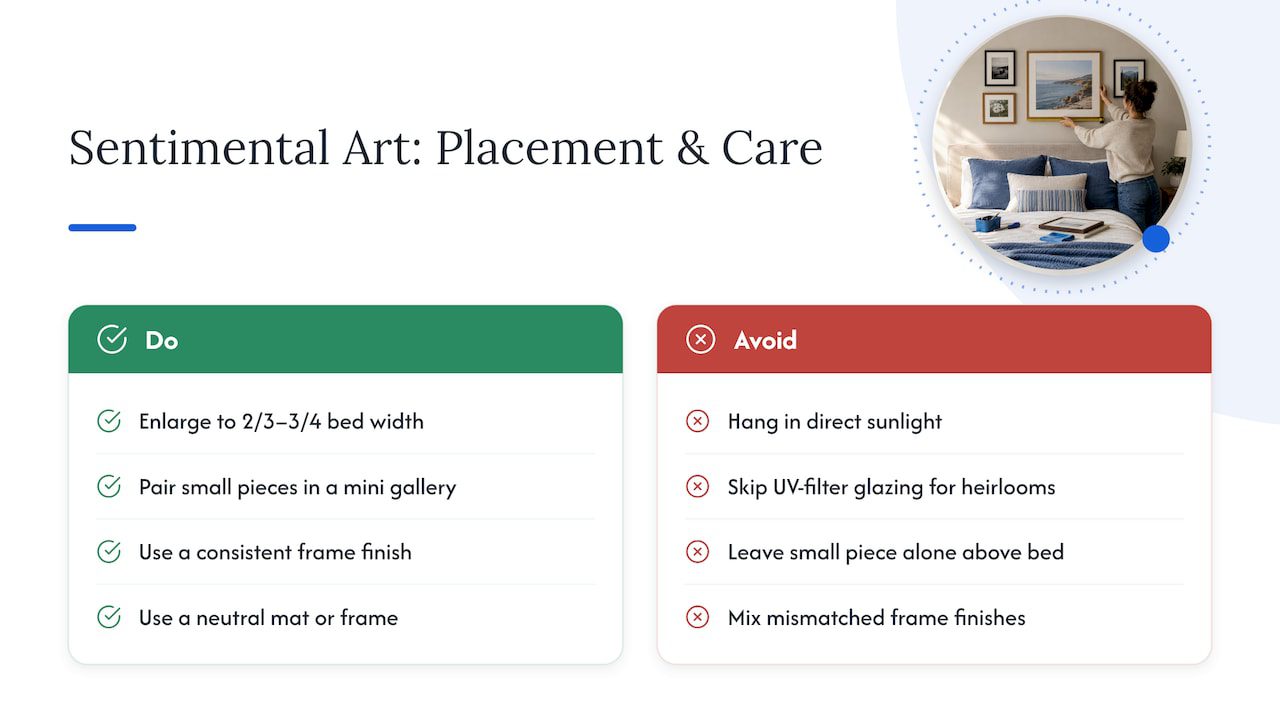
The trick with sentimental pieces is usually scale and cohesion rather than the subject itself. A small sentimental photo can feel lost alone above a queen or king bed, so pair it with one or two complementary prints in a mini gallery, or have it enlarged to match the two thirds to three quarters width guideline on its own. Framing matters more here than with purely decorative art: a consistent frame finish helps a sentimental piece feel curated rather than stuck on the wall as an afterthought.
If the piece carries deep personal weight, such as a family heirloom or a piece from someone who has passed, consider UV-filter glazing to protect it long term, since these are rarely pieces you can simply reprint. Keep it out of direct sun for the same reason. A sentimental piece does not need to match your bedroom’s color palette exactly, but a neutral mat or frame can help it sit more comfortably among more deliberately styled elements nearby.
10. Seasonal and rotating art displays above the bed
Treating above-bed art as a rotating display rather than a permanent fixture keeps a bedroom feeling current without a full redecorate. A floating shelf or picture ledge makes this especially easy, since leaned pieces can be swapped in minutes without new holes or hardware.
A simple seasonal rotation might swap a warm, textured tapestry in for cooler months and a lighter, airier print or botanical piece for spring and summer, echoing the shift in natural light through the room’s windows. Renters and frequent redecorators benefit most from rated adhesive strips or a gallery ledge, both of which make rotation painless compared to fixed nail holes.
For readers who like a gallery wall above the bed, rotation can be partial rather than total: swap one or two frames seasonally while keeping anchor pieces in place, which refreshes the look without redoing the whole layout. This also works well for displaying children’s art, travel photography, or a changing print series over the course of a year. A rotating approach pairs naturally with budget-friendly prints, since lower-cost pieces make frequent swaps far less precious an undertaking than rotating out a single expensive statement piece.
11. Where the conventional above-bed advice falls short
Most above-bed guidance treats the wall like a blank canvas problem: pick a pretty picture, hang it, done. That skips the part that actually determines whether a bedroom feels finished, which is proportion relative to the bed itself, not the wall. A gorgeous print hung at the wrong width or too far above the headboard reads as an afterthought no matter how good the art is on its own.
We would also push back on the idea that a single statement piece is always the safest, most foolproof choice. It often is the easiest, but a well-mapped gallery wall or a textile hanging can carry more warmth and personality for very little extra effort, and a leaned canvas costs nothing in hardware. The reader’s first move should be measuring the bed and the wall, not browsing for inspiration. Proportion and placement decide whether a piece looks intentional; the subject matter is almost secondary once those numbers are right.
— Nealda
Curated above-bed picks worth browsing
If measuring, mapping, and matching hardware to weight sounds like more trouble than a Saturday affords, our curated Store Finds collection does some of that legwork for you. We pull together wall art, statement prints, woven tapestries, and hanging hardware that are already style-matched, so you are choosing between vetted options rather than starting from a blank search.

Browse the current edit of wall art picks for pieces sized and framed with the proportions covered above already in mind, and pair them with a rated hanging kit for a result that looks finished on the first try.
FAQ
What kind of art should go above a bed?
A single oversized piece, a symmetrical pair, a triptych, or a gallery wall all work well, with the choice depending on your room’s style and the wall’s width. The deciding factor is proportion: the art should span roughly two thirds to three quarters of the bed’s width, as covered in the hanging rules above.
What are the rules for hanging art above a bed?
Hang the bottom of the frame about 6 to 10 inches above the headboard, following guidance from Architectural Digest, and size the piece to two thirds to three quarters of the bed’s width. Use anchors or studs rated for the artwork’s weight, especially for anything heavier than a lightweight print.
What are some creative ways to decorate above my bed?
Beyond a single framed print, consider a woven tapestry, a gallery wall of mixed sizes, a floating shelf with leaned art, or even a mirror to bounce light in a smaller room. A floating ledge is particularly useful since it lets you rotate pieces seasonally without new hardware.
What are the best pictures to hang above my bed?
The best pictures are the ones sized correctly for your bed, whether that is a bold abstract for a modern room, a soft landscape for a calming space, or a sentimental photograph enlarged to fill the wall. Subject matter matters less than proportion and consistent framing across the piece or set.
How do I keep art from feeling cluttered above a bed?
Map any multi-piece arrangement first using kraft-paper templates or painter’s tape, a method Better Homes & Gardens recommends for testing spacing before committing to holes. Keeping 3 to 6 inches of even spacing between frames in a gallery wall also keeps the arrangement feeling organized rather than crowded.
Sources
- A Potentially Impractical Headboard Idea That’s 100 Percent Worth Trying | Architectural Digest
- How to hang a gallery wall in 5 easy steps | Better Homes & Gardens