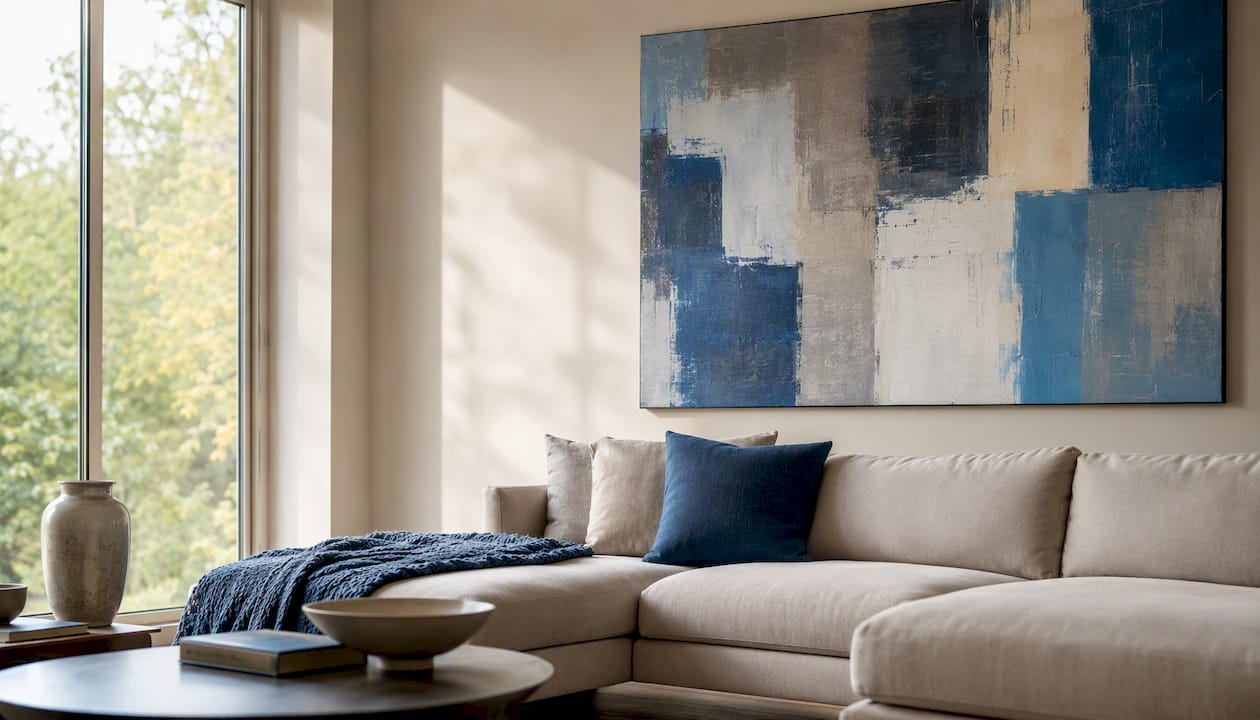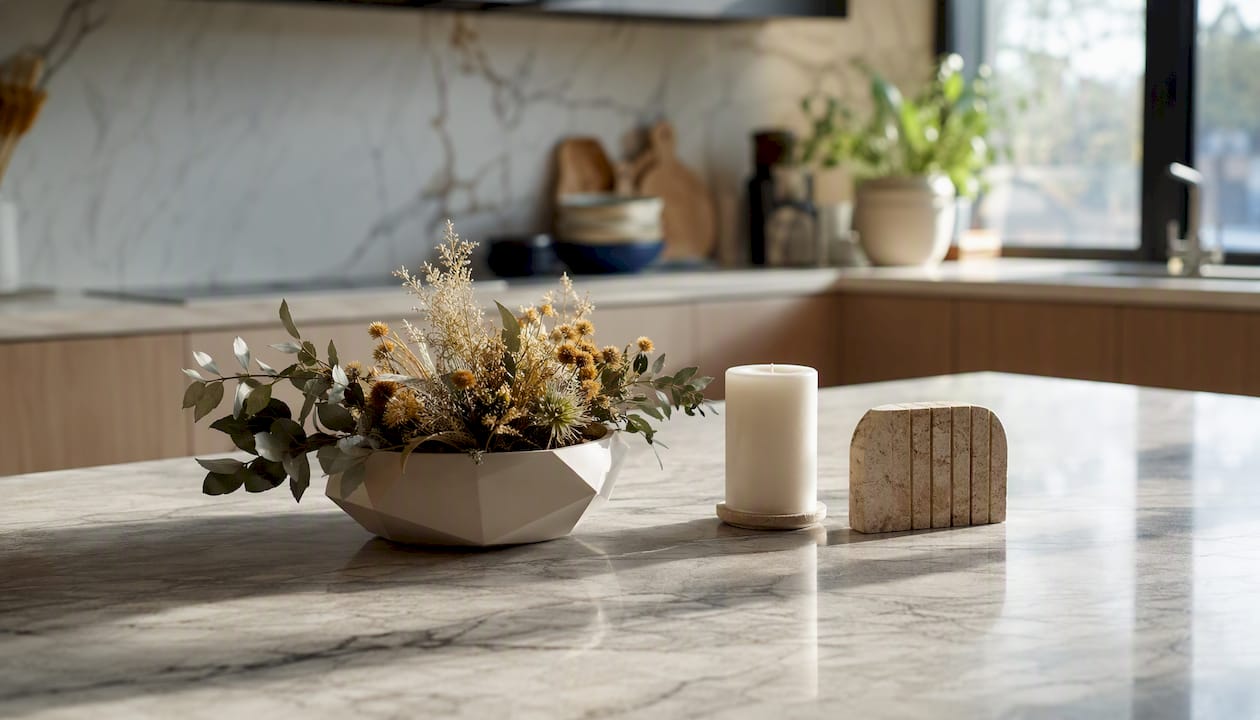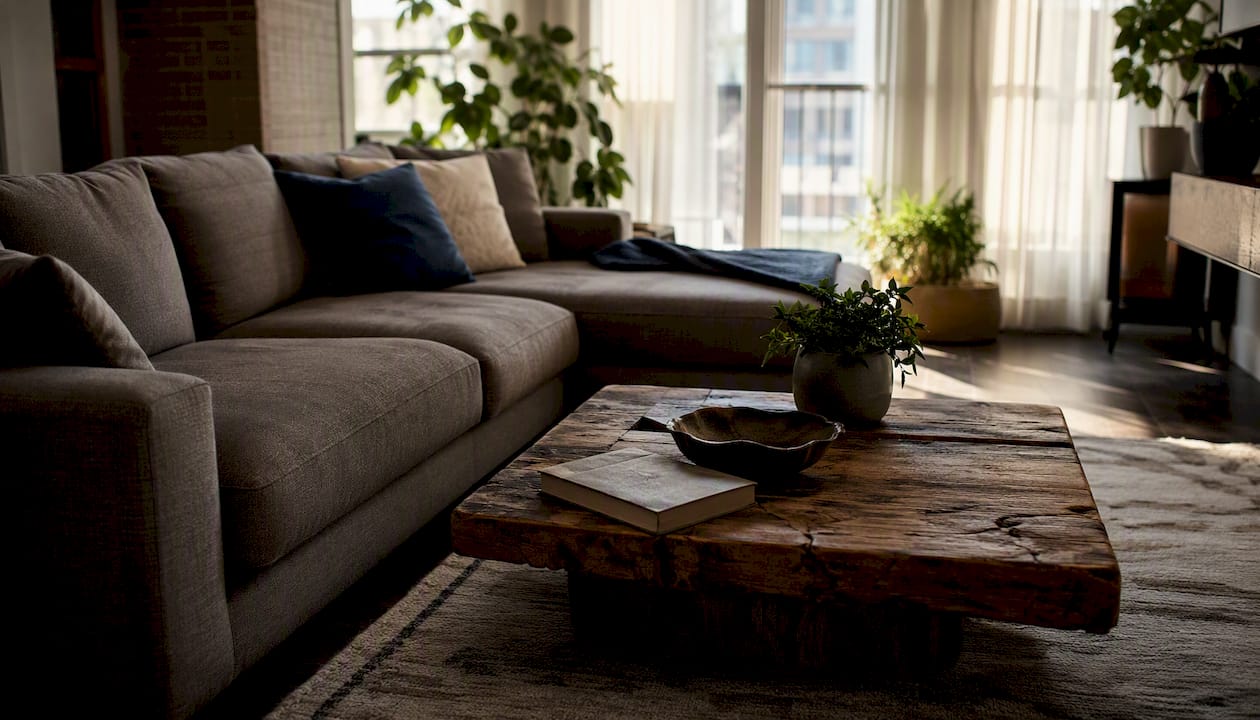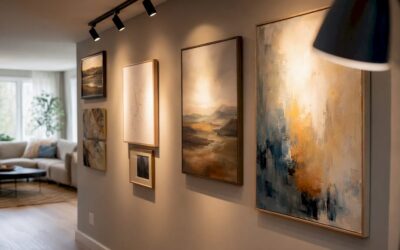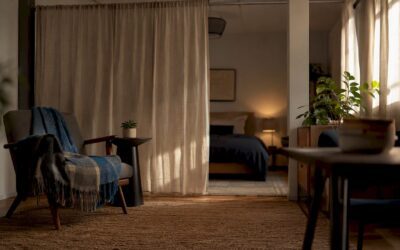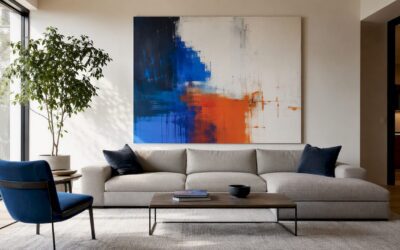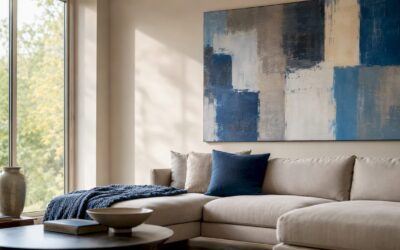
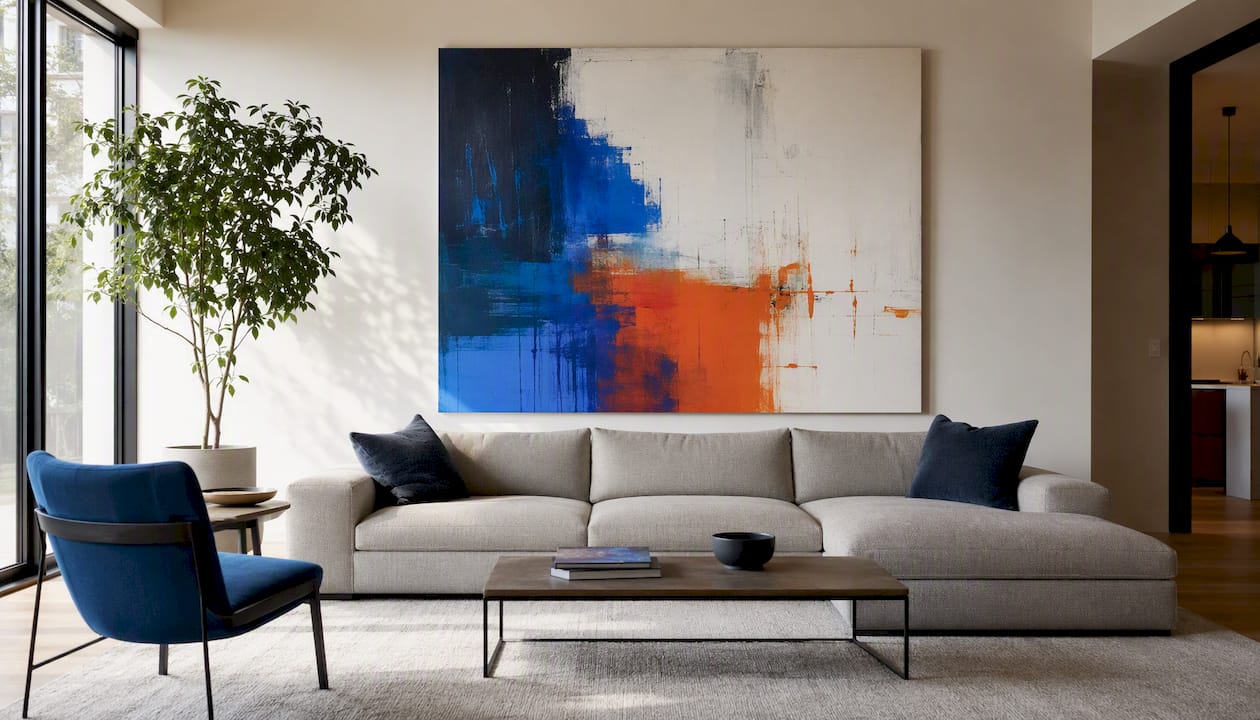
Three approaches solve most big-wall problems: one oversized statement piece, a multi-panel composition like a diptych or triptych, or an architectural treatment such as wallpaper, tapestry, or millwork paired with texture. Each works because it commits to scale instead of scattering small pieces across a wall that needs one confident gesture.
The sizing rule to remember before you shop: art should generally span two-thirds to three-quarters of the furniture width beneath it, not the total wall width. A sofa that runs 84 inches wants art closer to 56 to 63 inches wide. A blank stairwell with no furniture underneath plays by different rules entirely, and we’ll get to those.
Where this rule applies most cleanly:
- Above a sofa or console table, where the furniture sets the measuring line
- In a two-story foyer or stairwell, where height matters more than width
- On a single dominant wall with no furniture at all, where the wall itself becomes the measure
Pro Tip: The single most common mistake homeowners make with big walls isn’t buying art that’s too large. It’s hanging it too small and too low, which shrinks the whole room instead of grounding it.
Key Takeaways
The single most important rule for oversized art is sizing it to two-thirds to three-quarters of the furniture width beneath it, not the total wall.
| Point | Details |
|---|---|
| Apply the sizing rule | Measure furniture width, then target two-thirds to three-quarters of that number for art width. |
| Hang at seated eye level | Center art 6 to 8 inches above sofa or console height, higher in stairwells with distant sightlines. |
| Match hardware to weight | Use French cleats or stud-anchored hardware for pieces over 20 to 30 pounds. |
| Consider multi-panel alternatives | A linear row of 3 to 5 prints can simulate one wide piece for less cost and easier transport. |
| Start this weekend | Measure your key furniture piece and calculate your target art width before you shop. |
Table of Contents
- Oversized Art Ideas by Room, From Living Room to Stairwell
- How Big Should Oversized Art Actually Be?
- Formats and Materials for Large-Scale Wall Art
- Gallery Walls and Multi-Panel Layouts as an Oversized Alternative
- How to DIY or Commission Extra-Large Wall Art
- Hanging Oversized Art Safely: Hardware and When to Call a Pro
- A Simple Framework Designers Use to Choose Oversized Art
- Why Mood Should Beat Math When You Pick Oversized Art
- Sources
Oversized Art Ideas by Room, From Living Room to Stairwell
Where a piece hangs changes what it should say, how loud it can be, and what shape makes sense. A calming abstract that works over a headboard would read as flat and forgettable in a foyer where people pass through in seconds and need something with more presence.
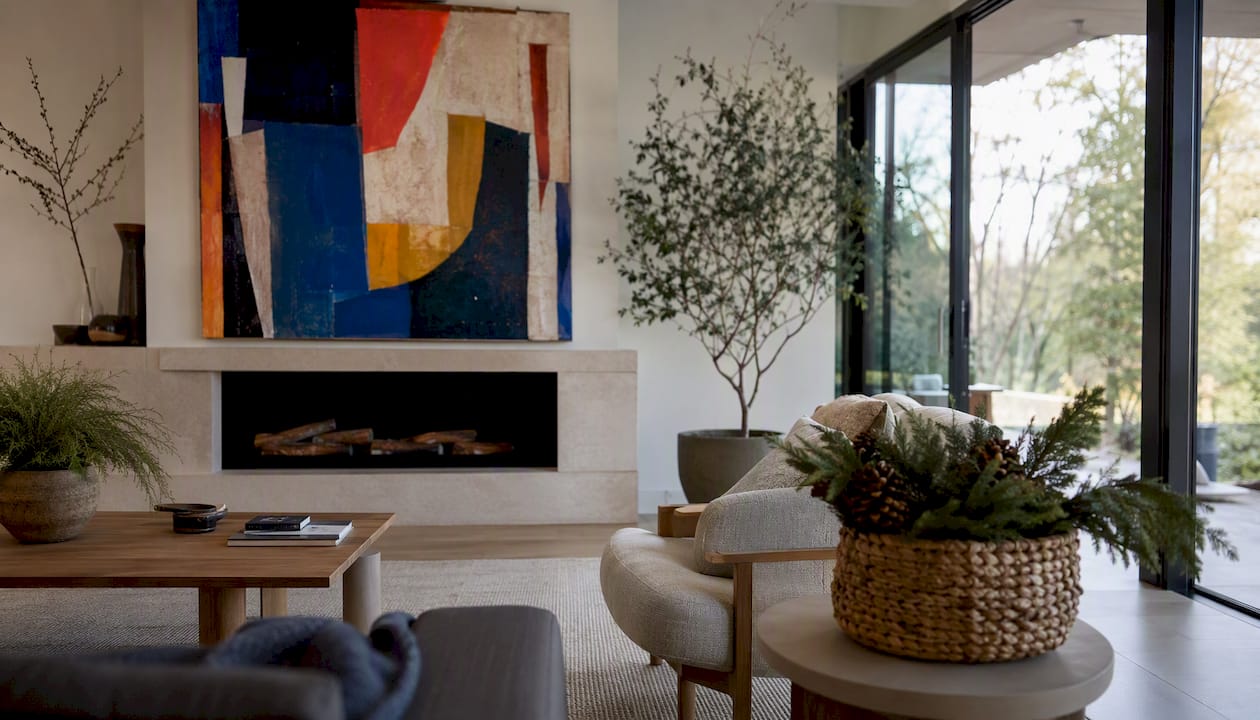
Living room. This is where a single massive canvas earns its keep, especially behind a sofa or flanking a fireplace. One large statement piece often outperforms several smaller works because it reads instantly from across the room and functions almost like a built-in architectural element. Subject matter that holds up at scale tends to be abstract compositions, color-field paintings, or wide landscape photography, since intricate detail work gets lost once a piece crosses the 60 inch mark. If you want color without picking a single loud canvas, Jonathan Adler’s recent summer-toned collection shows how saturated palettes can anchor a seating area without overwhelming it.
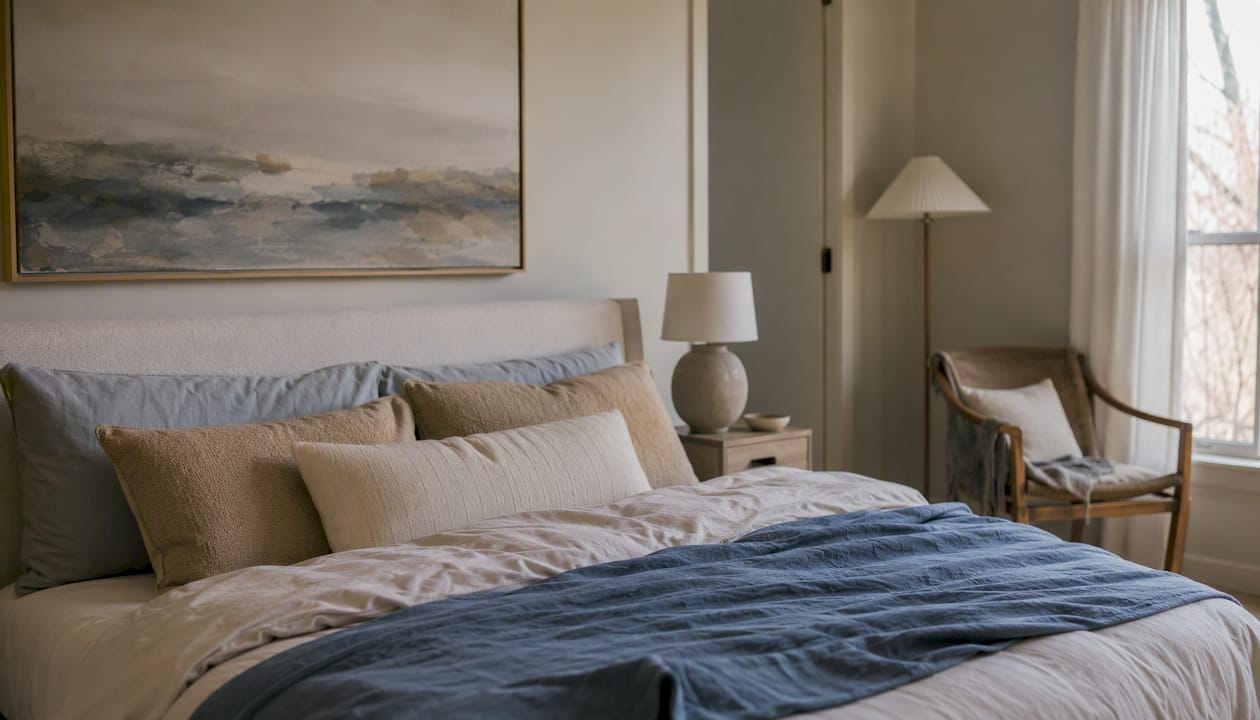
Bedroom. Restraint matters here. Low-contrast, softer imagery tends to support sleep and calm better than sharp geometric prints, especially directly above a headboard where a busy piece can feel like it’s hovering over you at night. Cameron Limbrick’s abstract paintings lean into this kind of quiet, textured mood rather than hard lines. Leave 6 to 12 inches of clearance between the top of the headboard and the bottom of the frame, and check the 2026 bedroom trend guide for palette pairings before you commit to a piece.
Dining room and foyer. People linger in these spaces, which means you can afford something louder and more conversational than you would in a bedroom. Large-scale tapestries, oversized photographic prints, and fabric wall hangings all work well here because guests have time to actually look at them.
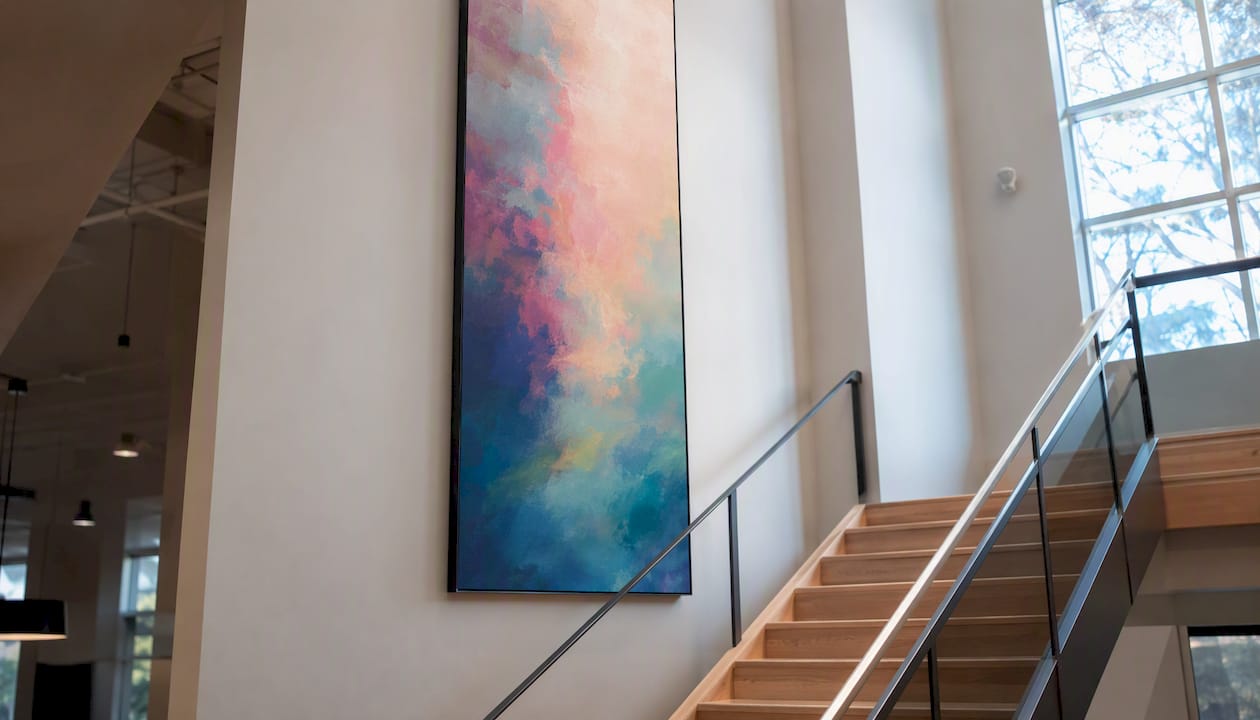
Stairwell and two-story walls. Vertical space wants a vertical solution: one very tall single piece, a stacked pair, or a linear column of same-size frames running with the stair line. Center the composition slightly higher than standard eye level, since viewers will typically see the work from across a landing or from the base of the stairs rather than standing directly in front of it. Homes with rustic, high-ceilinged architecture, like the kind featured in this French Alps interior guide, tend to favor one dramatic vertical canvas over a cluster of small frames.
Home office, media wall, bathroom. Compromise on scale here rather than forcing a formula that doesn’t fit the room. An oversized mirror can do double duty as art and light-bouncer in an office. Media walls often look better with a mid-scale piece flanking the screen rather than art dead-center behind it. Bathrooms need moisture-tolerant prints, acrylic face-mounts, or nothing larger than a well-framed piece rated for humidity.
Pro Tip: If a room has natural light hitting the art wall for several hours a day, ask about UV-resistant printing before you fall in love with a specific canvas. Standard inks and oil media fade noticeably faster under direct sun.
How Big Should Oversized Art Actually Be?
The math is simpler than most people expect, but it depends on what you’re measuring against. Designers commonly recommend sizing artwork to cover roughly 60 to 75 percent of the wall space directly above the furniture beneath it, using the furniture’s width as the baseline rather than the room’s total wall width. That distinction solves a problem a lot of homeowners run into: a wall might measure 12 feet across, but if the sofa underneath it is only 7 feet, sizing art to the wall produces something that floats awkwardly rather than anchoring the seating.
Here’s a working measurement checklist:
- Measure the width of the furniture piece beneath the art (sofa, console, headboard, bed frame).
- Multiply that number by 0.66 and by 0.75 to get your target size range.
- Confirm you have at least 6 to 8 inches of breathing room on either side within the furniture’s footprint.
- Check ceiling height and sightlines if the piece will be viewed from a seated position versus standing.
Hanging height follows its own logic. The center of the artwork should generally land around 57 to 60 inches from the floor for standing viewers, which mirrors museum convention. Over a sofa, drop that center point so it sits 6 to 8 inches above the top of the cushions when someone is seated, since that’s the sightline that matters most in a living room. Stairwells and double-height walls break this rule on purpose: center higher than eye level so the composition still reads correctly from a distance or from a lower stair landing.
A quick reference on what tends to go wrong:
- Hanging art too low, so it visually competes with furniture instead of framing it
- Leaving too little margin at the edges of a wall, which makes even a large piece look cramped
- Measuring against total wall width instead of furniture width, producing oversized art that floats rather than anchors
If you’re sketching this out before buying, a simple diagram helps: draw the furniture footprint, mark the two-thirds and three-quarters width lines directly above it, then mark the vertical center point at seated eye level. That one sketch prevents most sizing regrets before a single dollar gets spent.
Formats and Materials for Large-Scale Wall Art
Not every oversized idea calls for the same material, and the differences matter more at scale than they do with a small print. A canvas that looks fine at 16 by 20 inches can show every stretcher-bar flaw once it’s blown up to 60 by 80.
| Format | Best for | Cost tier | Watch out for |
|---|---|---|---|
| Stretched canvas | Living rooms, abstract or landscape work | Affordable to mid-range | Sagging over time on very large stretcher bars |
| Framed print | Foyers, offices, photography | Mid-range to high | Glass adds significant weight and shipping cost |
| Acrylic or metal print | High-gloss, modern spaces | Mid-range to high | Shows fingerprints and scratches more than canvas |
| Wood panel | Rustic or textured interiors | Mid-range | Heavier; needs sturdy hardware |
| Tapestry or textile | Dining rooms, bohemian or layered spaces | Affordable to mid-range | Can absorb odors, needs occasional cleaning |
| Wallpaper mural | Any wall as an alternative to hung art | Affordable to high (custom) | Requires clean, prepped walls and careful installation |
Budget generally breaks into three tiers. An enlarged print on canvas or acrylic through a print-on-demand service tends to land at the affordable end. A framed, gallery-quality print with archival inks sits in the mid-range. A commissioned original from a working artist, sized and painted specifically for your wall, occupies the top tier and can run considerably higher depending on the artist’s reputation and the piece’s complexity.
Material choice should also account for environment. Humid bathrooms and sun-drenched sunrooms both shorten the life of standard canvas and oil-based media, so UV-resistant prints or outdoor-rated substrates hold up better in those conditions, the same principle muralists apply on public commissions exposed to weather for years. For pieces that need to read as texture as much as image, mixed-media and hand-assembled panels can carry visual weight without needing raw square footage. One example: an artist recently built a 41 square meter mosaic from thousands of hand-rolled paper quills, proving that texture and repetition can do the work of scale even when the individual pieces are small.
Abstract canvases, mural-style wallpaper, and heavily textured panels tend to read best at the largest sizes, since they don’t rely on fine detail holding up from across a room the way a photograph or a detailed illustration might.
Gallery Walls and Multi-Panel Layouts as an Oversized Alternative
A single giant canvas isn’t always practical. Doorways are narrow, stairwells are tight, and budgets have limits. Grouped arrangements can achieve the same visual weight as one oversized piece while solving transport and cost problems a single massive canvas creates.
Three formulas cover most situations:
- Linear row. Three to five identical or coordinated frames running in a single horizontal line simulate one wide piece and work especially well above a long console or a stair run.
- Grid. A 4 to 9 piece grid with even spacing reads as one cohesive block from across the room, ideal above a sofa where a single canvas feels financially out of reach.
- Salon style. An intentionally irregular cluster of varied sizes works best in hallways and stairwells where the eye travels rather than lands in one spot.
Multi-panel pieces, whether a diptych, triptych, or staggered set of panels, need consistent gaps to read as one composition rather than three unrelated pieces. A 2 to 3 inch gap between panels usually holds the illusion together; anything wider starts to feel disconnected. Before hanging, measure the full composition width including gaps, then apply that combined figure against the two-thirds to three-quarters rule the same way you would for a single canvas.
Installation goes smoother with paper templates. Trace each frame’s dimensions onto kraft paper, tape the templates to the wall, and adjust the whole layout before a single nail goes in. This trick saves walls from unnecessary holes and lets you confirm alignment on the outer edges, which matters more to the eye than perfect spacing between individual pieces.
If budget is the real constraint, identical prints hung in a row remain one of the most affordable ways to simulate a single wide statement piece, and leaning an oversized canvas against the wall rather than mounting it is a legitimate, increasingly popular installation choice for renters or anyone who likes flexibility. For a full walkthrough of layout templates, Artinlifestyle’s gallery wall guide covers spacing formulas in more depth than we have room for here.
How to DIY or Commission Extra-Large Wall Art
Making or commissioning oversized art isn’t as intimidating as the price tags on gallery originals suggest. Homeowners have three realistic paths: scale something yourself, work with a large-format print shop, or commission an artist directly.
DIY scaling methods include collaging several smaller canvases into one composition, enlarging a favorite photograph through a print service, or working directly on a large canvas with acrylic paint and simple geometric or abstract techniques that don’t require fine detail work. Print-on-fabric services also let you turn a photo or digital design into a tapestry-style hanging without stretcher bars or framing at all.
If you’re going the print route, a few technical details separate a crisp result from a blurry, disappointing one:
- Confirm the file resolution supports at least 150 to 300 DPI at the final print size, not the size of your original photo file.
- Ask about bleed and margin requirements before finalizing dimensions, since most large-format printers trim slightly.
- Choose a substrate (canvas, acrylic, metal) based on where the piece will hang and how much light it gets.
- Request a proof or a small test print before committing to the full-size run, especially for color-critical work.
Commissioning an artist directly requires a clear brief. At minimum, include the desired dimensions, where the piece will hang and from what sightlines, your color palette, your budget tier, your timeline, and your expectations around shipping and installation. Artinlifestyle’s Art Concierge service exists precisely for readers who’d rather hand off sourcing and logistics than manage a commission solo.
Budget and timeline realities differ sharply between the two paths. A print enlargement can often be ordered and delivered within one to two weeks. A custom commission from a working artist typically takes several weeks to a few months, depending on complexity and the artist’s schedule. If you need to save money without sacrificing scale, spend less on framing and more on the print or canvas itself. A simple float frame or no frame at all often looks more intentional on an oversized abstract than an ornate frame that competes with the piece.
Hanging Oversized Art Safely: Hardware and When to Call a Pro
Weight changes everything once a piece crosses roughly 20 to 30 pounds, and oversized art routinely does. The hardware that holds a small print will not hold a 60 by 80 inch canvas or a framed piece with glass.
Reliable hardware options include:
- A French cleat system, which distributes weight along a horizontal bar rather than a single point and makes leveling easier
- Wall anchors rated specifically for the piece’s weight, chosen based on whether the wall is drywall, plaster, or masonry
- Threaded rod anchored into wall studs for the heaviest pieces, especially anything over 50 pounds
A basic installation checklist before you drill anything:
- Measure and mark the exact center point based on the sizing and height rules covered earlier.
- Locate studs with a stud finder, since anchoring into a stud is always stronger than relying on drywall alone.
- Choose hardware rated for the piece’s actual weight, not an estimate.
- Check the wall substrate (drywall, plaster, brick) before selecting anchors, since each requires different fasteners.
- Use a level and, for anything over 40 pounds or wider than 4 feet, a second person to help hold and check alignment.
Pro Tip: Hire a professional installer once a piece exceeds about 75 pounds, requires anchoring into a wall you can’t easily access (like a stairwell landing two stories up), or the wall itself is masonry or plaster rather than standard drywall. Professional installation also makes sense for multi-panel arrangements where precise alignment across several pieces matters more than a single hanger can guarantee.
Ongoing care matters too. Dust large canvases with a soft, dry microfiber cloth rather than anything damp, which can warp canvas or damage certain inks. Keep oversized pieces out of direct sun where possible, and in humid climates, monitor for warping at the edges of wood panels or canvas stretcher bars, since moisture tends to show there first.
A Simple Framework Designers Use to Choose Oversized Art
Professional designers rarely start with a mood board. They start with three questions that eliminate most of the wrong options before anyone falls in love with a piece that won’t work.
- What is the wall type and sightline? A stairwell wall demands a different shape and hanging strategy than a flat living room wall viewed from a seated sofa. Answering this question first narrows format and orientation before you even browse.
- What is the room’s function and desired mood? A home office wants focus and calm; a dining room can afford drama and conversation-starting color.
- What is the budget tier and installation constraint? A rental apartment with limited drilling options points toward leaning art or a gallery wall rather than a single massive commissioned canvas.
Two quick comparisons show how differently this plays out. A living room with a 90 inch sofa, warm neutral palette, and a mid-range budget likely lands on a single abstract canvas around 60 inches wide in warm tones, hung at seated eye level. A stairwell with a two-story sightline, minimal budget, and no furniture reference point likely points toward a vertical linear row of three affordable prints instead, since a single custom piece at that scale would be both expensive and difficult to transport up a stairwell.
Color harmony and visual weight matter as much as size. A piece with a lot of white space can feel smaller than its actual dimensions, while a dense, saturated composition of the same size reads as more dominant. When size alone can’t fill a wall’s ambition, texture, whether through a tactile canvas, a woven tapestry, or a mixed-media panel, can substitute for scale by giving the eye more to explore up close.
Why Mood Should Beat Math When You Pick Oversized Art
Most guides hand you a formula and stop there. But the sizing math only works once you already know what a wall wants to say, and that’s the piece designers rarely explain out loud. A stairwell that needs energy and a stairwell that needs calm can have identical dimensions and completely different correct answers.
The mistake I see most often isn’t undersizing, though that’s real and common. It’s homeowners treating scale as the entire decision instead of the last step. They measure the sofa, hit the two-thirds mark, and buy whatever fits that number in a color that matches the throw pillows. That produces a technically correct wall that says nothing.
What I’d push back on is the idea that one giant canvas is always the sophisticated choice. Sometimes a linear row of three modest prints, paired with layered lighting, does more for a room than a single expensive commission ever could, especially in a stairwell or hallway where people move through rather than sit and stare. Lighting is the piece most articles skip entirely: a picture light or a well-placed sconce can make a mid-size canvas read as monumental, while a genuinely oversized piece under flat overhead light can feel flat and forgotten.
If you take one thing from a monumental project like a 540,000 square foot mural built by roughly 100 specialists, it’s not the scale itself. It’s that scale gets solved by matching the right team and materials to the site, not by defaulting to “bigger.” Your living room wall deserves that same logic at a human size. Start with what the room needs to feel like, then let the measurements catch up. For inspiration on pairing bold, contemporary pieces with a room’s existing palette, Kat Yew’s abstract line work is worth a look before you commit to a size or a shape.
Sources
- Oversized Wall Art: Guide to Large-Scale Decor for Homes
- Large Wall Decor Ideas: 7 Stunning Tips for 2026
- Oversized Wall Art: 30+ Large Canvas Ideas for Big Walls
- What to Put on a Big Blank Wall – Fab
- How to Decorate a Large Wall: Step-by-Step Guide – D and G Flooring
- Domingo Zapata to paint world’s largest mural in Saudi Arabia