The core regimen for velvet sofa care is straightforward: vacuum and brush routinely, blot spills the moment they happen, use steam and a soft brush to restore crushed pile, and call a professional for large or set-in stains. That single sentence covers most of what keeps a velvet sofa looking its best for years.
When a spill strikes, three steps matter immediately:
- Blot with a clean, dry absorbent cloth. Press gently; never drag.
- Absorb any remaining liquid by layering a dry towel and applying light pressure.
- Call a pro if the spill is oil-based, deeply pigmented (red wine, ink), or has already dried.
Do: blot, work from the outside of the stain inward, air-dry fully, and always test any cleaner on a hidden spot first.
Don’t: rub, oversaturate with water or cleaner, or reach for bleach or alkaline products.
How can you identify your velvet type and read its care code?
Not all velvets are created equal, and the difference between a polyester performance velvet and a cotton velvet is the difference between a confident spot-clean and an irreversible water ring. Knowing what you have before you reach for any cleaner is the single most protective step in velvet upholstery maintenance.
Reading the care tag
The care tag, usually sewn under a seat cushion or along the sofa’s base, carries a cleaning code that tells you exactly what the manufacturer permits:
- W — water-based cleaners only
- S — solvent (water-free dry-cleaning) only
- WS — either water-based or solvent cleaners
- X — vacuum or brush only; no liquid of any kind
If the tag is missing or illegible, treat the fabric as S until you can confirm the fiber content with the manufacturer or an upholsterer.
Visual and tactile identification
Synthetic velvets (polyester, polyester blends) tend to have a uniform sheen and a slightly stiffer hand. Cotton velvet feels softer and more matte, with a subtle natural variation in the pile. Silk velvet, the most delicate, has a luminous depth and a very fine, light pile that crushes easily. When in doubt, reach out to a professional upholsterer before attempting any aggressive cleaning, because misidentifying natural versus synthetic velvet can cause irreversible damage.

Hidden-spot test
Before using any cleaner anywhere visible, apply a small amount to the underside of a seat cushion or the fabric beneath the sofa’s skirt. Wait 10 minutes, then blot dry. Check for color bleed, water rings, or texture change. Document what you used and what you observed so you have a reliable reference for future cleaning.
Velvet types at a glance
| Velvet type | Fiber | Typical Martindale rub count | Water tolerance | Notes |
|---|---|---|---|---|
| Cotton velvet | Natural | Lower | Low | Prone to water rings and abrasion marks |
| Polyester velvet | Synthetic | Higher | Moderate to high | More forgiving for spot-cleaning |
| Performance velvet | Polyester blend | High | High | Best choice for pets, children, heavy use |
| Silk velvet | Natural | Very low | Very low | Professional cleaning only |
Martindale rub counts reflect how different velvet constructions affect durability and cleaning tolerance, with polyester and performance velvets significantly outperforming cotton and silk in everyday resilience.
What does a good weekly maintenance routine look like?
Routine care is where velvet longevity is actually won or lost. The pile that gives velvet its characteristic depth and warmth is also what traps dust, pet hair, and fine debris, so consistent attention prevents the slow accumulation that makes deep cleaning necessary far too often.
Daily: Give cushions a gentle fluff and straighten any throws. If you notice a crushed area from sitting, a light pass with a soft-bristle brush in the direction of the pile is enough to coax it back.
Weekly: Vacuum the entire sofa using a soft-brush upholstery attachment on the lowest suction setting, always moving in the direction of the nap. HGTV’s guidance confirms that working with the pile direction prevents streaking and fiber stress. If you don’t have an upholstery attachment, a clean piece of nylon stretched over the nozzle diffuses suction enough to protect the pile.
Monthly: Rotate and flip seat cushions where the construction allows. Unzip removable cushion covers and check for debris inside. A lint roller works well for fine pet hair between vacuuming sessions.
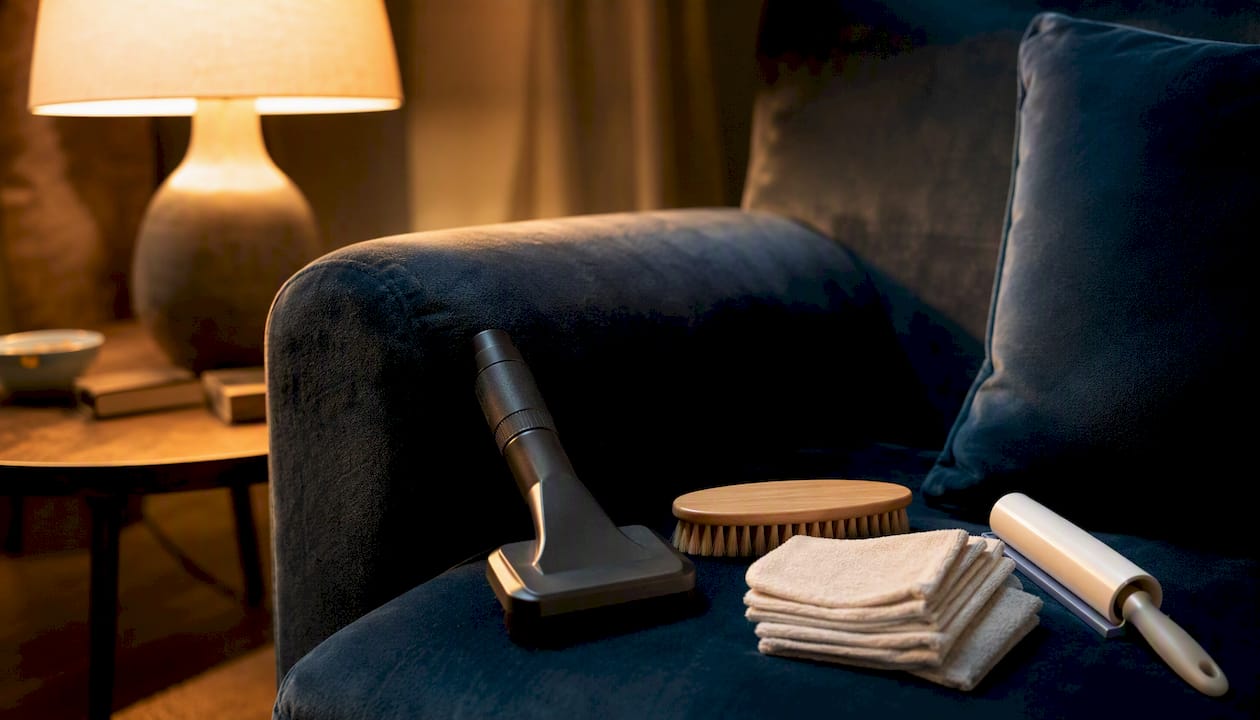
The right tools make this effortless: a vacuum with a soft upholstery head, a dedicated soft-bristle velvet brush, a lint roller, and a stack of clean absorbent cloths. Better Homes & Gardens specifically warns against high-suction settings, noting they can pull the pile or create bald spots over time. That’s a consequence that no amount of steaming will fully reverse, so low and slow is the rule every time.
Livingetc recommends weekly vacuuming as the single most effective preventive habit, with annual or biannual deep cleaning depending on household use. Homes with pets or children benefit from the more frequent schedule.
How do you spot-clean a velvet sofa without damaging it?
Speed and restraint are the two governing principles of spot-cleaning velvet. The faster you act, the less a spill has to penetrate the pile. The gentler your touch, the less likely you are to spread the stain or crush the fibers permanently.
- Act immediately. Blot the spill with a clean, dry microfiber cloth. Press straight down; never rub or drag sideways.
- Absorb the excess. Layer a dry absorbent towel over the area and apply gentle pressure for 30 seconds. Repeat with a fresh section of towel until no more liquid transfers.
- Test your cleaner. Apply a small amount of your chosen solution to a hidden spot and wait 10 minutes before proceeding.
- Dilute appropriately. For a W or WS coded fabric, mix one teaspoon of mild dish detergent in two cups of cool distilled water. A 1:1 mix of distilled white vinegar and water works for light odors and water-based stains on synthetic velvets.
- Apply sparingly. Dampen a clean microfiber cloth with the solution. Work from the outer edge of the stain inward, using small, gentle dabbing motions.
- Rinse. Blot with a cloth dampened with plain distilled water to remove any cleaner residue.
- Dry. Blot dry with a fresh towel, then allow the area to air-dry completely away from direct heat. Never use a hair dryer on high heat.
Architectural Digest makes the point clearly: cleaning technique is often more important than the specific product. Gentle blotting and testing first consistently outperform aggressive scrubbing with premium cleaners. For fabrics coded S, skip water entirely and use a water-free dry-cleaning solvent, applying it the same way.
For oil-based spills: sprinkle a thin layer of baking soda or cornstarch over the area first. Let it sit for 15 minutes to absorb the grease, then brush away gently before proceeding with a solvent-based cleaner appropriate for your fabric code.
For dye-based spills (red wine, ink): blot immediately and call a professional if the stain has any color remaining after blotting. Dye bleed on natural velvet is very difficult to reverse at home.
Caution: Never use bleach, alkaline cleaners, or abrasive scrubs on velvet. Avoid oversaturating the fabric; excess liquid can drive stains deeper and cause water rings on natural-fiber velvets.
How do you restore crushed or flattened velvet pile?
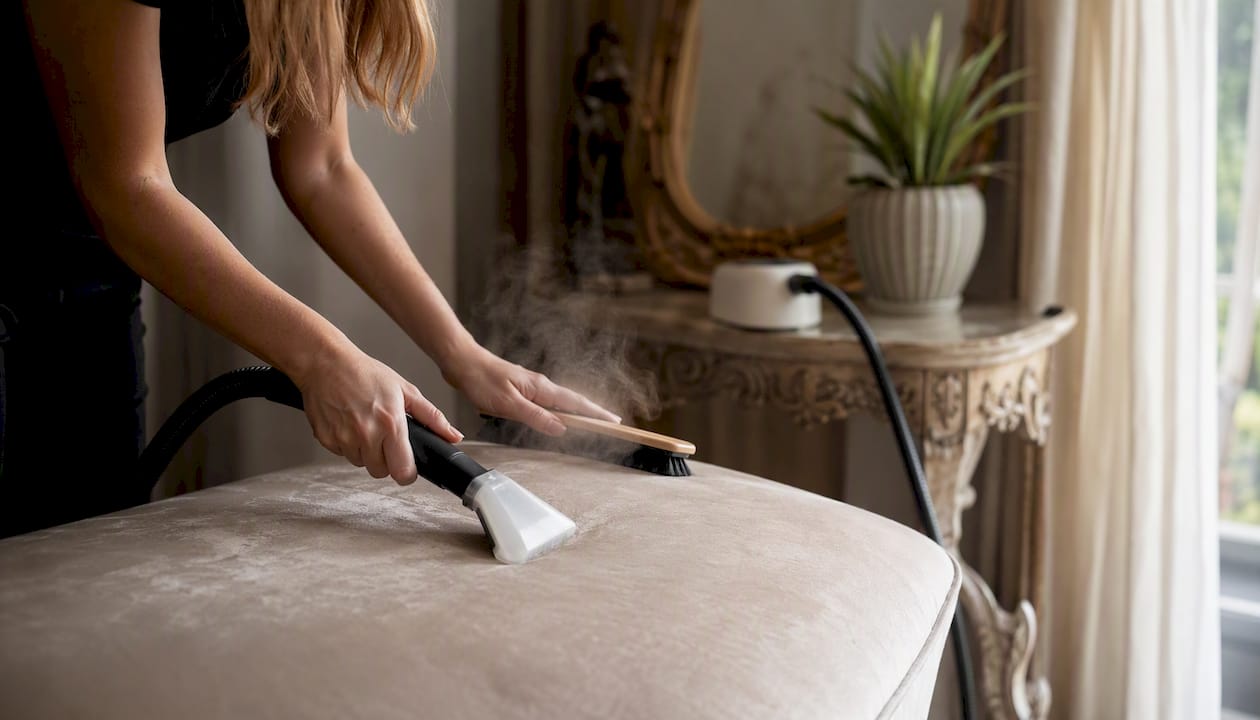
Crushed pile is velvet’s most common complaint, and it’s also one of the most satisfying to fix. The steam-and-brush method lifts flattened fibers gently without soaking the fabric, restoring that characteristic depth and sheen.

Martha Stewart’s guidance describes the sequence precisely: steam the area on a low setting while keeping the steamer continuously moving, allow it to dry fully, then use a soft-bristled brush to lift the fibers in the direction of the pile. The key word is moving. A stationary steamer head concentrates heat and moisture in one spot, which can flatten rather than lift the pile or, worse, leave a heat mark.
Hold the steamer 2–4 inches from the fabric surface. Work in smooth, overlapping passes, never lingering more than two seconds over any single point. One or two passes is usually enough for light crushing. Allow the area to dry for at least 20–30 minutes before brushing; brushing damp velvet can pull fibers out of alignment.
If the crushing is severe or covers a large area, repeat the process after the fabric has dried completely. Three passes with drying time between them will address most cases. If the pile does not respond after that, the compression may be structural, and a professional assessment is worth pursuing.
Pro Tip: After the fabric is fully dry, finish with a light pass of a soft-bristle velvet brush in the direction of the pile, followed by a very gentle vacuum on the lowest setting. This re-aligns the nap and restores an even, lustrous surface.
When should you call a professional to deep-clean your velvet sofa?
DIY care handles the vast majority of velvet maintenance, but there are situations where professional intervention is not just helpful but necessary to avoid permanent damage.
Call a professional when:
- A stain is set in (dried, older than a few hours, or has already been rubbed)
- The sofa is made from cotton, silk, or an unidentified natural fiber
- The care tag reads X or S and the stain requires more than dry brushing
- The sofa is vintage or antique
- The manufacturer’s warranty requires professional cleaning to remain valid
- Odors persist after surface cleaning
What professional methods look like
Professionals typically avoid steam extraction on velvet because the volume of water involved risks pile distortion and water rings. The preferred approaches are low-moisture cleaning (minimal water, fast-drying agents) and water-free dry-cleaning solvents, which lift stains without saturating the pile. Architectural Digest notes that some manufacturers explicitly recommend dry-clean-only treatment and water-free solvents for set-in stains.
When vetting a service provider, ask specifically: What method do you use on velvet upholstery? Do you use water-based or solvent-based products? Have you worked with this fiber type before? Are you insured, and can you provide references? Technicians certified by the IICRC or affiliated with WoolSafe have demonstrated training in textile and upholstery care, which is a meaningful baseline for delicate fabrics.
Cost and frequency guidance: Professional upholstery cleaning for a standard sofa in the U.S. typically runs $100–$300 depending on size, fiber type, and method. For households with pets or children, biannual professional cleaning is a reasonable cadence. For low-traffic adult households, once a year is generally sufficient, consistent with the Livingetc recommendation for routine deep-cleaning frequency.
How do you protect a velvet sofa from everyday damage?
Prevention is quieter than restoration, but it does far more work over the life of a sofa. A few consistent habits reduce the frequency of both spot-cleaning and professional visits.
- Sunlight: Position the sofa away from windows that receive sustained direct sun. Architectural Digest identifies UV exposure as a primary cause of color fading and fiber weakening in richly pigmented velvets. Window films or lined curtains filter the most damaging wavelengths without sacrificing natural light.
- Throws and arm covers: Drape a throw over the most-used seat and arm areas. This is especially practical in homes where guests eat or drink near the sofa, and it doubles as a styling element that adds texture and warmth to the room.
- Pets: Train pets to use a designated blanket on the sofa rather than sitting directly on the velvet. Regular grooming reduces the volume of hair and dander that works into the pile.
- Fabric protectors: Products like Scotchgard Fabric Protector can add a degree of stain resistance to synthetic velvets, but always patch-test on a hidden area first and follow the manufacturer’s application guidance. Natural-fiber velvets require more caution; some protectors can alter the sheen or pile texture.
- Lifestyle habits: A no-food zone around the sofa is the single most effective stain-prevention measure. Glass coasters on nearby surfaces reduce the risk of condensation rings on arm fabric.
Velvet rewards thoughtful placement. Paired with the right design context, a well-positioned velvet sofa becomes the sensory anchor of a room rather than a maintenance burden.
What tools and products should you keep on hand for velvet care?
The right toolkit makes every cleaning task faster, safer, and more effective. None of these items are expensive or hard to find, but having them ready before a spill happens is what separates a clean outcome from a permanent stain.
Tools to own: A vacuum with a soft upholstery brush head is the foundation. A dedicated soft-bristle velvet brush (sometimes sold as a suede brush) handles both routine pile maintenance and post-steam finishing. Microfiber cloths are gentler than cotton terry and less likely to leave lint in the pile. A hand steamer on its lowest setting is the right tool for pile restoration. A chamois or suede cloth works well for a final finishing pass after cleaning.
Safe product categories: Mild dish detergent diluted in cool distilled water is appropriate for W and WS coded fabrics. Distilled white vinegar mixed 1:1 with water addresses light odors and water-based stains on synthetic velvets. Home dry-cleaning solvents (such as those in the Dryel or K2r product families) are suitable for S-coded synthetics when used as directed.
Products to avoid: Bleach in any concentration, alkaline all-purpose cleaners, abrasive scrubs, and undiluted detergents. These can strip dye, flatten pile permanently, or leave residue that attracts more dirt.
Performance velvets (polyester-based) tolerate more robust, water-based spot treatments than natural fiber velvets, making them a practical choice for homes with pets or children. Heal’s velvet care guide confirms that performance velvets’ higher Martindale counts translate directly into greater cleaning tolerance. Always patch-test any product, regardless of fiber type, before applying it to a visible area.
What mistakes ruin velvet, and how do you avoid them?
Most velvet damage is self-inflicted, and almost all of it stems from the same handful of errors. Recognizing them is the fastest way to protect your investment.
- Rubbing spills instead of blotting. Rubbing spreads the stain laterally and drives it deeper into the pile. Blot straight down, always. A rubbed stain on cotton velvet can permanently mat the fibers.
- Oversaturating with water or cleaner. Excess liquid is the leading cause of water rings on natural velvets and can push a surface stain into the backing. Use the minimum amount of solution needed, applied to the cloth rather than directly to the fabric.
- Using bleach or alkaline cleaners. These strip dye and degrade the pile structure. Even a diluted bleach solution can cause irreversible color loss on richly pigmented velvets.
- Vacuuming on high suction. Better Homes & Gardens is explicit: high-suction settings can pull the pile or create bald spots. Low suction, soft attachment, always.
- Ignoring the care tag. Using a water-based cleaner on an S-coded fabric, or any liquid on an X-coded one, can cause irreversible pile loss or color change.
- Direct prolonged sun exposure. A velvet sofa placed in a south-facing window without UV protection will show fading within months, not years.
The corrective habit for every one of these is the same: pause, read the care tag, test in a hidden spot, and use the gentlest effective method. Patience is the quiet hero of velvet maintenance.
Expert technique notes: steaming, oversaturation, and professional standards
The difference between a homeowner’s steam pass and a professional’s comes down to distance, motion, and restraint. Hold the steamer 2–4 inches from the surface, keep it moving at a steady pace, and use the lowest steam setting available. Never let the steamer head touch the fabric. One or two passes is the homeowner’s limit; if the pile doesn’t respond, stop and allow the fabric to dry before reassessing.
Oversaturation is the most consequential risk in velvet cleaning, and Architectural Digest frames it well: technique matters more than product. When excess liquid penetrates the backing, it can wick back up through the pile as it dries, carrying dissolved dye or dirt to the surface and forming the characteristic water ring. On natural-fiber velvets, this process can be irreversible without professional intervention. The solution is always to apply less liquid than you think you need, applied to the cloth rather than the fabric.
Professionals certified by the IICRC follow procedural standards that govern moisture levels, dwell time, and extraction methods for upholstery textiles. WoolSafe certification indicates a cleaner has been vetted for working with delicate natural fibers. For a homeowner, the practical takeaway is this: ask for these credentials when hiring, and treat their absence as a reason to look further.
Pro Tip: A professional’s workflow for velvet typically begins with dry vacuuming, then a pre-treatment test, then low-moisture or solvent application in small sections, followed by a grooming pass with a velvet brush in the pile direction. Replicating the dry-vacuum and test steps at home before any wet cleaning is the single most transferable professional habit.
Living beautifully with velvet: an editor’s perspective
Velvet has a reputation for being demanding, but the reality is more forgiving than the mythology suggests. The care habits described in this guide take perhaps ten minutes a week, and most of them are simply a matter of attention: noticing a spill before it sets, running a brush over the pile after a long evening of use, keeping the sofa out of the afternoon sun.
What velvet gives back in return is something no performance fabric quite replicates: that particular quality of warmth and depth, the way light moves across the pile differently depending on the angle, the sensory richness that makes a room feel genuinely inhabited rather than merely furnished. Small, consistent habits preserve that beauty. They also protect the investment, which in the case of a quality velvet sofa is a meaningful one. The balance between luxury and livability is not a compromise; it’s a practice.
Key Takeaways
Proper velvet sofa care requires weekly vacuuming on low suction, immediate blotting for spills, steam-and-brush pile restoration, and professional help for large or set-in stains.
| Point | Details |
|---|---|
| Vacuum weekly on low suction | Use a soft-brush attachment; high suction can pull the pile or create bald spots. |
| Blot spills immediately | Press straight down with a dry cloth; never rub, which spreads stains and mats fibers. |
| Steam and brush to restore pile | Hold steamer 2–4 inches away, keep it moving, dry fully, then brush in the pile direction. |
| Avoid oversaturation | Excess liquid causes water rings and drives stains deeper, especially on natural-fiber velvets. |
| Check the care tag first | W, S, WS, or X codes determine which cleaners are safe; test any product on a hidden spot before use. |
Sources
The guidance in this article draws on cleaning technique, professional upholstery standards, and durability research from the following sources. Each one contributed a specific dimension: Martha Stewart and HGTV for step-by-step technique; Architectural Digest for the primacy of method over product and UV risk; Better Homes & Gardens for vacuuming safety; Livingetc for maintenance cadence; Heal’s for fiber-specific durability data; and the IICRC and WoolSafe for professional certification standards.
- How to Clean Velvet Furniture the Right Way
- How to Clean Velvet Upholstery
- How to clean a velvet couch | Better Homes & Gardens
- How to Clean a Velvet Sofa — 5 Steps to Refresh Delicate Fabric | Livingetc
- Velvet Care Guide | Heal’s | HEAL’S (UK)