
The quickest rule for bedside sconces: mount the fixture center 30 to 36 inches above the top of your mattress, which typically lands 55 to 66 inches from the floor. Ambient or decorative sconces elsewhere in the room can sit closer to the standard 60 to 66 inch floor baseline. Whichever number you start with, confirm it with a sitting test before anyone drills a hole.
TL;DR:
- Most bedside sconces should be mounted 30 to 36 inches above the mattress, with a sitting test to confirm comfort based on mattress thickness and headboard height.
- Ceiling height affects placement; for each foot above 8 feet, add approximately 3 inches to the standard fixture height.
- Adjustable swing-arm sconces offer more flexibility for imperfect height measurements, especially suited for reading tasks.
- Proper horizontal spacing from the headboard is 6 to 12 inches, with wider fixtures requiring more room to avoid bumping pillows.
- Use LED bulbs with enclosed shades near beds for safety, and ensure fixtures are mounted securely to prevent hazards from swings or heat.
Table of Contents
- Recommended Sconce Heights for Bedroom Walls: A Quick Reference
- How Do You Measure Bedroom Sconce Height With a Sitting Test?
- How Far Should a Sconce Sit From the Headboard?
- Adjusting Sconce Height for Ceilings and Bed Types
- Which Sconce Style Fits Reading vs. Ambient Lighting?
- What Should You Tell Your Electrician About Sconce Placement?
- Styling Sconces So They Look Intentional, Not Accidental
- What Nealda Would Tell You Before You Drill
- Where to Find Bedroom Sconces Built for These Measurements
- Why Sconce Placement Near Beds Comes With Real Safety Rules
- How to Keep Bedroom Sconces Clean and Working Well
- Where the Numbers in This Guide Come From
- Sources
- FAQ
Recommended Sconce Heights for Bedroom Walls: A Quick Reference
Two systems govern bedroom sconce placement, and they exist because bedrooms come in wildly different proportions. The floor-based baseline gives you a fast planning number: 60 to 66 inches from the finished floor to the fixture center works for most standard rooms with 8-foot ceilings. The mattress-based rule refines that number for actual comfort: 24 to 30 inches above the top of the mattress, which usually converts to that same 55 to 66 inch floor range depending on how tall the bed sits.
Ceilings taller than 8 feet call for an adjustment. Add roughly 3 inches of height for every additional foot of ceiling clearance so the fixture doesn’t look stranded on a tall wall.
| Bed profile | Mattress top height | Suggested fixture center |
|---|---|---|
| Low platform bed | ~18 in | 55 to 58 in |
| Standard bed frame | ~24 in | 60 to 63 in |
| Tall bed with box spring | ~28 to 30 in | 63 to 66 in |
- Standard 8-foot ceiling: use the baseline range as-is.
- 9-foot ceiling: add about 3 inches to your chosen height.
- 10-foot ceiling: add about 6 inches, and consider a slightly larger fixture to hold visual weight on the wall.
How Do You Measure Bedroom Sconce Height With a Sitting Test?
Numbers on a chart only get you so far. The sitting test accounts for your actual mattress thickness, your headboard, and how tall you sit up against your pillows, which a generic floor measurement never captures.
- Sit up in bed the way you normally would to read, with pillows arranged as usual.
- Have someone hold a pencil or a piece of tape at a point just above your shoulder and eye line, angled so light would fall onto a book or phone without hitting your eyes directly.
- Measure from that mark down to the top of the mattress. This confirms your mattress-based number, ideally in the 30 to 36 inch range.
- Measure from that same mark down to the finished floor. This is the number you hand to an electrician for the junction box height.
- Repeat on the opposite side of the bed if the mattress or box spring height differs, or if a partner sits noticeably taller or shorter.
Pro Tip: Before committing to hardwiring, clamp a work light or plug in a portable lamp at your marked height for a night or two to explore the best lighting options for your kitchen renovation. It costs nothing and it catches glare problems no tape measure ever will.
How Far Should a Sconce Sit From the Headboard?
Horizontal placement matters as much as height, and it’s the detail most people skip. Mount the fixture backplate 6 to 12 inches out from the headboard edge to prevent shoulders or pillows from bumping the shade during the night.
- Compact or slim fixtures: 6 to 10 inches from the headboard edge works well without crowding the nightstand.
- Wide or articulating sconces: lean toward 10 to 12 inches so the swing arm has room to move.
- King beds with matching nightstands: center each sconce roughly above or just inside the nightstand’s outer edge for a balanced look.
- Queen beds: pull the fixtures in slightly tighter since the wall span is narrower.
- No headboard: center the sconce visually between the mattress edge and the corner of the room, rather than measuring strictly from the bed frame.
Adjusting Sconce Height for Ceilings and Bed Types
The baseline numbers assume an 8-foot ceiling and a standard mattress. Change either variable and the math shifts.
- Ceilings above 8 feet: raise the fixture roughly 3 inches per additional foot, which keeps proportions intact without sacrificing reading function.
- Platform beds and low-profile frames: skip the floor baseline entirely and measure from the mattress top instead, since these beds sit lower than standard frames.
- Pillow-top or thick mattresses: recalculate from the actual mattress surface, not the box spring or frame height.
- Vaulted or lofted ceilings: mount slightly lower than the ceiling-adjusted formula suggests, since extreme height can make a sconce feel disconnected from the bed.
- Very low ceilings, under 8 feet: hold close to the mattress-based minimum around 30 inches above the mattress to avoid crowding the ceiling line.
Which Sconce Style Fits Reading vs. Ambient Lighting?
Fixture choice changes how forgiving your height measurement needs to be. A swing-arm or articulating sconce gives you room to correct for an imperfect installation, since the arm extends and the shade rotates toward the page. A fixed, decorative sconce offers no such flexibility, so getting the height right the first time matters more.
- Swing-arm or gooseneck sconces: best for committed readers; the adjustable arm compensates for height that’s slightly off.
- Directional or cone shades: aim light downward onto the page instead of outward into your eyes.
- Decorative or ambient sconces: can sit a few inches higher than the reading baseline since they’re not doing close-up work.
- Pendant-style bedside fixtures: require different clearance calculations since the drop cord or rod adds length below the mounting point.
Pro Tip: If you and your partner read at different times, consider two different fixture types rather than forcing one style to do both jobs. A dimmable, directional sconce on one side and a soft ambient sconce on the other solves more problems than matching fixtures ever could.
What Should You Tell Your Electrician About Sconce Placement?
Hardwired sconces look cleaner and never need a visible cord, but they’re a permanent commitment once the junction box goes into the wall. Plug-in sconces trade a bit of polish for the freedom to move or remove them later, which matters if you rent or simply aren’t sure yet.
Switch placement deserves the same attention as height. A wall switch near the bedroom door works for whole-room ambiance, but bedside reading lights function better with an in-line switch on the fixture itself or a small dimmer within arm’s reach of the pillow.
- Confirm the final mattress-based height, not just the floor baseline.
- Specify the exact junction box location, including horizontal offset from the headboard.
- Note clearance needed for the fixture’s swing arm or shade rotation.
- Decide on switch type: in-sconce toggle, nearby wall switch, or bedside dimmer.
- Flag any dimmer compatibility requirements for the bulb type you plan to use.
Styling Sconces So They Look Intentional, Not Accidental
Correct height means little if the fixture looks randomly placed on the wall. Align the sconce centerline with something else in the composition: the top of your pillows, the edge of the nightstand, or a piece of gallery wall art nearby.
- Modern bedrooms: favor slim, low-profile sconces set closer to the headboard for a tucked-in look.
- Traditional bedrooms: larger, more ornate fixtures can handle a slightly higher mount without looking oversized.
- Minimalist bedrooms: a single, well-scaled sconce per side often reads better than two competing decorative pieces.
- Tall walls behind a low headboard: size up the fixture rather than shrinking it, since a tiny sconce gets visually lost.
For more on balancing scale and warmth across an entire bedroom, our 2026 bedroom trends guide walks through composition choices beyond just lighting.
What Nealda Would Tell You Before You Drill
Floor measurements exist for planning, but function lives in the mattress-based number. A designer will sometimes push a sconce a few inches off the “correct” height to align with artwork or a headboard detail, because visual rhythm matters too. The real rule: test in place with a clamp light, sit where you’ll actually read, and let comfort settle the final call before the drill comes out.
— Nealda
Where to Find Bedroom Sconces Built for These Measurements
Once you know your target height, the harder part is finding fixtures that actually fit your wall and your style. There are many curated selections of adjustable-arm sconces, space-saving wall lights, and low-profile pendants designed with bedside measurements in mind.

Buying off the rack works well once you’ve already run the sitting test and know your ideal center height and headboard offset. That’s the order that matters: measure first, shop second, and hold the fixture against the wall (even just the box or a paper template) before committing to a mounting hole. Browsing curated picks is one path to the right fixture; a custom electrician consult is another, and neither replaces the other. If space is tight, our space-saving decor picks include several compact lighting options worth comparing against your measurements. Visit the Store Finds shop to browse current options and check dimensions against the height you just worked out.
Why Sconce Placement Near Beds Comes With Real Safety Rules
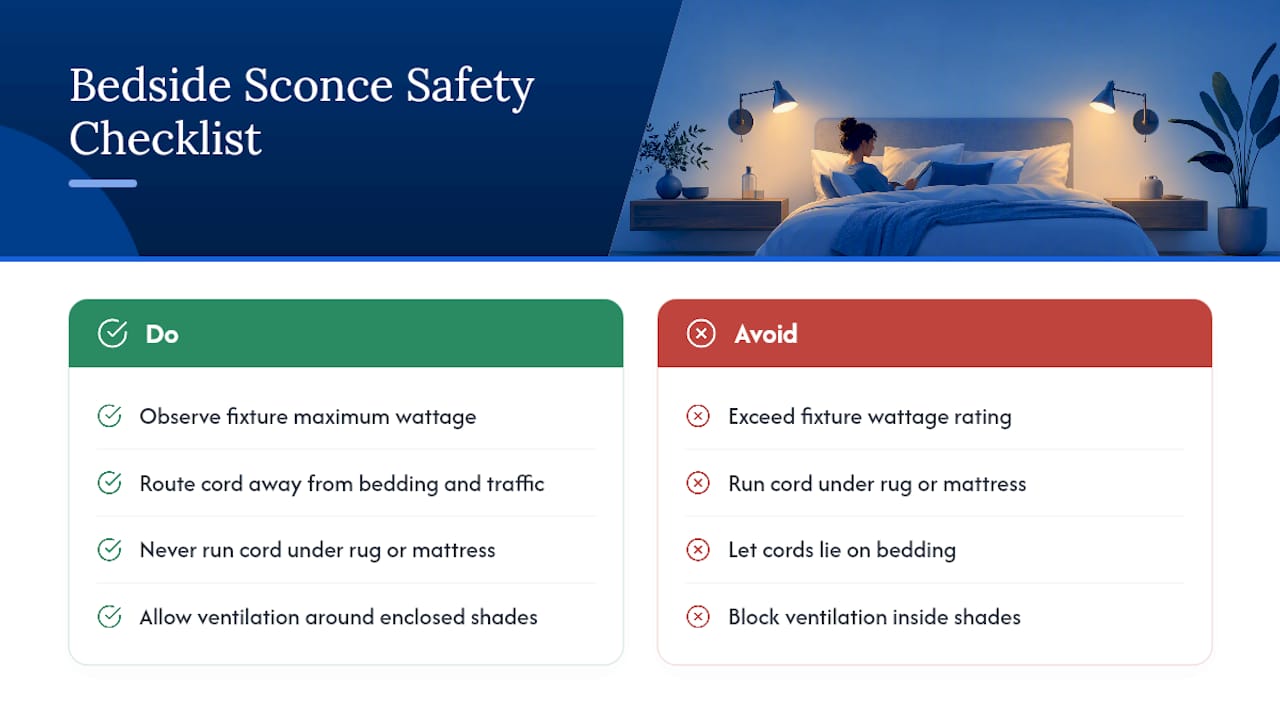
Bedside sconces sit close to pillows, bedding, curtains, and sometimes stacks of books, which makes heat and clearance genuine concerns, not just style preferences. Keep at least a few inches of clearance between any shade or exposed bulb and fabric that could shift into contact overnight, especially with fixtures that use higher-wattage incandescent or halogen bulbs.
LED bulbs run considerably cooler than incandescent equivalents, which makes them the safer default for a fixture mounted inches from where someone sleeps. If you or a family member tends to drape scarves, robes, or extra blankets over furniture near the bed, choose a fully enclosed shade rather than an open bulb design that could ignite draped material.
Check the fixture’s maximum wattage rating before installing any bulb, and never exceed it, since overheating inside an enclosed shade is a common cause of fixture failure and, in rare cases, fire risk. If a plug-in sconce is your choice, route the cord away from foot traffic and away from bedding, and avoid running it under a rug or mattress where heat can build without ventilation.
For households with young children who share a bed or climb onto parents’ beds, mount fixtures high enough and far enough from the headboard that a swing-arm or shade can’t be grabbed and pulled. A loose or wobbly mounting is its own hazard near a bed, so confirm the wall anchor or junction box is solid before finishing installation, particularly on plaster or older drywall.
How to Keep Bedroom Sconces Clean and Working Well
A bedside sconce collects dust faster than most people expect, partly because it sits at breathing height and partly because bedrooms accumulate lint from bedding. Wipe glass or fabric shades every few weeks with a dry microfiber cloth, and for glass, follow with a barely damp cloth to lift residue without leaving streaks.

Metal finishes like brass, bronze, or matte black need gentler handling. Avoid abrasive cleaners or anything with ammonia, since repeated use can dull a finish or strip a protective coating over time. A soft cloth with a small amount of mild soap and water handles most fingerprints and dust without damaging the metal.
Bulb replacement is worth planning for at the time of purchase, not after the first bulb burns out. Choose a fixture with a shade or arm that swings open or detaches easily, since bedside sconces mounted close to a headboard can be awkward to access otherwise. Keep a spare bulb of the correct wattage and base type on hand, matched to the fixture’s rated maximum, so a late-night burnout doesn’t turn into a multi-day inconvenience.
If your sconce includes a dimmer, test it periodically. Dimmers paired with the wrong bulb type, particularly older dimmers with newer LED bulbs, can cause flickering or premature bulb failure that looks like a wiring problem but usually isn’t.
Where the Numbers in This Guide Come From
- Sizing & Placing Bedside Wall Sconces – Bees Lighting
- Wall Sconce Placement: Exact Heights and Spacing for Every Room – LunaLightStudios
- How High to Hang Wall Sconces Next to Bed – Rowabi
- Bedroom Wall Sconces: Placement Guide, Height Rules – Hausgem
Sources
- Sizing & Placing Bedside Wall Sconces – Bees Lighting
- Wall Sconce Placement: Exact Heights and Spacing for Every Room – LunaLightStudios
- How High to Hang Wall Sconces Next to Bed – Rowabi
- Bedroom wall sconces: Placement guide, height rules & how… – Hausgem
FAQ
What Is the Recommended Height for a Bedside Wall Sconce?
Most bedside sconces work best 30 to 36 inches above the top of the mattress, which typically places the fixture center around 55 to 66 inches from the floor. Always confirm with a sitting test since mattress thickness and headboard style shift that number.
What Height Works for Wall Sconces on a 9-Foot Ceiling?
Add about 3 inches to the standard baseline for every foot of ceiling height above 8 feet. On a 9-foot ceiling, that means mounting the fixture center around 63 to 69 inches from the floor instead of the standard 60 to 66 inch range.
What Is the Average Height of a Wall Sconce Installation?
For general bedroom and living room use, most installers default to 60 to 66 inches from the finished floor to the fixture center. Bedside sconces run slightly lower on average once measured from the mattress rather than the floor.
How Do I Choose the Right Sconce for My Bedroom?
Match the fixture to how you’ll use it: swing-arm or directional sconces suit committed readers, while decorative or ambient sconces suit softer, whole-room lighting. Browsing curated options like those in Artinlifestyle’s Store Finds can help you compare adjustable-arm and space-saving styles side by side before measuring your wall.
Should Both Bedside Sconces Be the Same Height?
Not necessarily. If you and a partner have noticeably different mattress heights on your side of the bed or different reading habits, mounting each sconce at its own mattress-based height, rather than forcing symmetry, usually gives better results.